Website and Marketing Company: One Team, One Plan
01/11/2026

Most businesses do not have a “website problem” or a “marketing problem”. They have a coordination problem.
When the website is built by one vendor and marketing is run by another, the handoffs become the work: mismatched messaging, tracking gaps, slow landing page iterations, and launch dates that slip because someone is “waiting on access.”
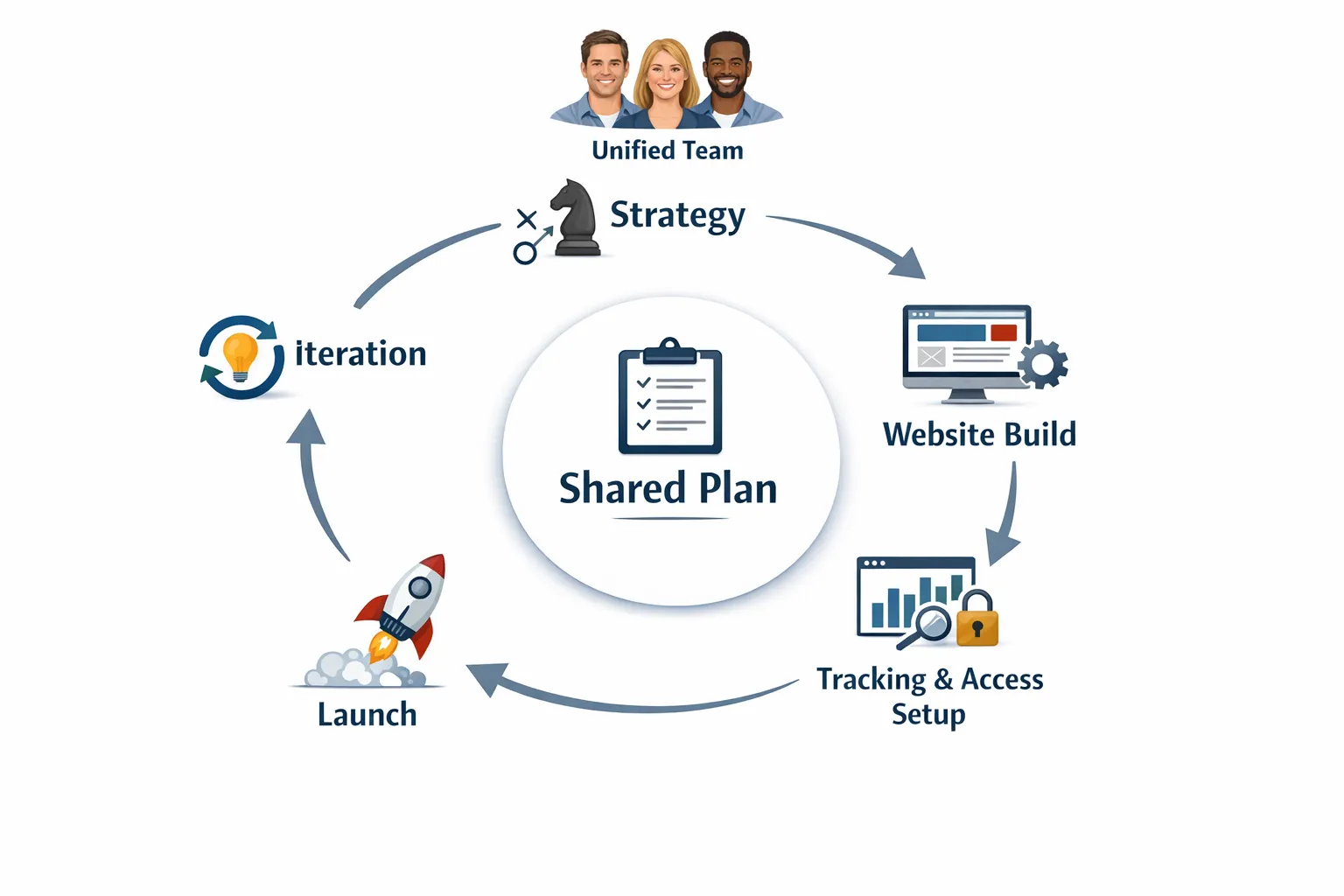
A website and marketing company that truly operates as one team can remove those seams. But “one team, one plan” is not a tagline. It is an operating model that ties strategy, execution, measurement, and onboarding into a single system.
Why a combined website and marketing company wins (when it is run correctly)
Your website is the conversion surface area for nearly every channel: paid search, paid social, SEO, email, partnerships, and even outbound. If the site is not built to support the marketing plan, the marketing team ends up fighting the site instead of scaling results.
Here are the most common failure modes when web and marketing are split across vendors:
- The website is designed for aesthetics, not for conversion paths (no clear offers, weak information architecture, slow iteration).
- Measurement is bolted on late (events, pixels, consent, and attribution are handled after launch, so early data is unreliable).
- Landing pages require a “ticket” (paid campaigns slow down because page updates take days).
- Ownership is unclear (DNS, CMS roles, analytics access, ad accounts, and creative approvals become blame games).
A combined team can plan the site and the campaigns together, ship faster, and keep accountability in one place.
What “one plan” should include (beyond a project timeline)
A real “one plan” connects business goals to the full path from click to customer. It should answer: what are we building, why does it convert, how will we measure it, and how will we improve it week over week?
At minimum, a unified plan typically includes:
- A positioning and messaging map (who it is for, what problem you solve, why you are different)
- A conversion architecture (offers, CTAs, forms, routing, lead quality gates)
- Channel strategy (which channels drive which stage of the funnel)
- Measurement and data governance (events, pixels, consent, naming conventions)
- A production cadence (how fast you can launch, test, and iterate)
The easiest way to pressure-test whether a company actually has “one plan” is to ask if web deliverables and marketing deliverables are planned from the same brief.
| Plan component | What good looks like | Typical output |
|---|---|---|
| Goals and KPIs | KPIs are shared across web and marketing, not siloed | KPI tree, targets, definitions |
| Conversion architecture | Pages and flows map to offers and intent | Sitemap tied to funnel stages |
| Measurement design | Tracking is designed before build and launch | Event list, tagging plan, QA checklist |
| Experiment cadence | Iteration is operationalized, not “when we have time” | Testing backlog, weekly review |
| Governance | Ownership and permissions are explicit | RACI, access standards, approval SLAs |
The “one team” operating model: how integrated teams actually work
The difference between two departments and one team is not Slack. It is shared rituals, shared definitions, and shared constraints.
A strong website and marketing company usually runs a few non-negotiables:
One cross-functional kickoff (not separate web and marketing calls)
Kickoff should unify the entire lifecycle: brand and messaging, site structure, tracking requirements, campaign launch sequence, and the “definition of done” for the first 30 days.
If kickoff focuses only on design preferences or only on campaign targeting, you are headed back to siloed delivery.
One backlog, one priority stack
When priorities are separate, marketing requests feel like interruptions to the web team, and web launches feel disconnected from revenue urgency.
A shared backlog forces the organization to make tradeoffs explicitly: do we ship the new landing page, improve Core Web Vitals, or add lead routing rules this sprint? Everyone sees the same board, and everyone commits to the same “next best work.”
One weekly growth review tied to numbers
Integrated teams work best when reporting is not a monthly slide deck. It is a weekly operating meeting where you review:
- Pipeline or revenue signals
- Conversion rates by step (visit to lead, lead to SQL, SQL to close)
- What shipped last week
- What will ship next week
This is where “one plan” becomes real. The website is treated like a performance asset, not a static brochure.
The hidden bottleneck: onboarding, access, and approvals
Even great strategy fails when execution is blocked by operational friction.
In practice, the fastest way for a combined web and marketing engagement to stall is access:
- CMS roles and publishing permissions
- DNS access for domain changes
- Analytics and tag management access
- Ad platform access for conversion setup and optimization
- Brand assets, legal disclaimers, consent rules, and approval workflows
This is also where security issues creep in. Password sharing, unmanaged admin accounts, and unclear ownership are common in rushed onboarding.
A better standard is least-privilege access, meaning each person gets only the permissions required to do their job, and nothing more. (See NIST’s definition of the principle of least privilege.)
A practical “access bill of materials” for integrated web + marketing
If you want “one team, one plan” to move quickly, define access requirements upfront.
| Access area | Examples | Why it matters |
|---|---|---|
| Website and infrastructure | CMS, hosting, DNS, CDN | Launches and changes cannot ship without it |
| Analytics and tags | GA4, tag manager, pixel/event tools | Attribution and optimization depend on clean data |
| Lead capture and routing | Forms, CRM, email platform | Speed to lead and lead quality controls |
| Paid platforms | Google Ads, Meta, LinkedIn, TikTok | Conversion setup and learning phases require correct access |
| Creative and brand | Asset library, brand guidelines, approvals | Prevents rework and inconsistent messaging |
Where Connexify fits: turning “one team” into a repeatable onboarding system
Even if you have the right operating model, you still need a reliable way to collect permissions and get clients through onboarding without endless follow-ups.
Connexify is built for agencies and service providers to streamline onboarding through a single, branded link. Instead of manual credential collection and scattered instructions, you can standardize how clients grant access across platforms and track progress from one place.
Connexify is particularly relevant for integrated website and marketing delivery because it helps you:
- Send one-link client onboarding that clients can complete quickly
- Keep the experience branded (and optionally white-labeled)
- Support multiple platforms without making clients jump between different processes
- Request customizable permissions to stay aligned with least-privilege practices
- Connect your workflow using API and webhook integrations
If your promise is “one team, one plan,” your onboarding needs to feel that way too.
You can also see how agencies apply this thinking in Connexify’s guide to building an integrated stack in Marketing Agency Digital Stack: What You Need.
How to evaluate a website and marketing company (so “one plan” is not just a slogan)
If you are hiring, the goal is not to find a vendor that offers both services. It is to find a company that runs both services as a single system.
Use these questions to qualify quickly:
- Who owns the plan? Ask to see a sample roadmap where web, campaigns, and tracking are planned together.
- How do you define success in the first 30 days? Look for clear leading indicators (time to launch, conversion tracking verified, first offers live).
- How fast can you ship changes? If landing page updates take a week, performance will lag.
- How do you handle access securely? No password sharing, role-based access, and a documented process.
- What is your onboarding SLA? Good teams define a target like time-to-verified-access, not “we’ll start soon.”
For agencies building this capability internally, Connexify’s operational approach in Online Marketing Company SOPs: Client Access in Minutes is a useful reference.
A simple implementation blueprint for agencies: “one team, one plan” in two weeks
If you run an agency that does both websites and marketing, the fastest way to operationalize the model is to standardize two things: your plan template and your onboarding.
Days 1 to 3: unify your brief
Create one intake that collects what both teams need, including offers, ICP, proof points, required integrations, and measurement requirements. The goal is to prevent the classic scenario where web learns about conversion goals after design is approved.
Days 4 to 7: standardize access and permissions
Document your access bill of materials by package (for example, “website only,” “website + paid,” “full growth”). Then convert it into a repeatable onboarding flow so every client gets the same secure process.
This is the step many teams skip, and it is the step that most directly affects speed.
Days 8 to 14: run a shared cadence
Pick one weekly growth meeting format, one backlog, and one definition of “ready to launch.” If you need a practical model for packaging plus onboarding so delivery stays consistent, see Packaging Digital Marketing Services With Frictionless Onboarding.
Frequently Asked Questions
What does a website and marketing company do that separate vendors cannot? A combined company can design the website around the marketing plan, build tracking and conversion paths early, and iterate faster because priorities and accountability live in one team.
Is it always better to hire one team for website and marketing? Not always. It is better when the company truly runs an integrated process (shared brief, shared KPIs, shared backlog). If they simply “offer both,” you can still end up with silos.
What should be included in a “one plan” for website and marketing? Goals and KPIs, conversion architecture, channel strategy, measurement design (events and tracking), a launch sequence, and a testing cadence for ongoing iteration.
Why does client onboarding matter for website and marketing projects? Because access and approvals control speed. If CMS, DNS, analytics, and ad platform access are delayed or handled insecurely, launches slip and early performance data becomes unreliable.
How can agencies reduce onboarding time without cutting corners on security? Use role-based access, avoid password sharing, request only the permissions required (least privilege), and standardize the process with a single onboarding flow that clients can complete quickly.
Make “one team, one plan” real with a single onboarding link
If your agency sells websites and marketing together, your onboarding experience should feel just as unified as your strategy. Connexify helps you streamline onboarding with one branded link, multi-platform support, customizable permissions, and API/webhook integrations, so you can reduce onboarding time from days to seconds.
Start a 14-day free trial or book a demo to see how Connexify fits into your delivery workflow.