Marketing Agency Digital Stack: What You Need
01/07/2026

A “digital stack” is not just a list of tools. For a marketing agency, it is the operating system that determines how fast you can launch, how reliably you can measure impact, and how confidently you can scale delivery without adding chaos.
In 2026, most agencies do not lose time because they lack talent. They lose time because work is fragmented across logins, disconnected forms, inconsistent client handoffs, and reporting pipelines that break whenever someone changes a permission.
What a marketing agency digital stack actually needs to do
A useful agency stack supports the full client lifecycle:
- Win and convert the right clients
- Collect the right inputs and access securely
- Deliver consistently (tasks, approvals, production)
- Prove performance (measurement, attribution, reporting)
- Retain and expand (communication, renewals, governance)
If any one of those stages is held together by “DM me the login” or “please resend that doc,” the stack is not doing its job.
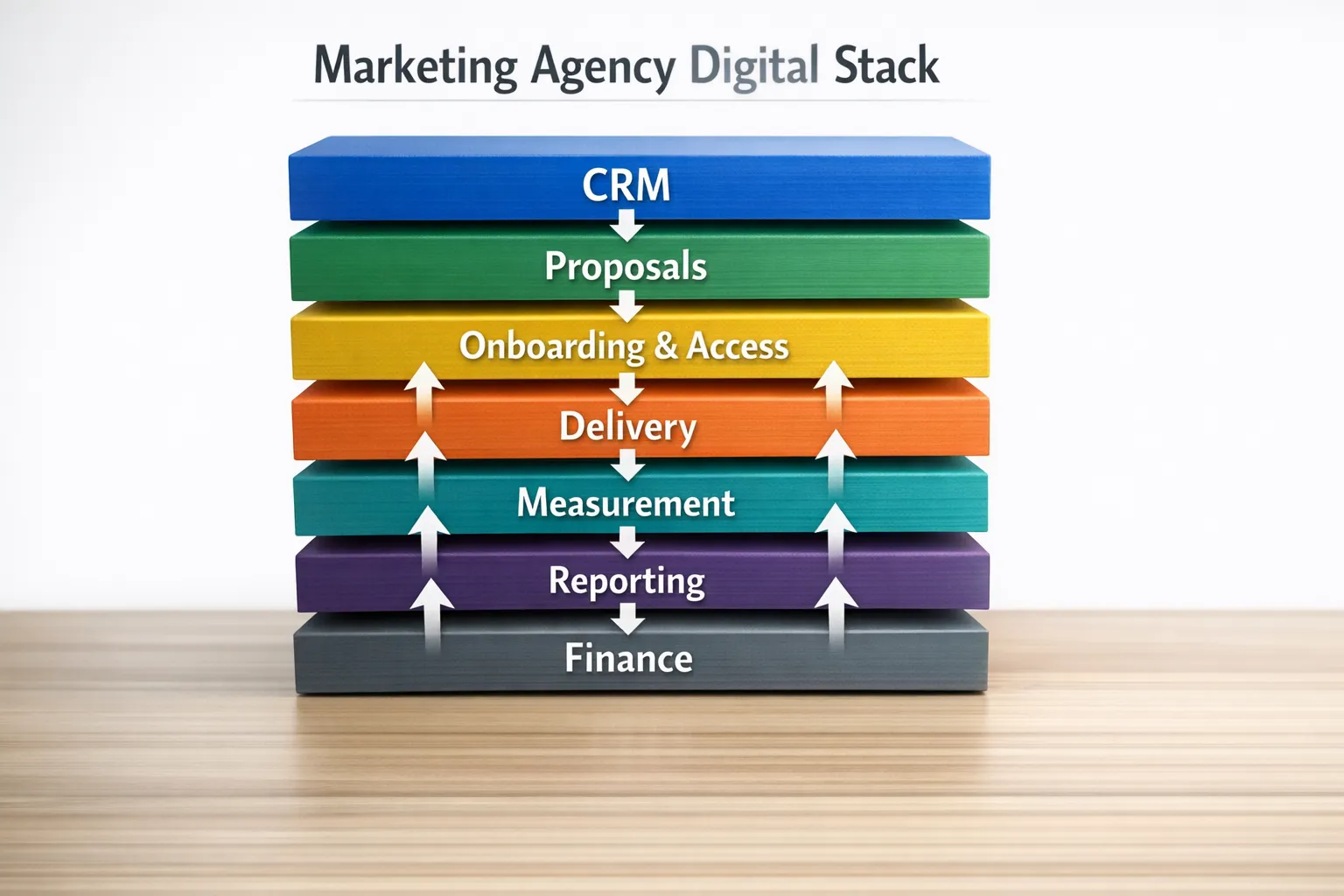
The 7 layers of a modern marketing agency digital stack
Instead of thinking in terms of tool brands, think in layers. Each layer has a clear purpose, a set of required capabilities, and specific handoffs to the other layers.
| Stack layer | What it’s responsible for | What “good” looks like | Common failure mode |
|---|---|---|---|
| 1) CRM + pipeline | Lead tracking, qualification, forecasting | One source of truth for deal stage, owner, next step | Sales info lives in inboxes and spreadsheets |
| 2) Proposals + e-sign | Scoping, pricing, contracts | Version-controlled scopes, fast approvals, signed docs stored centrally | “Final_v7_reallyfinal.pdf” and missing clauses |
| 3) Onboarding + access | Intake, asset IDs, permissions, compliance | Secure, repeatable handoff with least-privilege access | Password sharing and stalled launches |
| 4) Delivery (PM + docs) | Tasks, production, SOPs, collaboration | Clear owners, templates, standard workflows by service line | Every project is reinvented from scratch |
| 5) Measurement + tracking | Analytics, pixels/events, attribution, QA | Documented tracking plan, verified signals, change logs | Reports that do not match reality |
| 6) Reporting + insights | Dashboards, narratives, business outcomes | Fewer dashboards, more decisions, consistent definitions | “Vanity KPI” reporting that clients do not trust |
| 7) Finance + retention | Billing, renewals, expansion, offboarding | Clean invoicing, usage visibility, structured QBRs | Churn caused by misalignment and poor governance |
The stack does not have to be huge. It has to be integrated, predictable, and secure.
Layer 1 and 2: Growth systems that do not break delivery
Most agencies over-invest in lead gen tools and under-invest in the systems that prevent delivery friction.
A practical rule: any data you collect during sales should reduce onboarding time later. That means:
- Capture service scope in structured fields (not only inside PDFs)
- Tag deals by service line (paid social, search, SEO, creative, lifecycle)
- Store stakeholders and decision-makers early
- Define the “bill of materials” required to start (platforms, assets, access model)
This is where high-performing performance teams shine: they treat sales-to-delivery handoff as an engineered system. If you want to see what that looks like in practice, agencies building premium AI automation and performance marketing often emphasize process consistency as much as channel expertise.
Layer 3: Client onboarding and access is the keystone layer
For most agencies, the most expensive delay is not a missed internal task. It is waiting on access.
Your stack must make it easy for a client to:
- Provide the right IDs and assets (ad accounts, analytics properties, domains, catalogs)
- Grant the right permissions (not too little, not too much)
- Understand what will happen next
- Complete the process without back-and-forth
It also needs to make it easy for your team to verify that access actually works.
What to require from your onboarding and access layer
At minimum, your onboarding layer should provide:
- A single entry point clients can follow without confusion
- A branded experience that reinforces trust
- Support for multiple platforms, because onboarding is rarely “just Meta” or “just Google”
- Permission scoping and templates that match your service packages
- An audit-friendly record of what was requested and completed
- Integrations so downstream systems can be updated automatically
This is exactly the gap an onboarding platform like Connexify is built to fill: one-link client onboarding with a branded flow, multi-platform support, customizable permissions, white-label options, and API/webhook integrations, all without requiring installs. If your agency’s bottleneck is “waiting on access,” this layer typically produces the fastest operational ROI.
Layer 4: Delivery systems that scale the way you sell
Delivery is where many stacks become messy, because the work is varied and clients expect customization.
The goal is not to eliminate flexibility. It is to standardize what should be standard:
- Project templates by service line and client type
- Repeatable SOPs for launch, QA, and ongoing optimization
- A consistent approval path for creatives, copy, landing pages, and budgets
- A clear “definition of done” for each recurring deliverable
When delivery tooling is working, your best people spend their time on strategy and outcomes, not on status updates.
Layer 5 and 6: Measurement, then reporting (in that order)
Agencies often try to fix reporting before measurement is stable. That backfires.
A strong stack separates:
- Measurement and tracking: instrumentation, events, conversions, UTMs, offline imports, QA
- Reporting and insights: dashboards, analysis, narrative, next actions
A simple measurement quality gate to build into your stack
Before you consider a client “live,” confirm these are true:
- You can attribute leads or purchases to the right channel and campaign
- Conversions are deduplicated where applicable
- Admin access is not required for routine optimizations (you have the correct partner or role-based access)
- Tracking changes have an owner and a log
This is also why onboarding and permissions matter: measurement breaks most often when access is incomplete or granted inconsistently.
Layer 7: Finance and retention systems that reduce churn risk
Retention is rarely “saved” by a single dashboard. It is saved by operational maturity.
Your stack should help you:
- Align on billing scope versus actual work delivered
- Surface expansion opportunities with evidence (not gut feel)
- Keep renewal conversations structured (QBRs, roadmap, risks)
- Offboard cleanly, removing access and documenting what was done
When finance is disconnected from delivery, agencies end up over-servicing quietly and then wondering why margins erode.
The integration rules that make the stack feel like one system
A stack becomes “real” when information flows automatically. You do not need a complex data warehouse to start, but you do need integration discipline.
Rule 1: Define your system of record for each data type
Pick one source of truth for:
- Client account profile
- Stakeholders and contacts
- Active services and scope
- Platform access status
- Reporting definitions
When two systems both “own” the truth, people stop trusting both.
Rule 2: Prefer event-driven handoffs for onboarding and delivery
Onboarding creates natural events: link completed, access granted, intake approved, kickoff booked. These should trigger updates downstream (CRM stage, project creation, internal notifications).
Tools that offer APIs and webhooks make this far easier to maintain than manual copying.
Rule 3: Standardize identity and permissions
Even if your agency is small, treat identity and access as core infrastructure:
- Use named user accounts (no shared logins)
- Enforce MFA where possible
- Follow least privilege and time-bound escalation when needed
- Keep an offboarding checklist that actually removes access
This is not bureaucracy. It is what prevents revenue-threatening incidents.
How to choose tools without bloating your stack
The best stack is the one your team actually uses.
A simple scorecard can prevent “tool sprawl” decisions that feel exciting in week one and painful in month three.
| Criterion | What to look for | Why it matters |
|---|---|---|
| Time to value | Setup speed, templates, ease for clients | Every week of rollout is lost margin |
| Adoption | Clear UX, role fit, minimal training | Unused tools are pure overhead |
| Integration | API/webhooks, native integrations | Reduces manual rework and errors |
| Security posture | MFA support, audit trails, secure handling | Protects client assets and your reputation |
| Flexibility | Can match your packages and workflows | Prevents constant workarounds |
| Total cost | Licenses plus admin time | Admin time is often the real cost |
Notice what is not on the list: “most features.” Feature depth matters only if it supports the job the layer is responsible for.
Minimum viable stack (MVDS) for most agencies
If you are rebuilding or simplifying, aim for a minimum viable stack that supports the lifecycle end-to-end.
A practical MVDS usually includes:
- One CRM that your team keeps clean
- One proposal and signing workflow
- One onboarding and access layer that works across platforms
- One project delivery hub with templates
- One measurement QA routine with ownership
- One reporting approach clients can understand
- One billing system that matches your service model
The fastest way to improve performance is often not adding a new tool, but replacing a fragile handoff (especially onboarding) with a reliable system.

Frequently Asked Questions
What is a marketing agency digital stack? A marketing agency digital stack is the collection of software and workflows that supports the full client lifecycle, from sales to onboarding, delivery, measurement, reporting, and retention.
How many tools should an agency have in its stack? There is no perfect number, but fewer tools with cleaner integrations usually beats a large stack with duplicate functionality. Start by ensuring each “layer” has one clear owner tool and that handoffs are automated where possible.
What is the most important part of an agency stack to fix first? If your agency regularly loses days to stalled launches, fix onboarding and access first. Faster, safer access reduces time-to-value and improves client confidence early in the relationship.
How do I reduce tool sprawl without slowing the team down? Audit tools by layer, remove overlaps, and standardize templates and handoffs. Focus on adoption and integration, not feature depth.
How should agencies handle client account access securely? Use named accounts, MFA, least privilege permissions, and an auditable onboarding and offboarding process. Avoid password sharing and undocumented admin access.
Build an onboarding and access layer that makes the rest of your stack work
If your “digital stack” still depends on email threads to collect IDs, chase permissions, and confirm access, your operations will stay fragile no matter how good your delivery team is.
Connexify is designed for agencies and service providers that want onboarding to feel instant and professional. With a single branded onboarding link, multi-platform support, customizable permissions, and API/webhook integrations, you can standardize access setup without adding friction for clients.
Explore Connexify and start with the 14-day free trial or book a demo to see how it fits into your agency stack.