Packaging Digital Marketing Services With Frictionless Onboarding
12/07/2025

Winning new accounts is only half the game for agencies that sell digital marketing services. The real test starts the moment a client signs. If your team spends the first week chasing logins for Google, Meta, LinkedIn, analytics, and CMS access, momentum dies and trust erodes. Clients do not judge only on strategy, they judge on how quickly you begin delivering value.
A frictionless onboarding experience turns that risky window into a proof point. Package what you sell with a clear, branded path to access, approvals, and kickoff, and you will shorten time to first value, prevent scope confusion, and create a repeatable engine for growth.
Why packaging fails without frictionless onboarding
Most digital marketing engagements depend on many third party platforms, each with different permission models and terminology. Asking clients to hunt for account IDs, figure out admin roles, or share passwords introduces friction and security risk. It also delays your first deliverables, which can create early doubts about fit and execution.
This is not just about convenience. Research has long tied experience quality to revenue outcomes. For example, Harvard Business Review has shown that better experiences correlate with higher spending and improved loyalty, which is exactly what early onboarding moments influence most strongly. See The Value of Customer Experience, Quantified on HBR for a broader view on the link between experience and business results: https://hbr.org/2014/08/the-value-of-customer-experience-quantified.
The bottom line, a signed agreement without a smooth onboarding plan is a promise without a path.
Productize your services, and productize your onboarding
Service packaging clarifies value and price. When you also package onboarding, you clarify effort, data flows, roles, and success milestones. Treat onboarding like a deliverable with a name, an owner, and a standard operating procedure.
Start with an onboarding bill of materials. For each package, list the platforms to connect, the minimum permission levels, any assets to collect, and the first meaningful output you will deliver once access is in place.
| Service package | First outputs you can deliver | Access typically required | Permission guidance |
|---|---|---|---|
| SEO retainer | Technical audit highlights, priority fixes | Google Search Console, GA4, CMS | Request role based access, CMS Editor is usually enough, avoid requesting global admin unless necessary |
| Paid search retainer | Account audit, budget and structure proposal | Google Ads, Microsoft Advertising, GA4, Tag Manager | Use manager account linking or partner access, ask for Standard or Editor, not full admin if avoidable |
| Paid social retainer | Audience and creative gap analysis | Meta Business Manager, LinkedIn Ads, pixel or CAPI access | Request partner access to specific assets, restrict to ad accounts and pixels needed |
| Analytics and tracking | Event inventory, measurement plan, QA report | GA4, Tag Manager, server side tracking if in scope | Editor on GA4 and GTM is often sufficient, document publish rights and rollback plan |
| CRO program | Baseline funnel metrics, test backlog | GA4, tag manager or testing tool, CMS | Limit access to the testing tool workspace and CMS sections that experiments will modify |
When in doubt, document the least privilege you need to do the job, then justify exceptions. The principle of least privilege is a long standing security best practice in standards like NIST SP 800-53: https://csrc.nist.gov/publications/detail/sp/800-53/rev-5/final.
Helpful platform documentation, which you can share with clients when needed:
- Google Analytics Help Center: https://support.google.com/analytics
- Google Ads Help Center: https://support.google.com/google-ads
- Meta Business Help Center: https://www.facebook.com/business/help
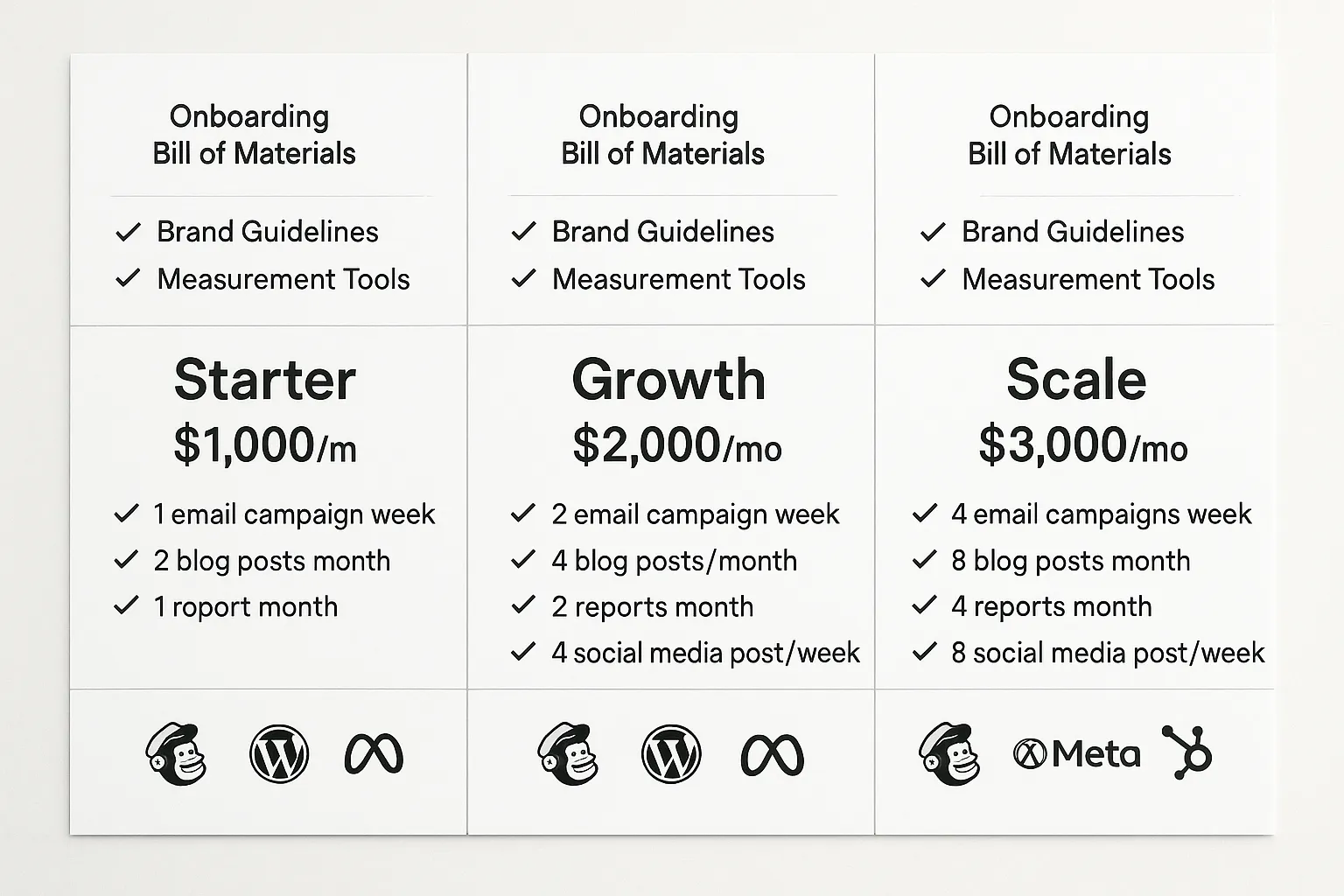
Principles of frictionless onboarding for agency clients
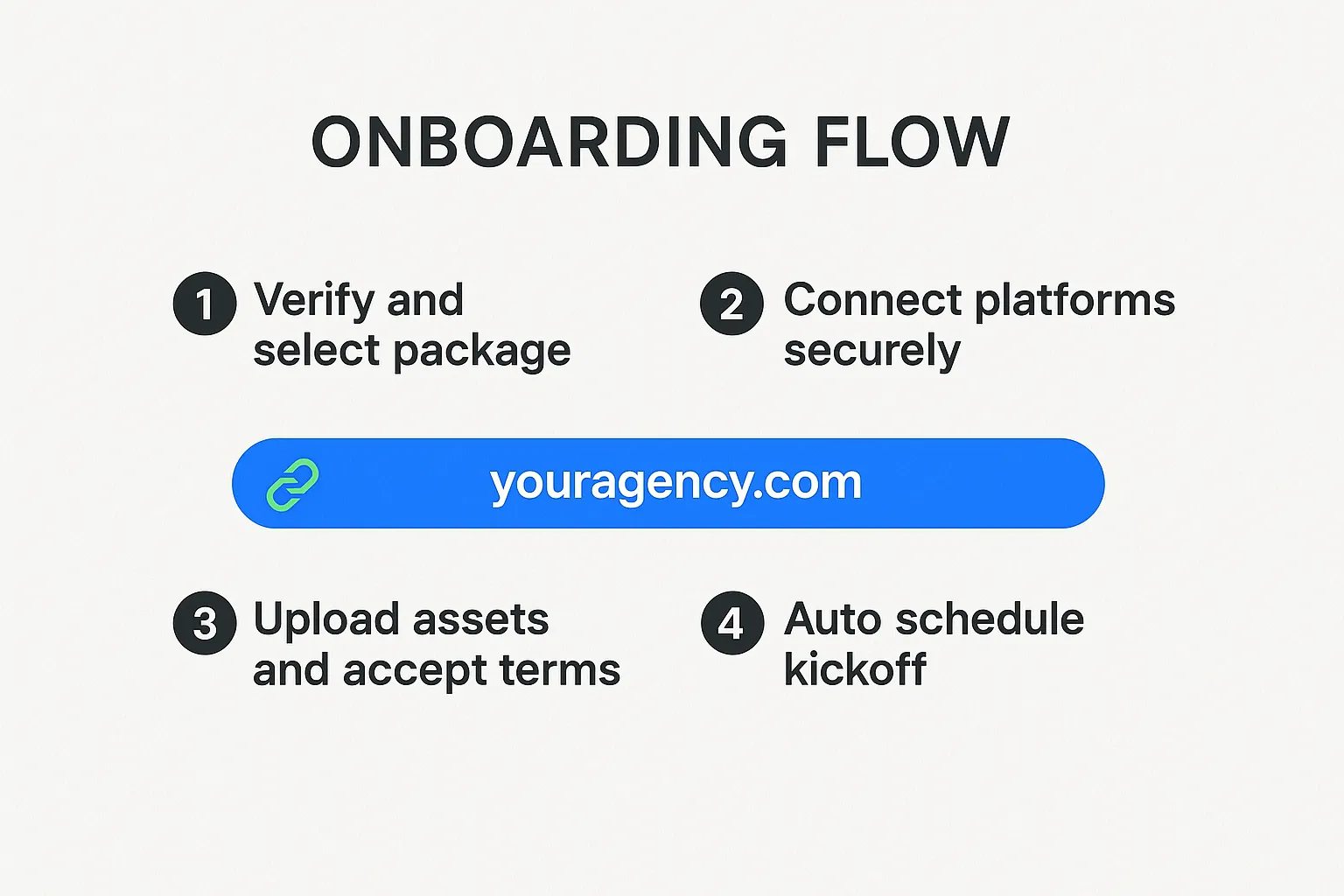
- Make it one link, not many. Replace a tangle of PDFs and email chains with a single, branded link that guides the client through identity verification, access granting, and kickoff scheduling.
- Ask for the least, at the right time. Use progressive disclosure to request only what you need for the package purchased, and only when it unblocks the next step.
- Use secure, standards based connections. Prefer OAuth based connections where clients grant permissions without sharing credentials. See the OAuth 2.0 specification for background: https://www.rfc-editor.org/rfc/rfc6749.
- Keep the language plain. Translate platform jargon into business outcomes. Instead of Request Editor on GA4, say Let us analyze traffic and conversions so we can prioritize wins.
- Confirm and summarize. Provide an automated recap showing who granted what, when, and what you will deliver next. This reduces back and forth and builds confidence.
- Automate the handoff to delivery. Push completed onboarding data to your PM tool, CRM, or Slack automatically, so the team starts execution immediately.
The ideal onboarding flow for a digital marketing client
-
Welcome and identity. Client clicks a branded link, verifies their identity, and sees the package they purchased, plus the timeline to first deliverable.
-
Company profile. Collect essentials in one short form, such as legal entity name, billing contact, primary stakeholders, and domains.
-
Connect platforms. The client chooses the channels in scope, then uses secure OAuth prompts to grant access to ad accounts, analytics properties, tags, and business managers. Provide clear permission descriptions and why each is needed.
-
Upload assets. The client adds existing brand guidelines, creative assets, product feeds, or existing measurement docs.
-
Approvals and compliance. Present your data processing terms and an optional security overview. Capture consents, then immediately generate an audit trail.
-
Kickoff logistics. Offer time slots for the kickoff call that adjust based on the package and region, then confirm calendar invites automatically.
-
Confirmation and next steps. Show a checklist of what is complete, what is pending, and the first deliverables with due dates. Start the clock on your first output right away.
Operationalize this flow with Connexify
If you want this experience without custom engineering, Connexify gives agencies and service providers a practical path to launch in days.
- One link client onboarding. Replace manual steps with a single branded link that guides clients through verification, access, and scheduling.
- Branded, white label experience. Keep the look and feel of your agency, not a vendor’s logo.
- Supports multiple platforms. Centralize access requests across major ad, analytics, and social platforms with consistent prompts.
- Customizable permissions. Request only the scopes you need and explain them in plain language.
- Secure data handling. Reduce risk by using standards based connections and permissions rather than credentials.
- API and webhook integrations. Pipe completed onboarding data into the tools your team already uses for project management and communications.
- No installation required and a user friendly dashboard. Launch quickly, view client progress at a glance, and resolve blockers before they become delays.
- Try it risk free. Connexify offers a 14 day free trial so you can validate the impact before rolling out to all packages.
Explore how client onboarding software can compress setup from days to seconds and create a repeatable, delightful start to every engagement.
Metrics that prove your onboarding works
Track a handful of operational and client facing KPIs to make onboarding a continuous advantage rather than a one time project.
| KPI | Definition | Why it matters | Benchmark goal to start |
|---|---|---|---|
| Time to first value | Time from signature to first tangible deliverable | Early wins build trust and momentum | Under 7 calendar days for most retainers |
| Access completion rate | Percent of required platforms connected within 48 hours | Predicts delivery speed and client satisfaction | Above 85 percent within 48 hours |
| Email back and forth | Email threads required to complete onboarding | Measures friction and hidden costs | Fewer than 3 total threads |
| Onboarding NPS or CSAT | Client rating within 14 days of kickoff | Captures the human side of the process | 8 or higher on a 10 point scale |
| Internal setup time | Staff hours from signature to ready to work | Reveals margin and capacity gains | Reduce by 30 to 50 percent over baseline |
You do not need to start with perfect numbers. Establish a baseline, then improve one variable at a time. Small gains compound across dozens of clients.
Security and trust by design
Great onboarding earns trust because it is safe, not despite it. Build your process on a few non negotiables.
- Least privilege. Request the minimum access required to deliver outcomes, and make exceptions explicit. The NIST control families provide helpful guidance: https://csrc.nist.gov/publications/detail/sp/800-53/rev-5/final.
- Standards based authentication. Favor OAuth over credential sharing so clients keep control of their accounts and can revoke access at any time: https://www.rfc-editor.org/rfc/rfc6749.
- Auditable by default. Log who granted what and when, store confirmations securely, and share a summary with the client.
- Communicate your posture. If your agency or vendors align to frameworks like SOC 2, give clients an overview and offer to share reports under NDA. For background on SOC reporting, see AICPA’s overview: https://www.aicpa.org/resources/article/system-and-organization-controls-soc-suite-of-services.
Connexify’s secure data handling, branded flows, and permission controls make it easier to uphold these principles without heavy custom build.
A quick start playbook you can run this week
- Map your current packages to an onboarding bill of materials. Identify the exact platforms and permission scopes required for each tier.
- Write plain language explanations for each permission, include why you need it and how the client can grant it.
- Standardize your first deliverables per package. Examples, an ad account audit, a measurement plan draft, or a 30 day roadmap.
- Build one generic, branded onboarding flow that adapts by package. Keep it to four or five steps end to end.
- Connect the flow to your CRM and PM tools so completed onboarding triggers task creation and a kickoff meeting.
- Pilot with two new clients and one expansion from your existing base. Collect feedback, tighten copy, and remove any remaining blockers.
The payoff
When you treat onboarding as part of the product, you remove guesswork for clients and toil for your team. You get to value faster, you look more professional, and you retain more accounts. For agencies selling digital marketing services, this is a strategic moat that compounds with every new client.
If you want a shortcut to that outcome, see how one link client onboarding with Connexify can unify access, permissions, and scheduling in a single, branded experience. Book a demo or start a 14 day free trial, and turn your next new logo into a fast, confident launch.