Internet Marketing: The Modern Client Onboarding Guide
01/19/2026

Internet marketing is faster than ever, but the operational reality behind it is still surprisingly manual. Deals get signed, campaigns get approved, and then everything stalls on access requests, scattered IDs, missing pixels, unclear goals, and “who owns this?” questions.
A modern client onboarding process fixes that. Not by adding more forms, but by compressing time-to-value: getting the right access, the right inputs, and verified measurement in place so your strategy can actually ship.
Why client onboarding is now part of internet marketing performance
In 2026, internet marketing is less about “running ads” and more about operating a connected growth system across paid media, creative, landing pages, analytics, CRM, and compliance. Onboarding is the moment that system either becomes:
- Fast and measurable (your team can launch with confidence)
- Slow and risky (your team improvises, over-requests access, and ships without tracking)
Onboarding is also your first real customer experience. According to PwC, 32% of customers will walk away from a brand they love after just one bad experience. If your onboarding feels chaotic or insecure, it creates doubt before results can even show.
What “modern” client onboarding looks like for internet marketing
Modern onboarding is not a single kickoff call. It is a short, structured sequence that turns a signed agreement into a launch-ready environment.
At a high level, it should do five things consistently:
- Clarify outcomes (what winning looks like, and how it will be measured)
- Establish ownership (client-owned assets, partner-based access, least privilege)
- Verify measurement (analytics, events, offline conversions, attribution assumptions)
- Lock operations (approvals, timelines, content inputs, communication cadence)
- Create visibility (status, blockers, and SLAs that both sides understand)
If your onboarding doesn’t explicitly do these, your “internet marketing strategy” becomes guesswork and your team burns time in follow-ups.
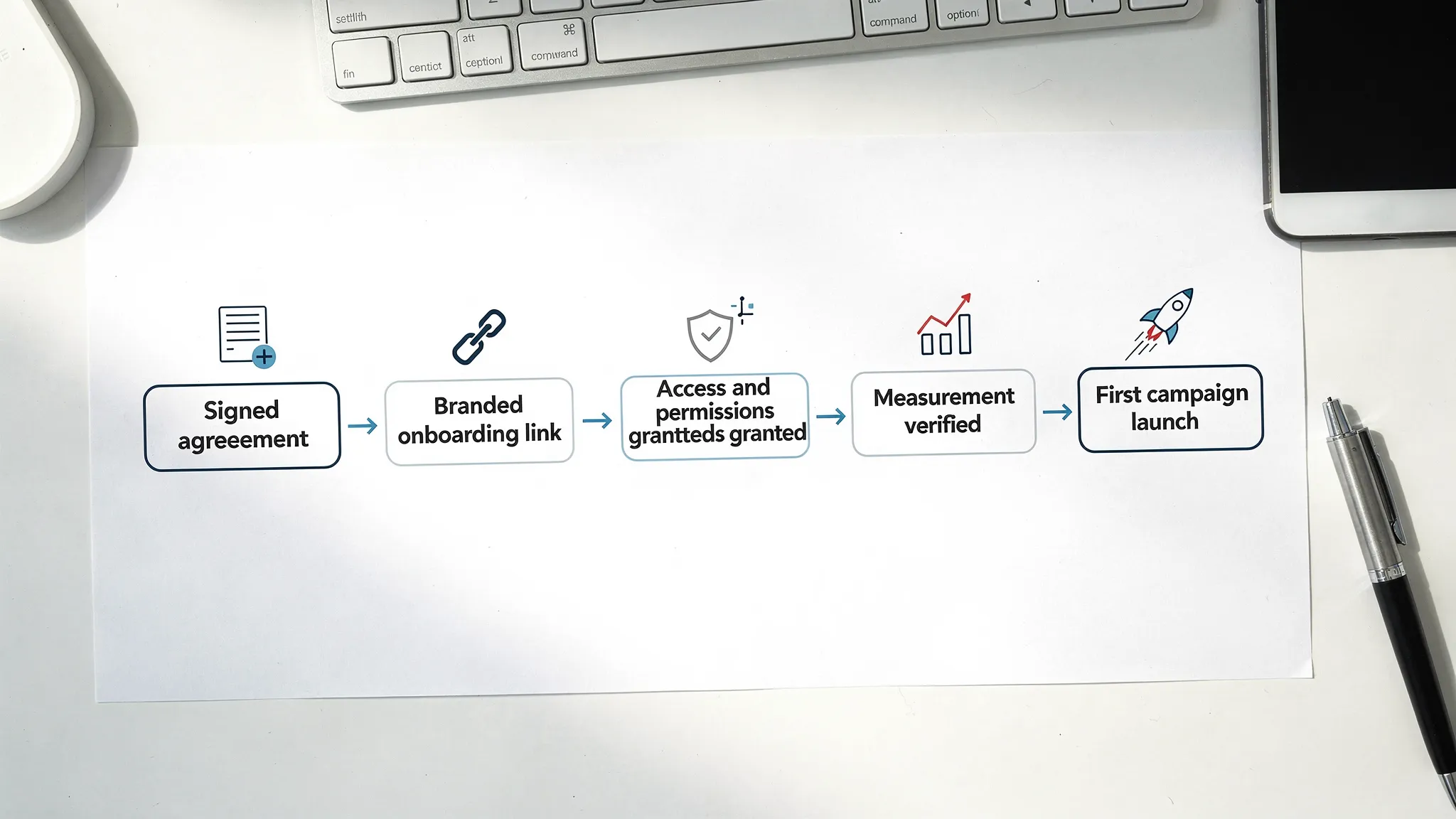
The RAMP framework: a practical onboarding sequence for modern internet marketing
To keep onboarding fast and repeatable, use a framework you can run in every engagement, regardless of channel mix.
1) Requirements (define the outcome and constraints)
This is where you prevent the two most expensive onboarding failures:
- Launching without a shared definition of success
- Building a plan around assumptions that were never approved
You want answers that are specific enough to drive execution within days, not weeks.
What to lock in during Requirements:
- Primary growth goal (pipeline, purchases, qualified leads, trials booked)
- Conversion definition (what counts, what does not)
- Ideal customer profile and exclusions (who you are not targeting)
- Offer and proof (what you will promote first, and why it should work)
- Budget constraints and ramp timeline
- “Non-negotiables” (compliance rules, brand boundaries, restricted categories)
A good output is a one-page “Launch Brief” that your strategist, media buyer, and creative team can all execute from.
2) Access (collect the minimum access needed, securely)
Access is where most internet marketing onboarding breaks. The usual reasons are predictable:
- Password sharing instead of role-based access
- Requesting the wrong permission level
- Using the wrong account structure (agency-owned assets where client-owned is required)
- Missing critical IDs, domains, or admin contacts
A modern approach is partner-based access with least privilege, plus a single place where the client completes all requests.
If you run multi-platform campaigns, your access scope typically spans:
- Ad platforms (paid social, search, retail media if applicable)
- Analytics and tag management
- Website/CMS (at least to deploy tracking and landing page updates)
- CRM and marketing automation (for lead lifecycle and offline conversion feedback)
- Creative repositories and brand assets
The key is consistency: the same categories, the same permission templates, and the same validation steps every time.
3) Measurement (verify tracking before you spend)
Internet marketing fails quietly when tracking is wrong. You can spend for weeks and still be unable to answer basic questions like:
- Which campaigns are producing qualified leads?
- Are we optimizing to real revenue, or to low-quality conversions?
- Did performance drop, or did attribution break?
Your onboarding should include a measurement verification sprint. Even if your campaigns are simple, verify the basics before launch.
Measurement verification checklist (high level):
- Analytics installed and receiving data (no duplicate tags)
- Key events defined and firing correctly
- Consent mode or privacy requirements accounted for where relevant
- UTM and naming conventions agreed
- Lead quality feedback loop defined (what happens after the form fill)
If you need a reference point for why measurement discipline matters, Google’s documentation on UTM parameters is a solid baseline for standardizing campaign tracking.
4) Process (make delivery predictable: approvals, timelines, ownership)
This is the part most agencies skip, then pay for later in delays and revisions.
At minimum, clarify:
- Approval path (who approves creative, budgets, landing page changes)
- Response-time expectations (both sides)
- Asset delivery dates (logos, brand guidelines, product claims, disclaimers)
- Meeting cadence and communication channel
- Escalation path when access or approvals stall
Onboarding should reduce ambiguity. If the client is unsure what to do next, your process is not done.
5) Proof (deliver a small win fast)
A modern onboarding sequence ends with proof of momentum, not just “setup complete.” Proof is a visible artifact that signals progress.
Examples:
- A verified tracking report (events firing, attribution assumptions documented)
- A first-launch plan with budgets, audiences, and creative mapped
- A “first results” goal (time-boxed) aligned to the client’s expectation
This proof step is what turns onboarding into trust.
What to standardize (so onboarding stays fast as you scale)
If you want onboarding to be fast for every client, you need standardization at the system level, not heroics from your team.
Here is a practical table of what to standardize, and why it matters.
| Onboarding component | What to standardize | Why it matters for internet marketing |
|---|---|---|
| Intake | A single launch brief format | Prevents strategy rework and misaligned expectations |
| Access | Permission templates by role (buyer, analyst, developer) | Reduces overpermission and delays |
| Measurement | A repeatable verification checklist | Prevents “we can’t trust the data” situations |
| Ops | Approval workflow and response-time SLA | Keeps creative and launches moving |
| Reporting | Naming conventions and KPI definitions | Makes performance comparable across time and channels |
The metrics that reveal onboarding quality
If onboarding is part of performance, it should be measurable.
Two metrics are especially useful because they predict speed to results:
- Time-to-verified-access: how long from “closed-won” until the correct access is granted and confirmed.
- Time-to-measurement-ready: how long until tracking is verified and you can trust reporting.
You can also track:
- Intake completion rate (how many clients finish without back-and-forth)
- Access defect rate (how often permissions are wrong or incomplete)
- Onboarding cycle time (end-to-end)
These are operational metrics, but they directly shape marketing outcomes because they determine how quickly you can test and learn.
Common onboarding mistakes in internet marketing (and what to do instead)
Treating onboarding as admin work
If onboarding is “someone sends emails,” you will keep losing days. Treat onboarding as a productized workflow with clear stages, owners, and SLAs.
Asking for passwords
Password sharing creates security risk, breaks audit trails, and often violates internal policies. Use role-based or partner-based access wherever possible, and request the minimum permissions needed.
For a general security baseline, the NIST Digital Identity Guidelines are a useful reference for identity and access thinking (even if you are not implementing them formally).
Launching before measurement is verified
Marketing teams feel pressure to “just launch.” But if your tracking is wrong, you cannot learn, and you risk optimizing to noise.
No single source of truth for onboarding status
Clients should not have to search email threads to understand what is blocked. Your team should not have to rebuild context in every handoff.
Where Connexify fits: one-link onboarding for multi-platform internet marketing
If you run internet marketing across multiple platforms, the fastest way to reduce onboarding friction is to remove fragmentation.
Connexify is built to streamline client onboarding for agencies and service providers with:
- One-link client onboarding (a single branded link clients can use to complete onboarding)
- Branded onboarding experience and white-label options
- Multi-platform support
- Customizable permissions
- API and webhook integrations for handoffs
- A user-friendly dashboard
- Secure data handling, with no installation required
The goal is simple: replace days of manual coordination with a consistent, secure onboarding journey that can complete in seconds when the client is ready.
If you want a platform-specific example of how a standardized access flow prevents delays, see Connexify’s guide on Meta (Facebook) Business Manager access.

Frequently Asked Questions
What is client onboarding in internet marketing? Client onboarding in internet marketing is the structured process of turning a signed client into a launch-ready account, including goal alignment, secure access provisioning, measurement verification, and operational setup (approvals, assets, timelines).
Why does onboarding affect marketing performance? Onboarding determines how quickly you can launch, whether your tracking is reliable, and how many delays you face due to missing access or unclear approvals. Faster, verified onboarding typically means faster learning cycles and quicker time to value.
What access should an internet marketing agency request from a new client? It depends on scope, but most engagements require scoped access to ad platforms, analytics/tag management, the website/CMS for tracking and landing pages, and often CRM or marketing automation for lead quality feedback. Best practice is least-privilege access and avoiding password sharing.
What is “time-to-verified-access”? Time-to-verified-access is the time from closed-won to the moment correct permissions are granted and confirmed across required systems. It is a strong operational KPI because it predicts how fast campaigns can start.
How can agencies speed up onboarding without sacrificing security? Use a standardized onboarding flow with permission templates, partner-based access, and a single client-facing onboarding link that centralizes requests and reduces back-and-forth. Track onboarding status and fix common blockers with a repeatable verification sprint.
Make onboarding your competitive advantage
If your internet marketing results depend on speed, measurement, and trust, your onboarding cannot be a patchwork of emails and screenshots. Productize it.
Connexify helps agencies streamline onboarding with a single branded link, multi-platform support, customizable permissions, and integrations for clean handoffs. Explore Connexify at connexify.io to book a demo or start your 14-day free trial.