Internet Marketing Company Near Me: Quick Scorecard
01/25/2026

“Internet marketing company near me” is a high-intent search. You’re not researching what marketing is, you’re trying to hire someone who can drive pipeline without wasting weeks on vague audits, messy access requests, and reporting that never connects to revenue.
This quick scorecard is designed for that moment. You can use it to shortlist and compare local (or local-ish) agencies in under an hour, then carry the winner into a clean kickoff.
First, define what “near me” really means (so you don’t optimize for the wrong thing)
A nearby agency can be valuable if you want on-site workshops, local market knowledge, or a partner who can meet your stakeholders in person. But for most internet marketing work, the bigger risk is not distance, it’s operational friction.
Two agencies can be equally smart strategically, but one gets stuck for 10 days waiting on logins, pixels, CRM access, and approvals. The other is live in 48 hours with tracking verified and a first test launched. “Near me” helps, but time-to-value wins.
So treat location as one signal, not the deciding factor.
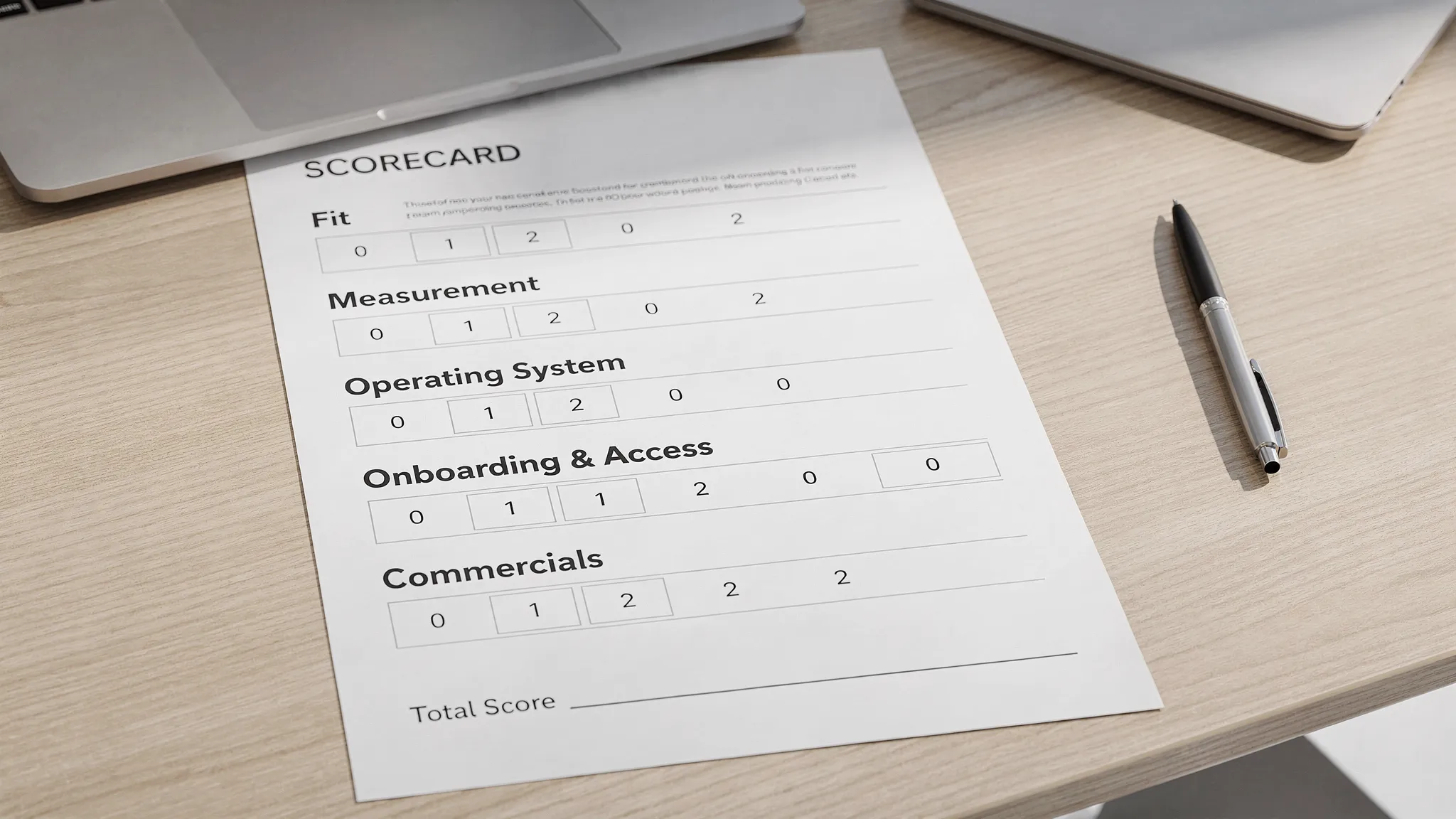
The Quick Scorecard (printable, 0–2 scoring)
Score each category from 0 to 2.
- 0 = missing, vague, or risky
- 1 = acceptable, but not proven
- 2 = clear, evidenced, and repeatable
A strong candidate typically scores 14+ out of 18. If two agencies tie, use Onboarding and Access as the tie-breaker, because it predicts how fast everything else will move.
| Category | What “2 points” looks like | Score (0–2) |
|---|---|---|
| 1) Fit to your business | They’ve grown companies with your sales motion (lead gen, ecommerce, ABM) and can explain why it worked | |
| 2) Offer clarity | A defined package or SOW with deliverables, cadence, and boundaries (not “we do everything”) | |
| 3) Proof you can verify | Case studies tied to comparable constraints, plus references you can actually contact | |
| 4) Measurement readiness | They start with tracking and CRM alignment, and define conversion events before proposing optimizations | |
| 5) Operating system | Clear process: kickoff, weekly cadence, owners, escalation path, and change control | |
| 6) Onboarding and access | They can collect/verify access without password sharing, with least-privilege permissions and a Day 0 checklist | |
| 7) Team and accountability | Named people, not just titles. You know who owns strategy, execution, analytics, and approvals | |
| 8) Commercials and incentives | Pricing matches scope, spend guidance is rational, and they avoid conflicts (like opaque markups) | |
| 9) Local credibility (optional) | Local reviews, local partners, local examples, and the ability to meet when it matters |
How to use the scorecard in 60 minutes
This is the fastest workflow that still produces a confident decision.
Step 1 (10 minutes): Pre-screen their surface area
Before you book calls, you want quick disqualifiers.
Check:
- Their homepage and service pages: do they clearly state who they help and how they deliver?
- Their case studies: do they mention measurement, constraints, and timeline, or only vanity outcomes?
- Their leadership and team: are there real operators, or only sales?
- Their reviews: look for patterns about responsiveness, reporting, and project management.
If you can’t find a clear offer and credible proof in 10 minutes, they start at 0 points in Offer clarity and Proof.
Step 2 (20 minutes): Run a tight discovery call (use a script)
You’re not trying to learn everything. You’re trying to reveal whether their thinking is diagnostic, measurable, and operational.
Use questions that force specificity:
Fit and strategy
- “What’s your working hypothesis for growth in a business like ours, and what would you test first?”
- “What would make you say no to a client like us?”
Measurement
- “Which conversions should we instrument first, and how do you validate they’re firing correctly?”
- “How do you reconcile platform reporting with CRM revenue?”
Operating rigor
- “What does the first 14 days look like, week by week?”
- “What are your standard meeting cadence and deliverables in month one?”
Onboarding and security
- “How do you request access to Ads, Analytics, Tag Manager, and CRM without sharing passwords?”
- “What permissions do you need, and what do you not need?”
Listen for a structured answer. If they sound like they’re making it up live, they’re telling you how the engagement will feel.
Step 3 (15 minutes): Ask for two artifacts that reveal competence
You want evidence, not promises. Request:
- A 1-page launch plan (prioritized tests, channels, measurement, timeline)
- An onboarding bill of materials (what they need from you, exactly, to start)
A serious internet marketing company will already have these templates.
Step 4 (15 minutes): Score, then write a 3-sentence decision brief
After you score each agency, write:
- Why we’re hiring them
- What success looks like in 30 days
- What would cause us to stop or renegotiate
That short brief prevents “moving goalposts” later.
What each scorecard category means (and how to grade it)
1) Fit to your business
Fit is not “we do SEO and PPC.” Fit is:
- Similar buyer journey (fast inbound vs long sales cycle)
- Similar constraints (compliance, approvals, limited creative, small team)
- Similar economics (high LTV, narrow ICP, seasonal demand)
Score 2 if they can explain tradeoffs and sequencing for your context.
2) Offer clarity
A strong offer reduces surprise. Look for:
- Clear deliverables (landing pages, ad groups, content, reporting)
- Clear cadence (weekly growth review, monthly strategy refresh)
- Clear boundaries (what is not included)
Score 0 if everything is custom but nothing is defined.
3) Proof you can verify
Case studies should include constraints, timeline, and what they actually did.
Score 2 when:
- Results map to a funnel metric you care about (qualified leads, CAC, pipeline)
- The story explains the mechanism, not just the outcome
- They offer references, or at least credible validation
4) Measurement readiness
If an agency can’t make measurement reliable, you can’t trust optimization.
Score 2 if they start by aligning:
- What counts as a conversion
- Where source-of-truth lives (often your CRM)
- How they will validate tracking (before scaling spend)
If they jump straight to “increase ROAS” without asking how you define revenue, that’s a 0 or 1.
5) Operating system
You’re buying execution, not ideas. Operational clarity prevents stall-outs.
Score 2 if they can show:
- A kickoff agenda
- A weekly operating cadence
- A simple workflow for approvals and changes
- How they handle emergencies (site down, disapproved ads, tracking breaks)
6) Onboarding and access (your highest-leverage category)
Onboarding is where most engagements lose momentum. The best agencies treat onboarding like a product.
Score 2 if they:
- Never ask for passwords
- Request least-privilege access (role-based, platform-native where possible)
- Have a clear “Day 0” checklist for access + measurement verification
- Can tell you their typical SLA for “time-to-verified-access”
If you want a practical benchmark, a good agency should be able to get from contract to verified access quickly when the client is responsive.
For agencies that onboard across many platforms, a dedicated onboarding layer can remove a lot of friction. Connexify, for example, is built to streamline secure access setup through a single branded onboarding link (with customizable permissions and multi-platform support), so clients can connect accounts without long email threads. If you’re evaluating agencies, ask what tooling they use to make onboarding predictable, then compare answers.
You can also sanity-check your own process with Connexify’s guide on online marketing company SOPs for client access.
7) Team and accountability
Score 2 if you meet (or are introduced to) the actual owner of:
- Strategy
- Day-to-day campaign execution
- Analytics/measurement
- Project management
Be cautious if everything routes through sales, or if they won’t name the team until after you sign.
8) Commercials and incentives
Great marketing partners make pricing legible.
Score 2 if:
- Fees align to scope (and they can explain resourcing)
- They’re transparent about ad spend management, creative costs, and tools
- There’s no weird incentive to push spend without performance
If you’re comparing proposals, normalize them into the same structure. This reduces “apples vs oranges” and makes tradeoffs obvious.
9) Local credibility (optional)
Local matters more when your demand is local.
Score 2 if they show:
- Experience in your metro area or region
- Local partnerships
- A realistic local SEO and review strategy (if relevant)
Also consider industry-specific local credibility. For example, if you sell into energy-intensive or regulated environments, it helps to work with marketers who understand industry stakeholders and constraints. Even browsing a relevant industry body like BVGE (Bundesverband der gewerblichen Energienutzer) can help you spot the difference between generic marketing language and domain-aware messaging.
Red flags that should end the evaluation
These are patterns that usually cost you months.
- They ask for admin access everywhere, or request passwords “just to get started.”
- They can’t describe onboarding steps, timelines, or owners.
- They report on impressions and clicks, but can’t connect to leads, pipeline, or revenue.
- They avoid specificity in the first 14 days, or can’t name what will ship.
- They promise outcomes without asking about constraints (sales cycle, pricing, margins, conversion rates).
A simple tie-breaker: run a micro-onboarding test
If you have two finalists, don’t debate. Test.
Ask each agency to do a limited, paid onboarding sprint focused on:
- Access requests (correct permissions, no password sharing)
- Tracking validation (can they confirm events and attribution basics?)
- A 1-page launch plan (prioritized, measurable, time-boxed)
Pick the team that is fastest, clearest, and safest. That predicts the relationship.
If you want a reference blueprint for what “fast and safe” looks like, Connexify’s modern client onboarding guide for internet marketing lays out a structured way to go from requirements to verified access to measurement-ready.
If you’re an agency: turn this scorecard into your advantage
Buyers are increasingly skeptical, and “near me” searches are crowded. The agencies that win tend to:
- Productize onboarding (so it feels predictable)
- Prove measurement readiness early
- Make access secure and easy
If you’re building that experience, Connexify can help you deliver a branded, one-link onboarding flow that reduces manual steps and speeds multi-platform access setup. You can explore Connexify at Connexify.io and, if it fits, start with the 14-day free trial or book a demo.