Choosing a Marketing Agency for B2B: Key Questions
01/17/2026

Most B2B companies don’t fail at marketing because they “picked the wrong channel.” They fail because they hired an agency built for a different reality: longer sales cycles, multiple stakeholders, messy attribution, and a handoff to sales that has to work in the real world.
This guide focuses on the key questions to ask when choosing a marketing agency for B2B, plus what strong answers look like, what to document before you sign, and where agencies commonly create hidden drag (especially during onboarding and access setup).
First, get specific about your B2B motion (so you don’t buy the wrong “solution”)
Before you evaluate agencies, align internally on the constraints that make B2B marketing different:
- Sales model: inbound-led, outbound-led, product-led, partner-led, or a hybrid.
- Sales cycle and ACV: a $2k monthly service and a $120k ACV platform need different creative, offers, and proof.
- Buying committee reality: how many roles influence the deal (finance, security, ops, the champion).
- Proof inventory: do you have case studies, benchmark data, customer quotes, recorded calls, win-loss notes.
- Systems of record: where revenue truth lives (Salesforce, HubSpot, Dynamics), and what “counts” as pipeline.
If you can’t articulate these, even a great agency will guess. And guessing in B2B is expensive.
Quick fit check: what kind of agency do you actually need?
| Your situation | The agency profile that usually fits best | Why it matters |
|---|---|---|
| You need positioning, ICP clarity, and a narrative that sales can repeat | Strategy-first B2B agency with GTM experience | Without crisp messaging, you will pay for traffic that doesn’t convert |
| You already have a strong story and need predictable pipeline creation | Demand gen agency with CRM-first measurement | Execution without revenue-grade measurement becomes “vanity marketing” |
| You sell into named accounts, complex deals, or enterprise security reviews | ABM-capable agency with sales alignment muscle | You need orchestration across ads, outbound, content, and sales plays |
| You need content that enables deals (not just blogs) | Content-led B2B agency that builds proof assets | Case studies, one-pagers, and ROI tools often beat more impressions |
Key questions about strategy (and whether they understand B2B buying)
B2B strategy is less about “what to post” and more about who you are for, what you help them do, and why you’re credible.
Ask: “How will you define and validate our ICP?”
Strong agencies don’t stop at firmographics. Look for a plan that includes:
- Segmentation by pain, urgency, and constraints (compliance, integrations, internal resources)
- Interviews or analysis of existing calls, closed-lost reasons, and support tickets
- A clear output such as an ICP brief plus “who not to target” guardrails
A weak answer sounds like: “We target companies with 50 to 500 employees in X industry.” That’s a directory filter, not an ICP.
Ask: “What’s your approach to positioning and messaging for a technical or complex product?”
Good answers reference tangible artifacts:
- A messaging hierarchy (value prop, pillars, proof, objections)
- Competitive differentiation (what you will and won’t claim)
- A plan to pressure-test messaging in ads and sales conversations
If they can’t explain how messaging gets validated, you’ll end up with polished words that don’t sell.
Ask: “How do you work with sales, not around sales?”
In B2B, marketing that doesn’t integrate with sales becomes a lead factory that everyone resents.
Look for specifics:
- Shared definitions for MQL, SQL, SAL, and pipeline stages
- Feedback loops (weekly pipeline review, objection mining, win-loss learnings)
- Enablement deliverables (battlecards, one-pagers, talk tracks)
Key questions about channels (and whether they can build a pipeline system)
Channels are not strategies, they’re distribution. A B2B agency should connect channels to stages of the journey.
Ask: “Which channels do you recommend for our motion, and what will you not do in the first 60 days?”
Strong agencies can say no. They will typically sequence work like:
- Foundation first (tracking, landing pages, offer, CRM alignment)
- One or two primary acquisition channels
- Retargeting and nurture only after the basics work
Be cautious of agencies that propose five channels immediately. That often signals shallow execution.
Ask: “How do you balance demand capture vs demand creation?”
B2B growth usually requires both:
- Capture: people already searching (high intent search, competitor terms, review sites)
- Creation: building preference so you show up in the shortlist (content, paid social, newsletters, webinars)
A good agency will describe how they’ll allocate budget and effort based on your current market awareness and sales capacity.
Ask: “What’s your ABM approach, and what counts as success?”
If they claim ABM, ask what they mean. ABM can range from light targeting to true account programs.
Look for:
- A named account list (or tiers) tied to revenue potential
- Multi-threading support (content for champion, exec, finance, security)
- Measurement beyond clicks (account engagement, meetings, pipeline influence)
Key questions about measurement (where most B2B agency relationships break)
If you can’t agree on measurement, you can’t agree on reality.
Ask: “What are the 3 to 5 metrics you will be accountable for?”
In B2B, “leads” alone is usually a trap. Better answers include a ladder such as:
- Qualified meetings held
- Sales accepted opportunities created
- Pipeline amount influenced or sourced
- CAC or cost per qualified opportunity (when volume allows)
Ask how they’ll handle low-volume reality. Many B2B teams will not generate statistically meaningful conversion rates every week, so the agency needs an approach that combines signal types.
Ask: “How will you connect ad platforms to our CRM, and what’s your plan for offline conversion tracking?”
If you run Google Ads or LinkedIn, you’ll eventually need CRM feedback to optimize for quality.
A credible agency should discuss:
- CRM as the source of truth
- Lead source hygiene, deduplication rules, and lifecycle stages
- Offline conversion import (for example, Google Ads offline conversion tracking)
If they only talk about platform dashboards, you’ll get platform-optimized results, not revenue-optimized results.
Ask: “What’s your plan for attribution, and how do you prevent attribution debates?”
There’s no perfect attribution in B2B, but there is a practical agreement.
Look for an answer that includes:
- A primary model (first touch, last touch, multi-touch, or blended)
- A clear definition of “sourced” vs “influenced” pipeline
- A recurring business review cadence that focuses on decisions, not dashboard theater
Key questions about creative and offers (because B2B conversions are rarely “one click”)
B2B creative is persuasion, proof, and clarity.
Ask: “What offers do you recommend for our stage and buyer?”
Strong agencies won’t default to “ebook gating.” They’ll tailor offers to sales cycle and intent, such as:
- ROI calculator, pricing guidance, or migration checklist
- Competitive comparison pages
- Case studies with quantified outcomes and implementation detail
- Webinar or workshop that earns a meeting (not just registrations)
Ask: “How do you create proof, not just content?”
In B2B, proof is a growth lever. Ask how they’ll produce:
- Case studies (including interview process and approvals)
- Proof snippets for ads (quotes, outcomes, benchmarks)
- Sales enablement assets that reduce sales cycle friction
If they can’t describe how they get approvals through legal and stakeholders, your content engine will stall.
Key questions about operating model (how work actually gets done)
A high-performing B2B agency relationship feels like a system: clear owners, clear handoffs, clear timelines.
Ask: “Who will do the work, and how do we communicate week to week?”
You want to hear specifics:
- Named roles (strategist, media buyer, creative, analytics)
- Weekly cadence (standup, backlog review, performance review)
- Shared workspace expectations (Slack, email, Asana, Jira)
Ask: “What are your SLAs for execution and responsiveness?”
B2B marketing often depends on speed: shipping landing pages, updating ads after product changes, reacting to sales feedback.
Ask for:
- Turnaround time for creative iterations
- Reporting cadence
- Escalation path when something breaks (tracking, disapprovals, access issues)
Key questions about onboarding, access, and security (the hidden cost center)
In 2026, a surprising amount of agency “performance” is actually operational. If onboarding takes two weeks, your Q1 pipeline doesn’t care that the strategy deck was good.
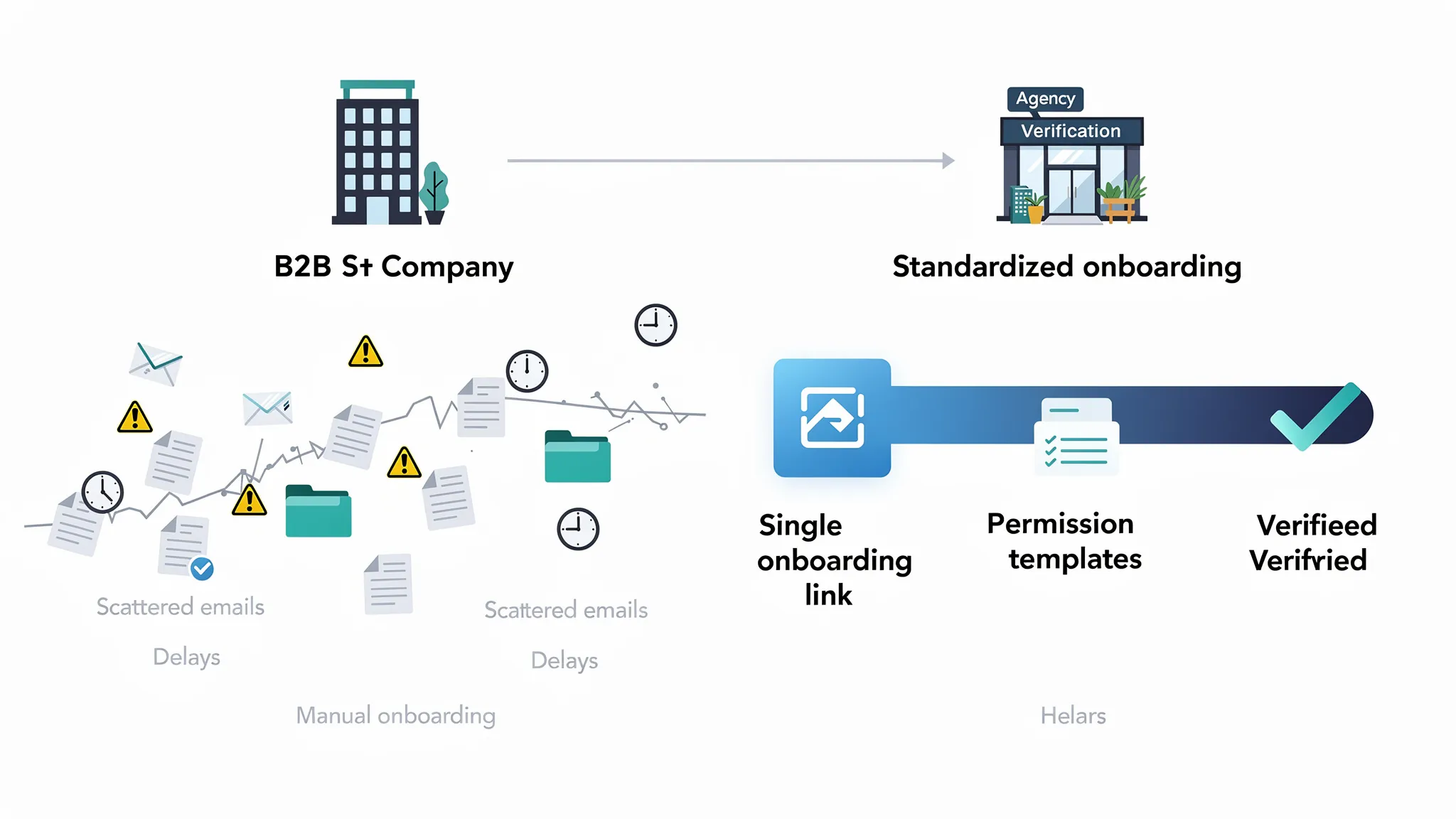
Ask: “What access do you need, and how do you request it securely?”
Listen for security hygiene:
- No password sharing
- Role-based access and least privilege
- Partner access models where platforms support it
- Documentation of what was requested and why
If you want a benchmark for what “good access onboarding” looks like, Connexify has platform-specific playbooks (for example, secure Meta access workflows) that highlight the difference between clean partner access and chaotic credential handoffs.
Ask: “How fast can you get to verified access, and how do you track it?”
A strong agency can give you an onboarding SLA like “time-to-verified-access,” plus how they instrument it.
This is where tooling matters. Many agencies now use a dedicated client onboarding layer (like Connexify’s one-link onboarding) to collect access, permissions, IDs, and approvals through a single branded flow instead of scattered emails.
If you’re evaluating agencies, it’s fair to ask:
- Do you have a standardized onboarding link or portal?
- Can you support multiple platforms in one flow?
- Can you prove what access was granted (and when)?
(If you’re an agency reading this, this is also a sales advantage. A frictionless, secure onboarding experience reduces perceived risk and shortens time-to-value. Connexify is built for exactly that, you can explore it at Connexify.)
Key questions about commercial terms (and incentives)
Pricing models can silently shape behavior.
Ask: “How do you charge, and what does ‘management’ actually include?”
Make sure you understand:
- Whether creative, landing pages, reporting, and strategy are included or add-ons
- If there are minimum term requirements and exit terms
- How ad spend increases affect fees
Ask: “Who owns the accounts, data, and creative?”
In B2B, losing historical data can set you back months. Clarify:
- Your ownership of ad accounts, analytics, pixels/tags, creative files
- Admin access for your team
- What happens on termination (handoff plan and timeline)
A practical scorecard you can use on discovery calls
Use this to keep evaluations objective, especially when multiple stakeholders are involved.
| Category | The question to ask | What a strong answer includes |
|---|---|---|
| ICP and positioning | “How will you define our ICP and messaging?” | Interviews or data review, clear artifacts, validation plan |
| Channel strategy | “Why these channels for our motion?” | Sequencing, tradeoffs, what they will not do yet |
| Measurement | “How do you tie marketing to pipeline?” | CRM-first reporting, lifecycle stages, offline conversion plan |
| Creative and proof | “How do you create assets that help sales win?” | Case study process, enablement assets, approval workflow |
| Operating cadence | “How will we work together weekly?” | Named team, cadence, SLAs, escalation path |
| Onboarding and access | “How do you request access securely and quickly?” | Least privilege, no passwords, standardized onboarding flow |
| Commercial alignment | “How do fees and incentives work?” | Clear scope, change control, ownership, exit plan |
How to de-risk the decision: run a B2B pilot that tests the right things
Many B2B teams hire agencies based on a pitch, then discover the delivery reality later. A short pilot can flip that.
A good pilot is not “run ads for 30 days.” It’s a test of the agency’s ability to:
- Onboard cleanly (access, tracking, approvals)
- Produce credible messaging and offers
- Create a measurement loop tied to CRM outcomes
- Operate with speed and clarity
If you want a concrete operational lens on onboarding quality (and why it impacts outcomes), you can also compare agencies on how they handle access setup and verification. Connexify’s perspective on this is covered in resources like B2B advertising agency onboarding that wins deals.
Red flags that should pause the process
Some warning signs are universal in B2B:
- They promise results without asking deep questions about sales cycle, ACV, or CRM stages
- They report success primarily through clicks, impressions, or platform ROAS without revenue context
- They request passwords or suggest workaround access methods that bypass governance
- They can’t explain a repeatable onboarding process and timeline
- They can’t show examples of B2B work that matches your complexity (not just your industry)
The goal: an agency that can ship, measure, and earn trust
Choosing a marketing agency for B2B is less about finding the cleverest campaign, and more about finding a partner that can build a revenue-connected system: clear positioning, disciplined channel execution, CRM-grade measurement, and a delivery model that doesn’t stall during onboarding.
If you’re an agency or service provider looking to make that final piece (onboarding and access) faster and safer, Connexify is designed to compress onboarding from days to seconds with a single branded link across platforms. You can explore the product and book a demo at Connexify, or start by seeing how top teams operationalize onboarding in what top Facebook ad agencies automate in onboarding.