B2B Advertising Agency: Onboarding That Wins Deals
01/15/2026


If you run a B2B advertising agency, you already know the deal is rarely won on creative alone. Procurement wants predictability. The VP of Marketing wants speed. Legal and IT want control. And everyone wants a partner who feels “enterprise-ready” from the first call.
That is why onboarding is not an afterthought in B2B advertising, it is part of the sale. When your onboarding experience is clear, secure, and fast, it reduces perceived risk, shortens time-to-value, and gives the buyer confidence to sign.
Why onboarding wins deals for B2B advertising agencies
B2B buyers are usually not evaluating one vendor, they are evaluating whether your agency can be trusted inside a complex system (people, platforms, and governance). Onboarding becomes a proxy for how you will operate when things get stressful.
A strong onboarding motion helps you win deals because it:
- De-risks the decision: clear roles, permissions, and a security posture make you feel safe to approve.
- Compresses “time to first signal”: the faster you can launch tracking and a first campaign, the faster you can prove value.
- Prevents stakeholder whiplash: B2B onboarding often requires coordination across marketing, sales ops, finance, and web or engineering.
- Protects brand trust: password sharing and messy access requests can trigger internal pushback before you ever launch.
If you want your agency to win more competitive evaluations, your onboarding must look like a product.
What B2B buyers want to see before they sign
In many B2B agency sales, the buyer is thinking, “How do I explain this choice to my CFO, my security team, and my CEO if it goes wrong?” Give them the story.
Here are the most common “silent objections” and the onboarding proof that neutralizes them:
| Buyer concern (what they are really asking) | Onboarding proof that answers it | What it signals |
|---|---|---|
| “Will this take forever to launch?” | A written onboarding SLA and a Day 0 plan | Operational discipline |
| “Will you ask for passwords?” | A clear no-password policy and partner-based access approach | Security maturity |
| “Who on our side has to do what?” | A stakeholder map (approver vs contributor) and a checklist by role | Buyer empathy |
| “How do we know tracking is correct?” | A measurement verification sprint (analytics + CRM alignment) | ROI seriousness |
| “What happens when scope expands?” | A permissions model and governance cadence | Scalability |
Your goal is to make the buyer feel, “This agency has done this 100 times, and they will not make me chase people internally.”
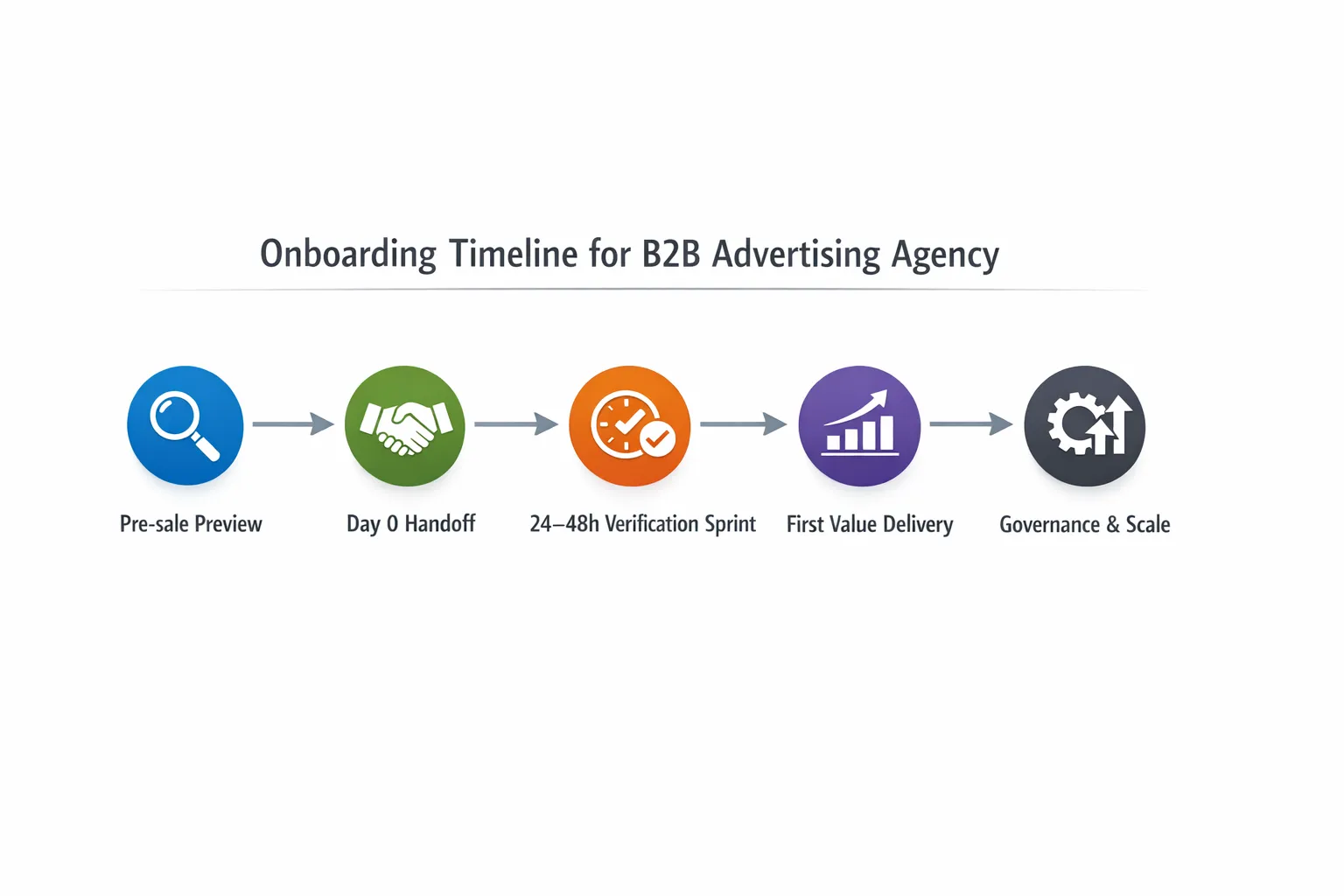
The B2B onboarding flow that shortens sales cycles
Most onboarding breaks because it starts too late. The best B2B agencies introduce onboarding during the sales process, then execute it fast once the agreement is signed.
Phase 1: Pre-sale onboarding preview (before the proposal is final)
Instead of promising speed, show the workflow.
What to include in your sales cycle:
- A one-page onboarding timeline (Day 0, Week 1, Week 2)
- Your access principles (no password sharing, least privilege)
- A “bill of materials” (what accounts, IDs, and stakeholders you will need)
This is especially powerful when prospects are comparing multiple agencies that all sound similar.
Phase 2: Day 0 handoff (signed to kickoff, without chaos)
Day 0 is where deals quietly bleed margin. If your team is chasing links, logins, and asset IDs across email threads, you are burning expensive hours.
A clean Day 0 handoff includes:
- A single client-facing onboarding destination (link, portal, or flow)
- Clear owners (client approver, client technical contact, agency operator)
- A kickoff agenda that assumes access will be verified live
If you want an example of how agencies formalize this, see Connexify’s broader guide on streamlining onboarding: How Digital Marketing Agencies Streamline Client Onboarding.
Phase 3: Access plus measurement verification sprint (24 to 48 hours)
For B2B advertising, access alone is not the milestone. Verified measurement is. That means your team can see conversions or pipeline events flowing and can trust what they are seeing.
In practice, a verification sprint usually includes:
- Ad platform access confirmed
- Analytics and tag management access confirmed
- Conversion events validated (lead, demo request, trial signup, etc.)
- CRM or marketing automation alignment confirmed (what counts as an MQL, SQL, pipeline)
Security note: B2B organizations often require least-privilege permissions. The principle is widely recognized in security frameworks, including NIST guidance on access control concepts (see NIST SP 800-53).
Phase 4: First value delivery (within 7 days)
“First value” is the fastest proof that your agency was the right choice.
For B2B, first value is often one of these:
- A measurement readiness memo (what is tracked, what is missing, what will be fixed)
- A live baseline report (current CAC, CVR, lead quality notes)
- A first campaign launched with verified conversion tracking
This is where onboarding directly impacts retention. A slow, confusing start increases second-guessing and buyer’s remorse.
Phase 5: Governance and scale (first 30 days)
B2B accounts tend to expand across stakeholders and campaigns quickly. Governance is what keeps that growth from turning into access sprawl.
Governance basics:
- Quarterly access review (remove old users, confirm roles)
- A predictable approval process for spend, creative, and landing pages
- A single source of truth for asset IDs, owners, and logins (without storing passwords in spreadsheets)
A practical “bill of materials” for B2B advertising onboarding
B2B advertising onboarding is usually cross-platform. Even if your primary channel is LinkedIn Ads or Google Ads, you typically need measurement and CRM context to judge lead quality.
Here is a practical onboarding matrix you can adapt per service package:
| Category | Common systems | What you need from the client | Why it matters |
|---|---|---|---|
| Paid media | LinkedIn, Google Ads, Microsoft Advertising | Account access plus billing alignment | Launch campaigns without delays |
| Measurement | GA4, Google Tag Manager, server-side tagging (if used) | View/edit access, event map, domain ownership inputs | Prevent broken attribution |
| CRM and lifecycle | HubSpot, Salesforce, Marketo, Pardot | Field definitions, lifecycle stages, lead routing rules | Align ads to revenue, not vanity leads |
| Web and landing pages | CMS, landing page builder, forms | Ability to publish or coordinate changes | Fix conversion friction fast |
| Creative and brand | Brand guidelines, DAM, past ads | Approved assets, claims, compliance notes | Speed creative iteration |
| Collaboration | Slack, Teams, email distribution lists | Who approves, who executes | Stop approval bottlenecks |
The biggest shift for B2B agencies is to treat CRM alignment as onboarding, not “later.” Many campaigns fail because onboarding never clarified what a qualified lead is.
How to productize onboarding so it becomes a differentiator
If your agency sells B2B advertising, you are not just selling ads, you are selling execution certainty.
A simple way to productize onboarding is to define one core SLA and build your process around it:
- Time-to-verified-access: how long from signed agreement until your team has confirmed access and measurement readiness.
You can reinforce this in proposals without overpromising. Examples you can adapt:
- Security language: “We do not request passwords. We use role-based access and request only the minimum permissions required for the agreed scope.”
- Timeline language: “Within 48 hours of kickoff, we aim to confirm platform access and measurement readiness, assuming client approvers complete access steps.”
- Scope clarity: “Campaign launch is contingent on verified conversion tracking or an agreed interim measurement plan.”
If you want a deeper SOP-style approach to fast access, see: Online Marketing Company SOPs: Client Access in Minutes.
Six onboarding mistakes that cost B2B agencies deals
These are the patterns that make prospects hesitate, even after they say they are ready to move forward.
1) Asking for passwords (or implying it)
Even hinting at password sharing can trigger security escalation. Use partner invites, delegated access, and scoped permissions instead.
2) Treating “access granted” as the finish line
Access without verification leads to false starts. You want “access verified and measurement validated.”
3) No stakeholder map
B2B onboarding often needs:
- A marketing approver
- A finance or billing owner
- A web or technical contact
- A sales ops or CRM owner
If you do not identify them early, you will wait days between steps.
4) Vague definitions (MQL, SQL, pipeline)
If the agency and client disagree on lead quality, performance reviews turn into politics. Clarify definitions during onboarding.
5) Fragmented onboarding across tools
When onboarding lives across email, docs, spreadsheets, and DMs, nothing is trackable. Buyers interpret this as operational immaturity.
6) No visible progress tracking
B2B stakeholders want status. If they cannot see where onboarding stands, they assume it is stalled.
Where client onboarding software fits for B2B advertising agencies
If you are scaling, onboarding should not depend on your best operator manually pushing every step forward.
A dedicated onboarding layer is useful when you need:
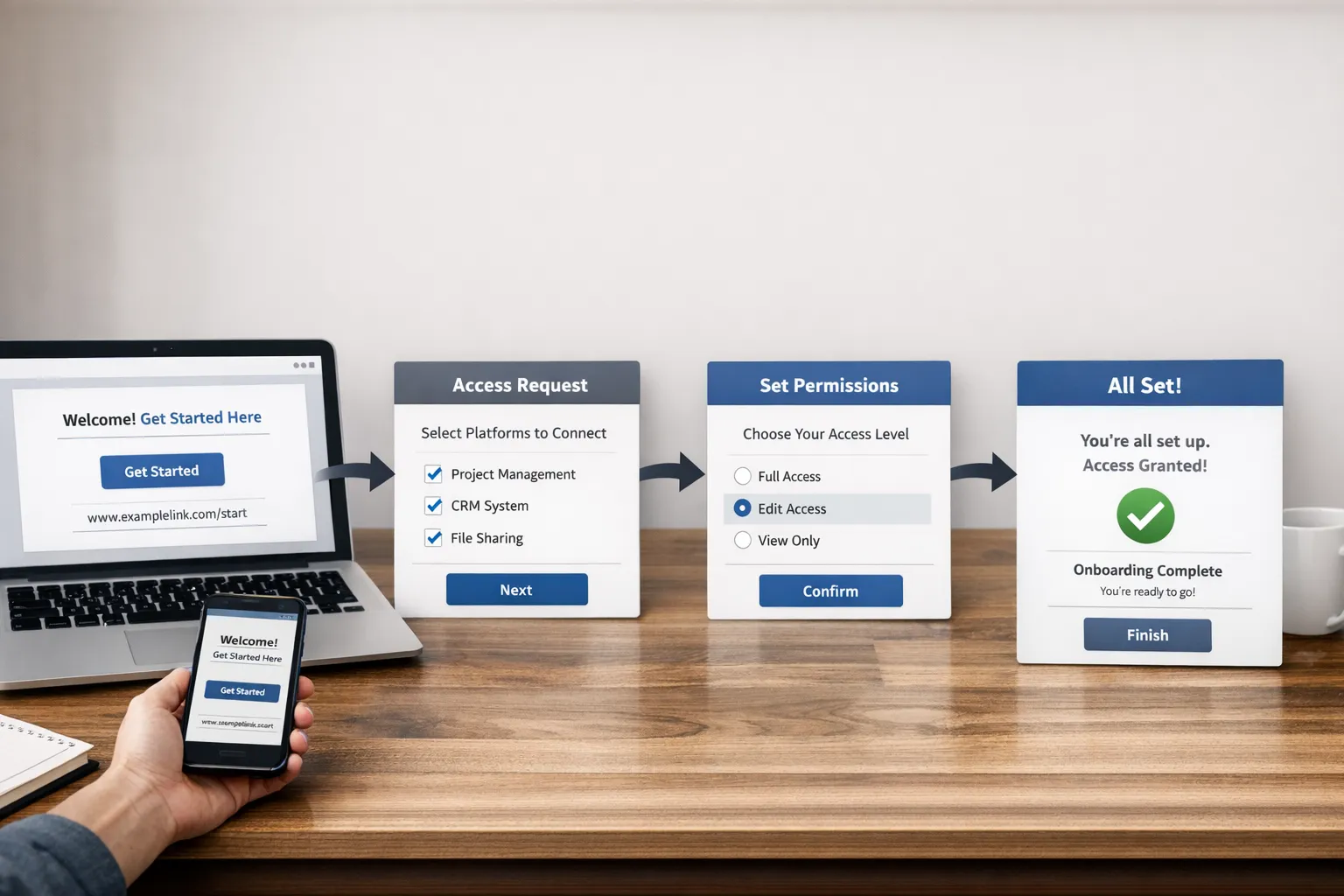
- One-link onboarding so clients know exactly where to go
- A branded onboarding experience that feels like your agency, not a patchwork of tools
- Multi-platform support (ads, analytics, CRM, and more)
- Customizable permissions so you can request the minimum required access by role and package
- Integrations (API and webhooks) to sync onboarding status into your CRM or project management workflow
Connexify is built for exactly this use case: streamlining client onboarding for agencies and service providers with fast, secure account access setup through a single branded link, designed to eliminate manual steps.
If you are currently evaluating what “good” looks like across your stack, you may also find this helpful: Top Tools for Marketing Agencies to Speed Onboarding.
Frequently Asked Questions
How fast should onboarding be for a B2B advertising agency? Many agencies aim for verified access and measurement readiness within 24 to 48 hours after kickoff, but timelines depend on how quickly client approvers can complete access steps and whether CRM or web changes are required.
What is the most important onboarding KPI for B2B advertising? A high-signal metric is time-to-verified-access (including measurement verification). It correlates strongly with time-to-first-campaign and time-to-first-value.
Do we really need CRM access to run B2B ads? You can launch without it, but B2B performance is often determined by lead quality and pipeline conversion. At minimum, you need agreement on lifecycle definitions and a plan to connect ad outcomes to downstream revenue.
How do we keep onboarding secure without slowing it down? Use role-based, least-privilege access, avoid password sharing, and standardize what you request by service package. A single, trackable onboarding flow also reduces insecure side-channel sharing.
What should we automate first in B2B onboarding? Start with the repeatable, high-friction steps: client intake, access requests by platform, permission templates, onboarding status tracking, and internal handoffs to delivery teams.
Turn onboarding into your unfair advantage
If you want onboarding to help you win more B2B advertising deals, treat it like a product: a branded experience, a clear SLA, and a verification sprint that proves you can launch safely and quickly.
Connexify helps agencies do that with a single, branded onboarding link, multi-platform support, customizable permissions, and integrations via API and webhooks.
- Explore Connexify at connexify.io
- Book a demo: Client Onboarding Software for smart agencies
- Or start with the 14-day free trial and standardize your onboarding flow before your next deal closes