B2B Marketing Firm: The 30-Day Launch Checklist
01/16/2026

A B2B marketing firm can win deals with sharp strategy and great creative, but it keeps deals (and margins) with operational rigor. In the first 30 days, your job is to make the business easy to buy from, easy to onboard with, and easy to deliver through.
This checklist is built for founders and operators who want a launch plan that is practical, time-boxed, and focused on what actually creates momentum: positioning, pipeline, onboarding, measurement, and a repeatable delivery system.
What “launched” should mean by Day 30
By the end of your first 30 days, aim to have these outcomes locked in:
- A clear ICP and offer that a buyer can understand in 30 seconds
- A simple proof library (even if small) that supports your claims
- One primary acquisition channel working (not five channels half-built)
- A sales process that produces a clear next step after every call
- A standardized onboarding flow that collects access, assets, and approvals without chaos
- A delivery cadence and reporting model that makes results traceable
If you only do one thing exceptionally well in your first month, make it this: compress time-to-first-value for every new client.
The 30-day launch checklist (week-by-week)
Days 1 to 3: Nail positioning and the “buyer-ready” offer
Your offer is not your services list. It is the promise, scope boundaries, and proof you can stand behind.
- Write a one-sentence positioning statement: who you help, what outcome you create, and the category you operate in
- Pick one primary ICP (industry + company size + a specific buying trigger)
- Define one flagship offer with:
- The outcome and timeframe (what changes, and how fast)
- In-scope deliverables (what is included)
- Out-of-scope items (what is not included)
- Required client inputs (access, data, approvals)
- Decide your “first value” deliverable (what you can ship quickly to reduce buyer anxiety)
A useful sanity check: if you cannot write your offer on a single page without jargon, it is not productized enough to scale.
Days 4 to 7: Build your minimal operating system (so delivery does not depend on memory)
A B2B marketing firm needs a few fundamentals working before you scale outreach.
- Set up core tools (keep it lean):
- A CRM (even a lightweight one) and a single pipeline with defined stages
- A proposal + e-sign flow
- A project space where delivery lives (not in email)
- A shared folder structure for client assets and exports
- Create three templates:
- Discovery call notes (to standardize diagnosis)
- Proposal/SOW structure (to standardize scope)
- Kickoff agenda (to standardize alignment)
- Define your internal roles for launch work:
- Sales owner (pipeline and follow-up)
- Delivery owner (implementation and deadlines)
- Measurement owner (tracking and reporting)
Security and governance matter early, especially with access-heavy marketing work. If you handle credentials, permissions, or client data, align your process with least-privilege access principles (see NIST guidance on access control concepts).
Days 8 to 14: Build pipeline with one channel and one repeatable motion
Pick one acquisition channel that matches your strengths and your ICP’s buying behavior. The mistake most new firms make is spreading effort thin.
Choose one:
- Outbound: targeted lists + a tight message + consistent follow-up
- Partnerships: a small number of complementary providers who already serve your ICP
- Content-led inbound: one “pillar” topic that matches your offer and ranks over time
Then implement:
- A simple lead list qualification rule (so you stop selling to “maybe” accounts)
- A single message that ties trigger events to your outcome (for example: “hiring a VP Marketing,” “new funding,” “pipeline stagnation,” “CRM migration”)
- A weekly activity cadence you can keep for 90 days
This is also the week to publish your “proof in context.” It does not need to be a giant case study. A short teardown, before/after narrative, or a documented process can be enough.
Days 15 to 21: Standardize sales, then productize onboarding
The goal of sales in a B2B marketing firm is not to impress. It is to reduce perceived risk.
- Build a discovery structure that produces a clear diagnosis:
- Current state (systems, channels, constraints)
- Desired state (what must be true in 90 days)
- Gaps (why it is not working today)
- Constraints (budget, approvals, compliance)
- Define a “definition of done” for the first 30 days of the engagement
- Add an onboarding SLA to your proposal (for example: access verified within a defined window after signature)
Now productize onboarding. This is where many firms quietly lose a week per client.
At minimum, your onboarding must reliably collect:
- Decision-makers and day-to-day contacts
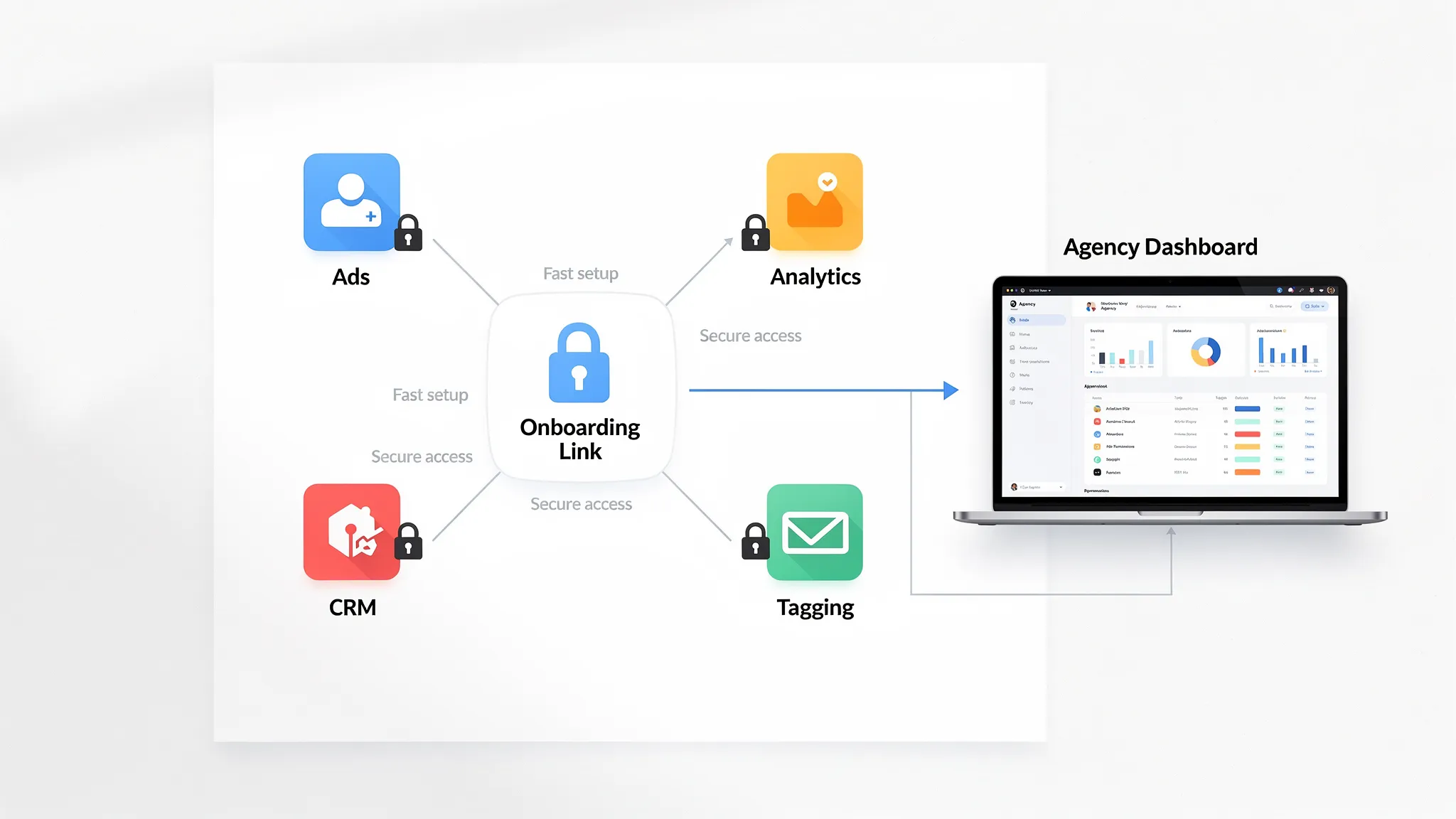
- Platform access (ads, analytics, tag manager, CRM, email)
- Billing and ownership confirmation (who pays, who owns assets)
- Brand assets (logos, guidelines, offers, approvals)
- Measurement requirements (conversion events, pipeline definitions)
If your team is still chasing access across email threads, you will feel “busy” but move slowly.
Connexify exists for this problem: it lets agencies and service providers send one branded onboarding link to set up fast, secure access across platforms, with customizable permissions and optional white-labeling. If your bottleneck is client access setup, a single-link workflow can remove days of back-and-forth.
Related reading if your work includes paid social onboarding:
- How digital marketing agencies streamline client onboarding
- Online marketing company SOPs: client access in minutes
Days 22 to 30: Ship first value, instrument measurement, and lock the cadence
This is the week that turns “new firm energy” into a real operating rhythm.
- Run a kickoff that ends with:
- Confirmed goals and constraints
- A short list of prioritized actions for the next 14 days
- A clear approvals path (who signs off, how fast)
- Verify measurement before you scale effort:
- Conversion tracking working
- Attribution assumptions stated (what you count as a lead, MQL, SQL)
- Baselines captured (so progress is provable)
- Deliver the first value milestone:
- A quick win deliverable (tracking fix, landing page improvement, campaign relaunch, nurture sequence)
- A clear explanation of what changed and what will happen next
- Establish your ongoing cadence:
- Weekly working session
- Weekly metrics snapshot
- Monthly strategy review
The client onboarding “bill of materials” (what to collect every time)
Most delays in B2B marketing delivery come from missing access, unclear ownership, and unverified measurement. Use this table to standardize your requirements.
| Category | What you need from the client | Why it matters | Common failure mode | How to prevent it |
|---|---|---|---|---|
| Contacts and ownership | Business owner, marketing owner, technical contact | Prevents approval bottlenecks | No one can approve, or approvals stall | Set an explicit approver and backup in kickoff |
| Ads platforms | Correct business IDs and scoped permissions | Launches campaigns without credential sharing | Wrong account, wrong role, or personal logins | Use partner access and least-privilege roles |
| Analytics | Admin access to analytics property and key views | Enables baseline + ongoing reporting | Partial access blocks configurations | Verify access live on kickoff |
| Tagging | Access to tag manager or equivalent | Enables conversion and event tracking | “We do not know who owns it” | Ask for ownership early, document it |
| CRM and pipeline | Stage definitions and conversion points | Makes marketing performance measurable | Leads cannot be mapped to revenue | Align on lifecycle stages and fields |
| Creative and brand | Logos, guidelines, offer details, exclusions | Prevents rework and compliance issues | “We will send later” delays launch | Make assets part of the onboarding gate |
If your firm frequently onboards across multiple tools, the fastest route is to turn this table into a standardized intake flow. Connexify is designed to centralize those requests into a single branded experience rather than scattered emails.
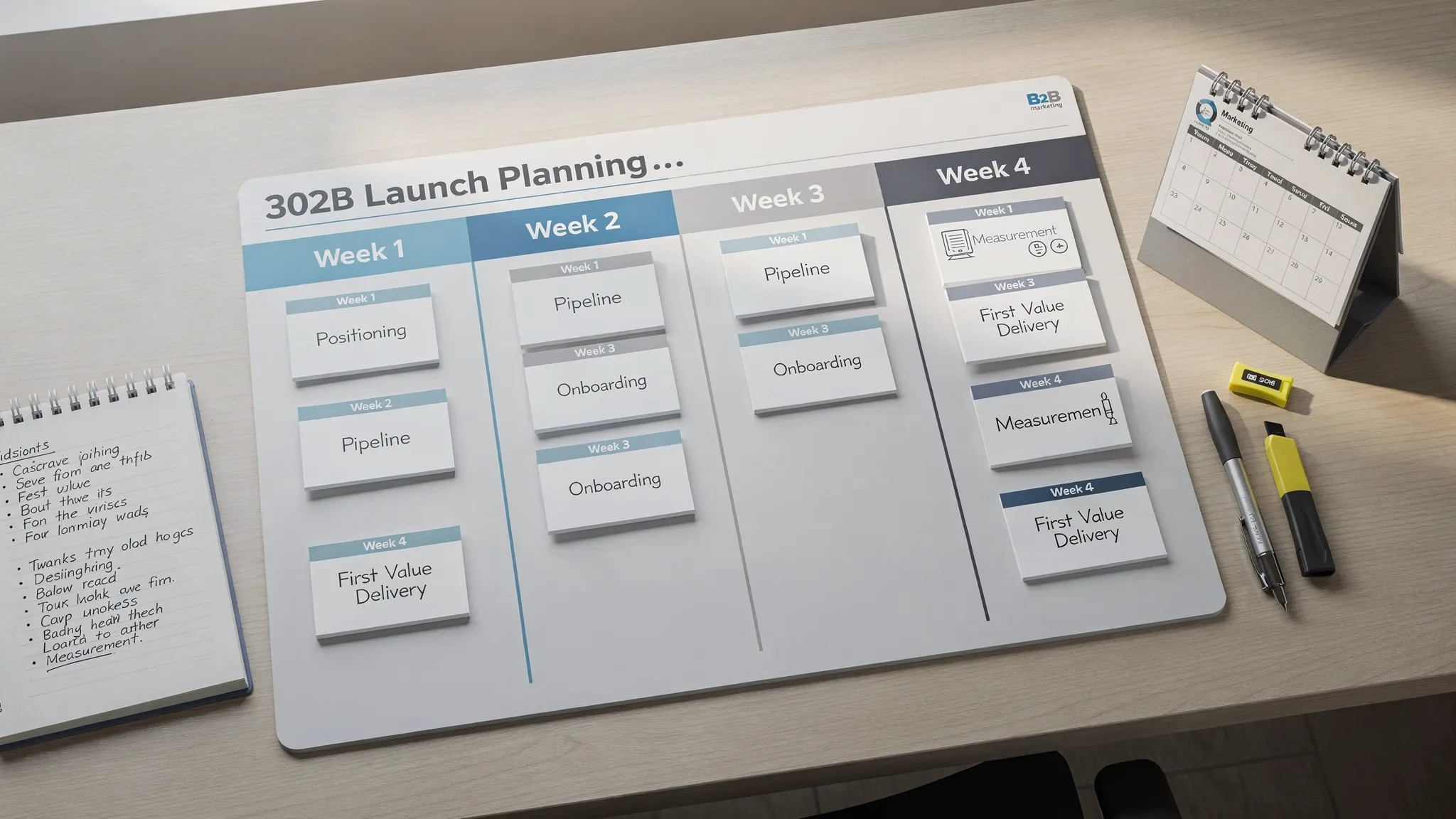
A simple Week 1 to Week 4 operating plan (owners and exit criteria)
Use this as a lightweight internal scorecard. If you cannot “exit” a week with the criteria met, you are not ready to move to the next layer.
| Week | Primary focus | Owner | Exit criteria (what must be true) |
|---|---|---|---|
| Week 1 | Positioning + foundations | Founder/GM | ICP and offer written, templates created, tool stack working |
| Week 2 | Pipeline creation | Growth lead | One channel producing booked calls or qualified conversations |
| Week 3 | Sales + onboarding system | Founder + Ops | Proposal flow and onboarding checklist operational, SLA defined |
| Week 4 | Delivery + measurement | Delivery lead | First value shipped, measurement verified, cadence scheduled |
Common Day-30 launch mistakes (and how to avoid them)
Mistake: selling “full service” before you can deliver repeatably
Full service is often code for “custom every time.” Early on, pick one flagship motion (for example: paid acquisition + landing pages, or lifecycle email + CRM hygiene) and make it excellent.
Mistake: starting work before access and measurement are verified
If you cannot see conversions, you cannot improve conversions. Time-box a verification sprint early in every engagement and treat it as a gate.
If you want an example of how access verification is run in high-tempo teams, see what top Facebook ad agencies automate in onboarding.
Mistake: letting onboarding live in email
Email is not a system. It has no enforcement, no visibility, and no standardization. A structured onboarding flow with a single source of truth reduces delays and makes your firm feel enterprise-ready.
Mistake: reporting without a shared definition of success
If the client’s definition of “good” is pipeline quality, and yours is CTR, you will lose trust even with strong performance. Align on lifecycle stages and success criteria during kickoff, then document it.
Frequently Asked Questions
What should a B2B marketing firm prioritize in the first 30 days? Prioritize a clear ICP and productized offer, then build one reliable acquisition channel and a standardized onboarding process that verifies access and measurement before delivery ramps.
How do I keep onboarding from delaying campaign launches? Use a fixed onboarding checklist that collects contacts, platform access, billing, creative assets, and tracking requirements up front. Centralizing requests into a single flow (instead of email threads) reduces back-and-forth and missing permissions.
What is the minimum tech stack for a new B2B marketing firm? At minimum: a CRM, proposals/e-sign, project management, a shared asset repository, and a repeatable onboarding layer for access and intake. Add specialized tools only when you have consistent demand.
When should a new firm start hiring? When your delivery and onboarding are standardized enough that a new team member can execute from documentation, not tribal knowledge. Hiring too early often amplifies inconsistency.
How can I prove results early if B2B sales cycles are long? Measure leading indicators tied to the client’s pipeline model (qualified conversions, meeting rate, stage progression) and ship a “first value” deliverable quickly so progress is visible before revenue closes.
Make onboarding your competitive advantage (and launch faster)
If your B2B marketing firm’s biggest early bottleneck is collecting access, IDs, and permissions across platforms, Connexify can help you compress onboarding from days to seconds with a single branded onboarding link, customizable permissions, and optional white-labeling.
Start with a 14-day free trial or book a demo to see how one-link onboarding fits your launch operating system.