Social Media Marketing Agency Services Breakdown
01/15/2026

Buying “social media marketing” can feel like buying “fitness.” Everyone agrees it’s valuable, but the actual work can range from a simple posting calendar to a full-funnel paid acquisition system with creative production, measurement, and governance.
This breakdown explains the most common social media marketing agency services, what you should expect to receive, what the agency will need from you (especially account access), and how to scope the right level of support without paying for work you do not need.
What “social media marketing” really includes in 2026
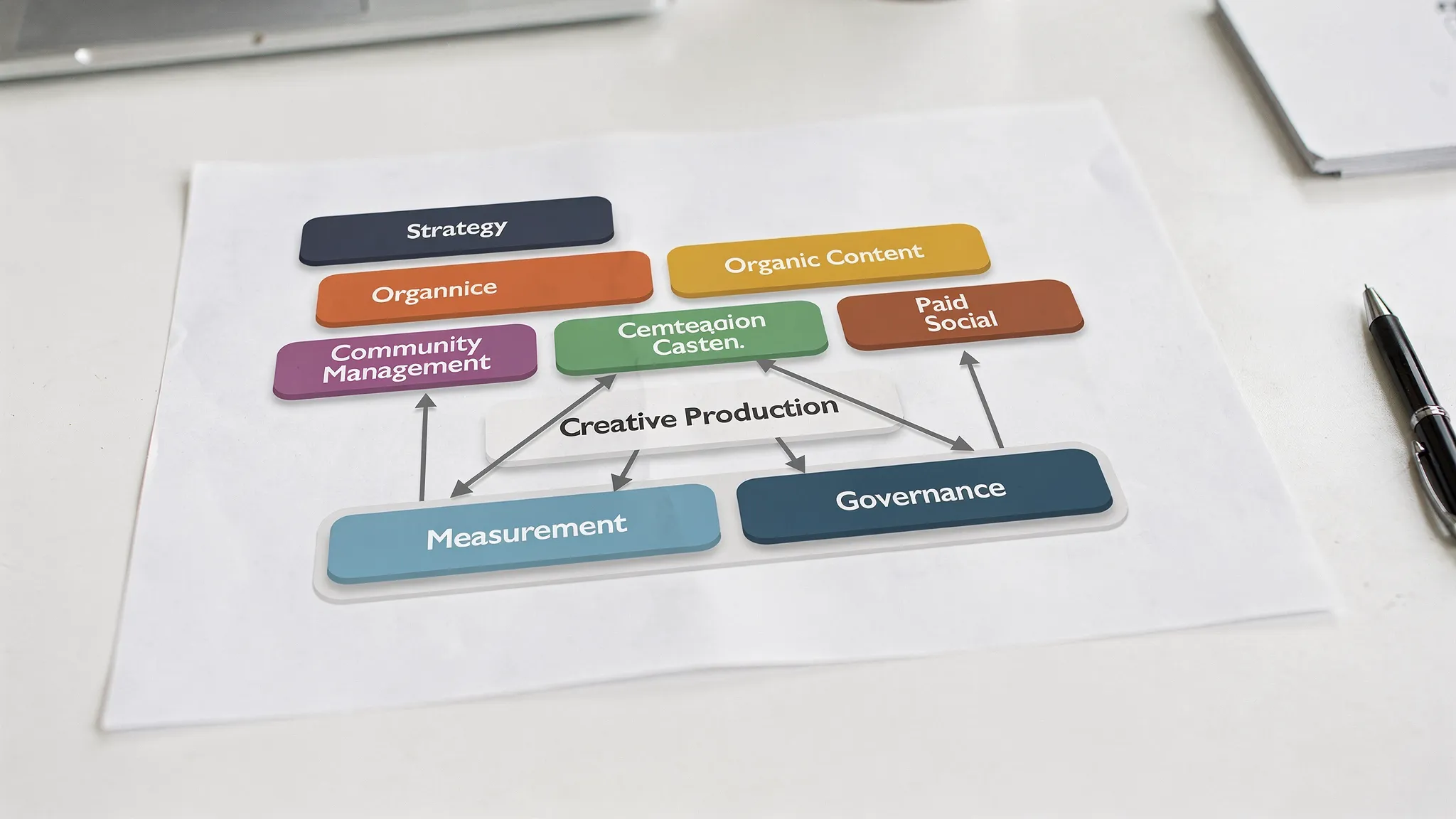
Social media is no longer just “posting.” For many brands, it is a mix of:
- Organic distribution (content, community, reputation)
- Paid distribution (ads, retargeting, prospecting)
- Creator-driven content (UGC, influencers, Spark Ads and whitelisting)
- Measurement (pixels, events, conversions APIs, incrementality thinking)
- Governance (permissions, approvals, brand safety, compliance)
Platform behavior also changes quickly. If you want a useful benchmark for how widely social platforms are used globally, DataReportal’s Digital reports are a strong starting point for context and trends.
Social media marketing agency services (core categories)
Most agencies bundle services, but they usually map to the same set of building blocks. The best way to evaluate an agency is to ask, “Which building blocks are included, and what outputs do we get every month?”
1) Strategy and planning
This is the foundation that prevents random acts of posting.
What you should expect: positioning for social, audience and channel priorities, content pillars, tone of voice, competitive scan, and a 30 to 90 day plan that matches your sales cycle.
What the agency needs from you: brand guidelines, product/service priorities, target customer definitions, and historical performance data if you have it.
Good signs: the strategy includes a clear “definition of done,” a testing plan, and a measurement plan that goes beyond vanity metrics.
2) Organic content management
Organic is still critical for trust, customer education, and demand capture (people checking your profile after seeing an ad, a podcast, or a referral).
What you should expect: a content calendar, post production (often templates plus brand-specific design), captions, publishing, and performance review.
What the agency needs from you: brand assets (logos, fonts, existing photos and videos), access to your profiles, and an approval workflow (who signs off, how fast).
Common gap: “content creation” can mean anything. Clarify whether the agency is producing net-new photo/video, repurposing what you already have, or designing from templates.
3) Community management and social customer care
For many brands, comments and DMs are not a “nice to have.” They are customer support and sales.
What you should expect: moderation, response guidelines, escalation rules, spam management, and optionally inbox management (DM triage).
What the agency needs from you: escalation contacts, FAQs, refund and complaint policies, and clarity on what the agency can and cannot say on your behalf.
4) Paid social (campaign management)
Paid social is where many agencies drive measurable pipeline or ecommerce revenue, but only if the account structure, creative, and tracking are solid.
What you should expect: campaign builds, audience strategy, creative testing plan, budget pacing, weekly optimization notes, and a consistent reporting rhythm.
What the agency needs from you: access to ad accounts, pixels/events, product catalog (if ecommerce), landing pages, and conversion definitions.
Note on safe access: most major ad ecosystems support partner access and role-based permissions. For example, Meta documents business asset access and partner sharing in its Meta Business Help Center. You should rarely need to share passwords.
5) Creative production (static, video, motion)
Creative is often the bottleneck. Great targeting cannot save weak messaging or poor hooks.
What you should expect: creative briefs, concepts, iterations, and production aligned to placements (Reels, Stories, TikTok, feed, etc.). Some agencies also run creative “sprints” and testing pipelines.
What the agency needs from you: brand do’s and don’ts, offers and differentiators, customer proof (reviews, case studies), and fast approvals.
Important scoping detail: ask whether edits and variants are included. Performance creative requires volume and iteration.
6) Measurement and analytics
This is where “activity” turns into business outcomes.
What you should expect: KPI definitions, tracking QA (pixels, events, UTMs), reporting dashboards or monthly reporting packs, and insight narratives that inform next actions.
What the agency needs from you: access to analytics (GA4 or equivalent), ad accounts, tag managers, and clarity on how leads or revenue are counted downstream.
7) Governance, security, and account hygiene
Governance is often invisible until something breaks, then it becomes the whole project.
What you should expect: a permissions model (least privilege), account ownership clarity (client-owned assets where possible), documentation of IDs and key settings, and an onboarding and offboarding process.
What the agency needs from you: a list of admins, who owns what, and confirmation of compliance requirements (regulated industries, HIPAA, financial promotions, etc.).
A practical “deliverables vs inputs” table
Use the table below to sanity-check scope. If an agency promises an output but does not request the inputs needed to do it, you are likely heading toward delays.
| Service area | Typical deliverables you can ask for | What the agency typically needs from you | Early success signal (first 2 to 4 weeks) |
|---|---|---|---|
| Strategy | Channel plan, content pillars, testing roadmap | Brand guidelines, goals, past results | A prioritized plan with clear KPIs and owners |
| Organic management | Calendar, posts, publishing, monthly insights | Profile access, assets, approvals process | Consistent publishing cadence and iteration notes |
| Community management | Response playbook, moderation, escalation flow | FAQs, escalation contacts, policy boundaries | Faster response times and fewer unresolved threads |
| Paid social | Campaign builds, optimizations, reporting cadence | Ad account access, pixel/events, landing pages | Clean tracking, stable delivery, clear test plan |
| Creative production | Concepts, variants, production schedule | Proof, offers, brand constraints, feedback SLAs | Volume of testable assets and learning velocity |
| Measurement | QA checklist, KPIs, reporting pack/dashboard | Analytics access, CRM or lead data definitions | Fewer attribution gaps, consistent source tagging |
| Governance | Permission templates, asset inventory, documentation | Ownership clarity, admin list, compliance needs | Reduced access-related blockers and faster launches |
Common “add-ons” (when they are worth paying for)
Many teams do not need every add-on on day one. Add these when your core engine is stable.
Influencer and creator partnerships
Best when you have a clear offer, a repeatable brief, and a process to turn creator output into paid amplification.
Ask whether the agency handles contracting, usage rights, whitelisting, and brand safety review.
Social listening and reputation monitoring
Useful for larger brands, regulated industries, or businesses where sentiment and customer care drive retention. It can also help content teams find themes that resonate before spending on production.
Social commerce and catalog-based systems
If you are ecommerce, you may need product catalog management and feed health checks (especially for dynamic ads and shop experiences).
Training and enablement
Some organizations want the agency to build the system, then train an internal team to run it. If that is your goal, ask for documentation, playbooks, and “handoff-ready” processes.
How social media agency services are typically priced (and what changes the cost)
Pricing depends less on “how many platforms” and more on operational load: creative volume, ad spend complexity, approval cycles, and reporting requirements.
| Pricing model | Best for | What to watch out for | How to protect yourself |
|---|---|---|---|
| Monthly retainer | Ongoing management, continuous testing | Vague deliverables, unclear creative volume | Demand a deliverables list and review cadence |
| Project-based | One-time launch, audit, content sprint | No continuity, learning gets lost | Add a transition plan or optional ongoing phase |
| Performance or rev-share | Clear attribution and mature tracking | Misaligned incentives, attribution disputes | Define attribution rules and data sources upfront |
| Hybrid | Most scaling teams | Complexity in scope management | Use tiered packages with explicit inclusions |
What a strong SOW includes (so there are no surprises)
If you want fewer surprises, your statement of work should be specific about:
- Outputs: how many posts, how many creative concepts, how many ad variants, how often reporting happens
- Ownership: client owns accounts and assets, agency gets partner access, clear offboarding steps
- Approval SLAs: how fast you provide feedback, and what happens if approvals stall
- Measurement responsibility: who owns pixels/events, landing page QA, UTMs, and conversion definitions
- Communication cadence: weekly async updates, weekly calls, monthly reviews (whatever fits your team)
This matters because delays are rarely strategic. They are usually operational, missing access, slow approvals, or unclear responsibilities.
The hidden bottleneck: access and onboarding
Even excellent agencies lose momentum if onboarding is messy. In practice, “we start next week” turns into “we are waiting on access” across five different platforms.
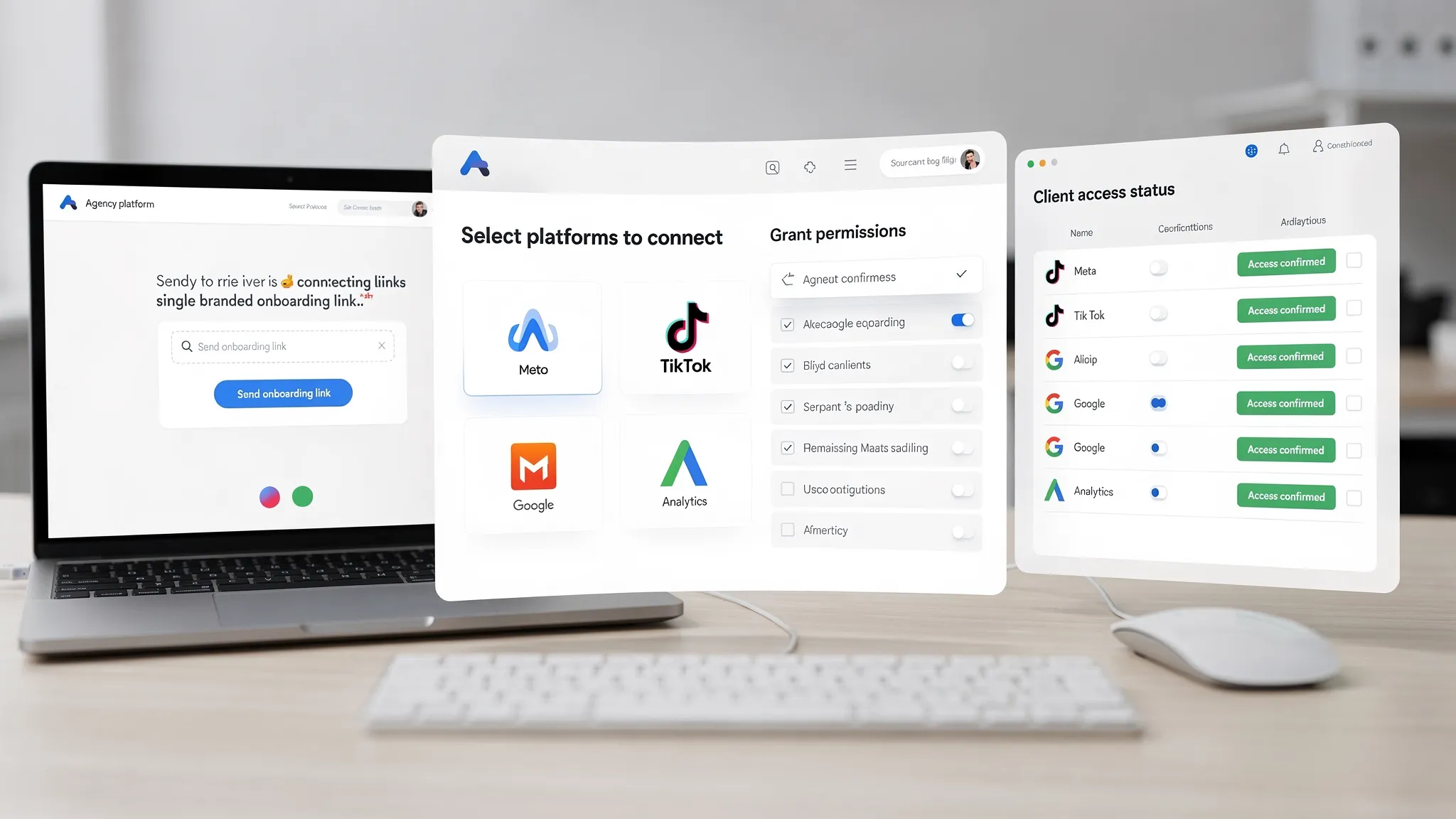
If you want faster time-to-first-campaign (or time-to-first-post), ask the agency to show you their onboarding flow. The best ones have:
- A standardized intake process
- A secure method to request access with least-privilege permissions
- A clear checklist of required IDs and assets
- A way to track completion status without chasing emails
If you are an agency building this system, Connexify is designed specifically for that: one-link client onboarding with a branded experience, multi-platform support, customizable permissions, and API/webhook integrations. (No installation required.)
To see what a standardized onboarding playbook can look like, you can also reference Connexify’s more process-heavy guide: Social Media Agency Onboarding: A Step-by-Step Playbook.
How to choose the right service mix (quick decision guide)
Choose your service mix based on your constraint:
- If you lack a clear message, start with strategy plus creative concepts.
- If you have strong content but weak distribution, add paid social.
- If you are getting attention but not leads or revenue, prioritize measurement and landing page alignment.
- If execution is slow and stressful, invest in governance and onboarding rigor.
A practical way to reduce risk is to run a 30-day pilot with explicit success criteria, then expand scope once access, approvals, and reporting are stable.
Frequently Asked Questions
What are the main social media marketing agency services? The core categories are strategy, organic content management, community management, paid social, creative production, measurement/reporting, and governance (permissions, ownership, compliance). Most agency packages are bundles of these building blocks.
What should I ask a social media agency before signing? Ask for a deliverables list, examples of reporting, how creative iteration works, who owns measurement, and a walkthrough of their onboarding process (how they request access, how they handle permissions, and how they track completion).
Do I need organic and paid social, or can I choose one? You can choose one, but they reinforce each other. Organic builds trust and proof, paid drives consistent reach and testing. Many teams start with one based on their immediate constraint, then add the other once foundations are stable.
How long does it take to start campaigns after hiring an agency? It depends on access, approvals, and tracking readiness. If account access and assets are ready, initial launches can happen quickly. If access is scattered across platforms and handled manually, onboarding often becomes the main delay.
Should I share passwords with an agency? In most cases, no. Use platform-native partner access and role-based permissions whenever possible, and keep ownership of business assets on the client side.
What deliverables should be included in a monthly retainer? At minimum, you should see planned outputs (posts and creative, or campaign and testing plan), execution, and a recurring performance review with next actions. The exact deliverables should match your goals and channels.
Make onboarding the advantage, not the delay
If you are an agency selling social media services, your fastest way to improve client experience is to remove onboarding friction. Connexify helps you do that with a single, branded onboarding link that can streamline secure access setup across platforms, with customizable permissions, white-label options, and integrations via API and webhooks.
Explore Connexify and start a 14-day free trial at Connexify. If you want to see how it fits your onboarding flow, you can also book a demo.