Social Media Agency Marketing: A Simple Playbook
01/09/2026

Most social media agencies do not struggle because they lack tactics. They struggle because their marketing is not a system.
A simple playbook fixes that. It helps you answer three questions with confidence:
- Who do we win for?
- What do we do (and not do)?
- How do we consistently create demand, close deals, and deliver fast enough to keep trust?
This guide is built for agency owners and operators who want a straightforward, repeatable approach to social media agency marketing, without turning their business into a content mill or a discount shop.
1) Start with an ICP you can describe in one sentence
“Everyone who needs social media” is not an ICP, it is a hope.
A usable ideal customer profile (ICP) has constraints. Constraints make marketing easier because they narrow your messaging, your proof, your offer, and your channels.
A practical one-sentence ICP includes:
- Buyer (role and seniority)
- Company type (industry and business model)
- Trigger (why now)
- Outcome (what success looks like)
Example: “VP Marketing at a B2C subscription brand that just raised Series A, needs paid social to scale profitably and clean attribution to report to the board.”
To make this concrete, here are a few ICP patterns that tend to produce cleaner positioning and faster sales cycles.
| ICP pattern | “Why now” trigger | What they usually buy | What they need to believe to hire you |
|---|---|---|---|
| Local multi-location services (dental, medspa, home services) | New location, competitor pressure | Always-on content + lead gen | You can generate leads without brand risk |
| Ecommerce / DTC | Plateaued ROAS, rising CAC | Paid social + creative testing | You can produce a testing cadence that finds winners |
| B2B SaaS | Pipeline gap, new GTM motion | LinkedIn + paid social for demand | You understand long sales cycles and targeting constraints |
| Creator-led brands | Founder visibility spike | Social + shop integration + ads | You can move fast without breaking governance |
Your goal is not to pick the perfect niche forever. Your goal is to pick a niche that makes the next 90 days of marketing obvious.
2) Choose a single primary promise (and a measurable proxy)
Great agency marketing is specific. Clients want outcomes, but outcomes can lag. So you need:
- A primary promise (the outcome you aim for)
- A proxy metric (what you can improve quickly and report weekly)
Examples:
- Promise: “Scale Meta spend profitably.” Proxy: “Increase creative testing velocity and stabilize tracking.”
- Promise: “Increase qualified leads for a local brand.” Proxy: “Improve lead quality and appointment show rate.”
- Promise: “Launch and learn in 14 days.” Proxy: “Time-to-first-campaign and first data signal.”
This matters because your promise becomes your homepage headline, your cold outreach angle, your case study structure, and your onboarding plan.
3) Package your offer like a product (not a custom project)
Prospects buy clarity. Operators deliver systems.
When your services are packaged, you can:
- Sell faster (fewer custom calls)
- Onboard faster (repeatable inputs)
- Deliver more consistently (standard operating rhythm)
A simple way to productize is to define three layers: Launch, Operate, Scale.
| Package layer | What the client gets | What you standardize internally | Best for |
|---|---|---|---|
| Launch (fixed scope) | Audit, access setup, tracking checks, first campaign plan | Intake fields, permission templates, QA checklist | New clients, rescues, migrations |
| Operate (retainer) | Weekly testing cadence, reporting, creative pipeline | Meeting cadence, reporting format, test log | Stable accounts with predictable needs |
| Scale (expansion) | New channel rollout, CRO/landing support, extra creative | Playbooks by channel, governance rules | Accounts that proved product-market fit |
Two practical rules keep packaging honest:
- Ship a deliverable in the first 7 days (even if it is a clear measurement readout or a prioritized action plan).
- Define what you need from the client as a bill of materials (assets, access, approvals, constraints). If you do not define inputs, you will absorb chaos.
Connexify’s blog has deeper onboarding and packaging guidance if you want to operationalize the “inputs” side, for example in Packaging Digital Marketing Services With Frictionless Onboarding.
4) Build a proof library that matches how buyers decide
Most agencies have “proof.” Few have proof that maps to a buyer’s questions.
A good proof library answers:
- Can you solve my kind of problem?
- Can you do it without putting my brand at risk?
- Can you do it fast enough that we do not lose momentum?
Instead of chasing vanity awards, build reusable assets you can attach to proposals and send in follow-ups.
Here is a proof set that works for most social media agencies:
- One-page case studies with: starting point, constraints, actions, results, time window
- Two-minute teardown videos (Loom style) of how you would approach an account (with sensitive info removed)
- Process screenshots: reporting format, creative test backlog, naming conventions
- Risk controls: how you handle access, approvals, and brand safety
If you run paid social, also maintain a lightweight “measurement credibility” artifact. Buyers increasingly care about how you track, not just what you claim. Official docs are worth linking in your materials (and in client comms) so stakeholders trust the setup, for example the Meta Business Help Center and the TikTok Business Help Center.
5) Pick two acquisition channels and commit for 90 days
Agencies often spread themselves thin across five channels and master none.
For a simple playbook, pick:
- One outbound channel (direct control)
- One inbound channel (compounding)
Common channel pairs that work
Outbound examples:
- Founder-led LinkedIn outbound to a narrow ICP
- Warm outreach via partnerships (web dev shops, email agencies, studios)
- Reactivation of your past client list and “lost deal” list
Inbound examples:
- “Proof-first” content (case studies, teardowns, benchmark posts)
- A webinar or workshop tailored to one ICP
- A niche landing page + lead magnet (audit checklist, budget calculator)
To decide quickly, use a simple fit test.
| Channel | Best when | Weak when | What you need to be consistent |
|---|---|---|---|
| LinkedIn outbound | You have clear ICP and offer | You pitch generic services | A tight list, 1 angle, daily habit |
| Partnerships | You can share revenue or exchange leads | You cannot define your best-fit clients | A partner kit + clear referral process |
| Content (case studies/teardowns) | You have real work to show | You publish generic tips | Editing discipline + distribution |
| Paid lead gen | You can convert quickly and track CAC | You need long education cycles | Strong funnel + fast onboarding |
The “secret” is not which channel you choose. It is whether your offer, proof, and follow-up system match the channel.
6) Tighten the sales journey (and reduce decision anxiety)
Social media services feel risky to buyers because outcomes are uncertain and platforms change.
Your sales process should reduce uncertainty by making three things explicit:
- Scope (what you will do, what you will not do)
- Cadence (how decisions happen weekly)
- Governance (how access, approvals, and accountability work)
A simple sales journey that converts well for agencies:
The diagnostic call (not a demo)
You are not selling “social media.” You are diagnosing constraints.
High-signal questions:
- What changed in the last 60 days that made this urgent?
- What is your current bottleneck (creative, tracking, budget, approvals, offer)?
- Who has to approve spend, creative, and claims?
- What would make this a win in 30 days (not 12 months)?
The proposal: show the plan, not the platform
Strong proposals include:
- A short “what we heard” section
- A 30-day plan with weekly milestones
- A clear list of client responsibilities (approvals, access, creative inputs)
- A measurement and reporting definition (what you will track and why)
The close: make the first week feel safe
Buyers hesitate when they imagine a messy kickoff.
If you want to increase close rate without discounting, add an operational promise like:
- “We can verify access and tracking within 48 hours of signature, assuming the client completes the intake.”
That line only works if your onboarding is actually engineered.
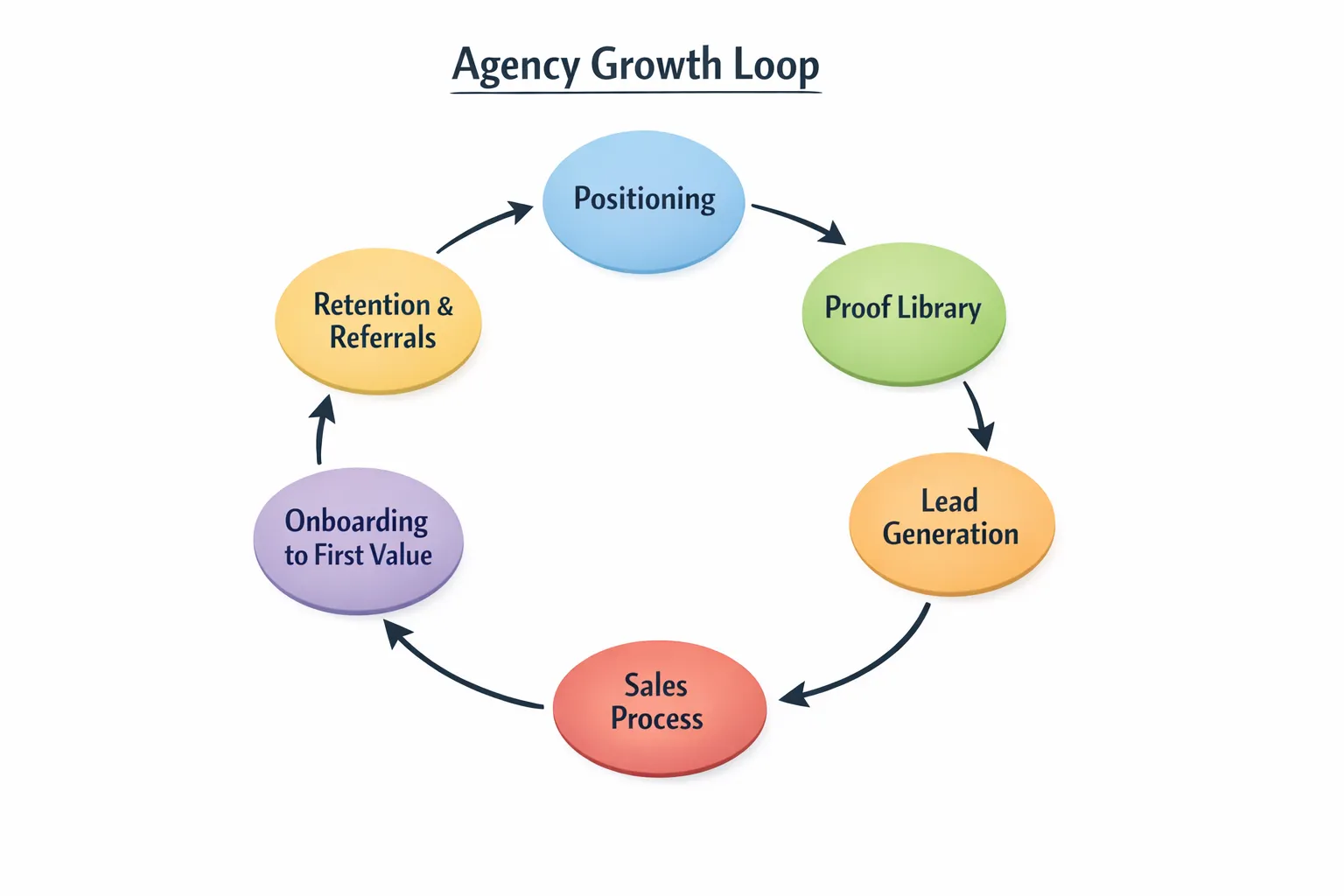
7) Treat onboarding as marketing (because it is)
Most agencies think marketing ends at signature. Clients think the opposite.
The moment money changes hands, your client is watching for proof that they made a good decision. If onboarding is slow, fragmented, or insecure, confidence drops and churn risk rises.
Operationally, onboarding is where social media agencies lose the most time:
- Waiting on ad account, Page, Business Center access
- Chasing asset IDs across email threads
- Getting blocked by permission confusion
- Repeating the same “how to grant access” instructions per platform
From a marketing lens, fast onboarding creates a differentiator you can actually sell:
- Faster time-to-first-campaign
- Fewer errors and fewer awkward “can you resend that?” moments
- More trust (because you handle access securely and consistently)
If you want to see what “standardized onboarding” looks like for social media agencies, Connexify has a dedicated playbook in Social Media Agency Onboarding: A Step-by-Step Playbook.
Where Connexify fits (without changing your stack)
Connexify is built to streamline client onboarding for agencies and service providers, especially the access and permissions layer across platforms.
Used well, it helps you turn onboarding into a branded, trackable workflow:
- One-link client onboarding so clients do not have to navigate scattered instructions
- Branded onboarding experience (and white-label options) to reinforce trust
- Support for multiple platforms so your process is consistent across channels
- Customizable permissions to keep access least-privilege by default
- API and webhook integrations to hand off data to your CRM, PM tool, or internal workflows
If your agency is scaling, even small improvements here compound because every new client repeats the same steps.
You can explore the product at Connexify and, if it fits your workflow, use the 14-day free trial to validate whether it reduces time-to-first-value.
8) Run a simple marketing scoreboard (so you know what to fix)
Marketing feels chaotic when you cannot see where the system leaks.
A simple scoreboard turns “we need more leads” into a precise diagnosis.
| Funnel area | Metric | How to calculate it | What it tells you |
|---|---|---|---|
| Demand creation | Qualified conversations started | Count per week | Whether your channel output is sufficient |
| Conversion | Discovery to proposal rate | Proposals sent / discovery calls | Whether your positioning and call quality fit |
| Conversion | Close rate | Deals won / proposals sent | Whether your offer and proof reduce risk |
| Speed | Sales cycle length | Days from first call to signature | Whether stakeholders and scope are clear |
| Delivery | Time to first value | Days from signature to first shipped deliverable | Whether onboarding and ops match your promise |
| Retention | Net revenue retention (NRR) | (Start MRR + expansion − churn) / start MRR | Whether your delivery creates durable value |
The key is to review this weekly, not monthly. If “time to first value” is slipping, your marketing will eventually pay the price through churn, referrals drying up, and reviews getting softer.
A 30-day rollout plan (simple, not perfect)
You can implement this playbook without a rebrand, a new website, or a new CRM.
Week 1: Pick focus and rewrite your core message
- Finalize your one-sentence ICP
- Write your primary promise + proxy metric
- Update your homepage hero, LinkedIn headline, and your primary outbound message
Week 2: Package and proof
- Define Launch, Operate, Scale scopes
- Turn one recent win into a one-page case study
- Build a “how we work” one-pager (cadence, approvals, reporting)
Week 3: Choose channels and start producing signal
- Start a daily outbound habit (small, consistent)
- Publish one teardown or case study post and distribute it
- Add a simple lead capture offer (audit or benchmark) tied to your ICP
Week 4: Tighten sales and onboarding together
- Standardize your discovery agenda
- Standardize proposal format
- Reduce onboarding friction so you can credibly promise fast time-to-first-value
If you want a practical guide to streamlining the onboarding side (especially client access), Connexify’s overview in How Digital Marketing Agencies Streamline Client Onboarding is a strong companion to this marketing playbook.
The simplest competitive advantage: speed you can prove
Most agencies compete on taste, tactics, or price. The durable advantage is a system that creates trust quickly.
When your marketing promise, sales process, and onboarding reality line up, prospects feel it. Deals close faster, clients ramp sooner, and referrals become a predictable channel.
If you want to operationalize that last mile, you can try Connexify’s one-link onboarding approach at connexify.io or book a demo to see whether it fits your agency workflow.