Online Marketing Service: Scope, Pricing, and SLAs
01/13/2026
Buying an online marketing service should not feel like gambling on what you will actually get, how much it will cost once “extras” show up, or how long it will take before anything goes live. Most bad engagements fail for predictable reasons: unclear scope, mismatched pricing expectations, and SLAs that measure the wrong things.
This guide breaks down what “online marketing service” typically includes, how pricing usually works, and which SLAs matter if you care about speed to value and predictable delivery. It is written for agency operators, founders, and client-side marketing leads who need clarity before signing.
Scope: what an online marketing service should include
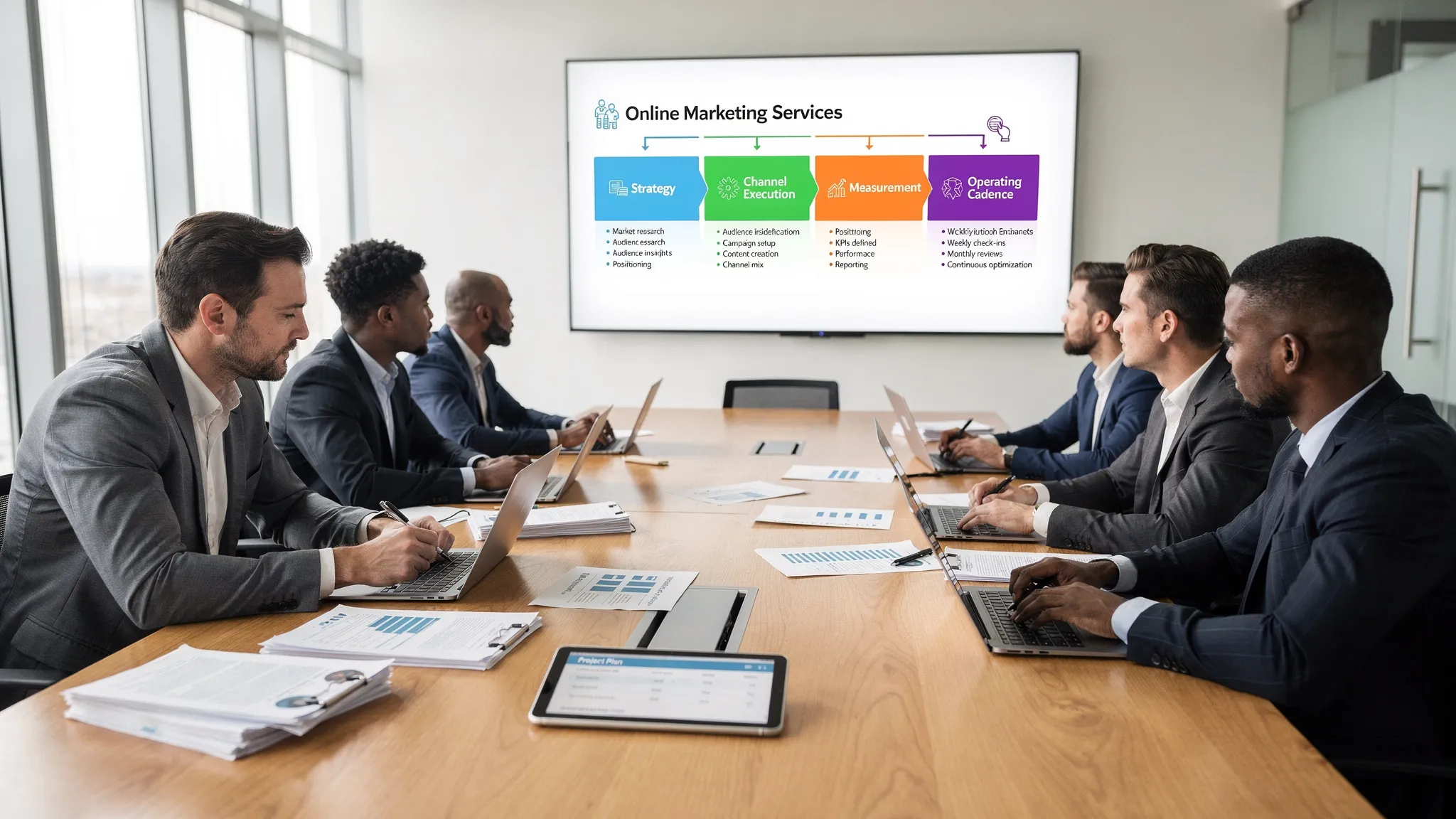
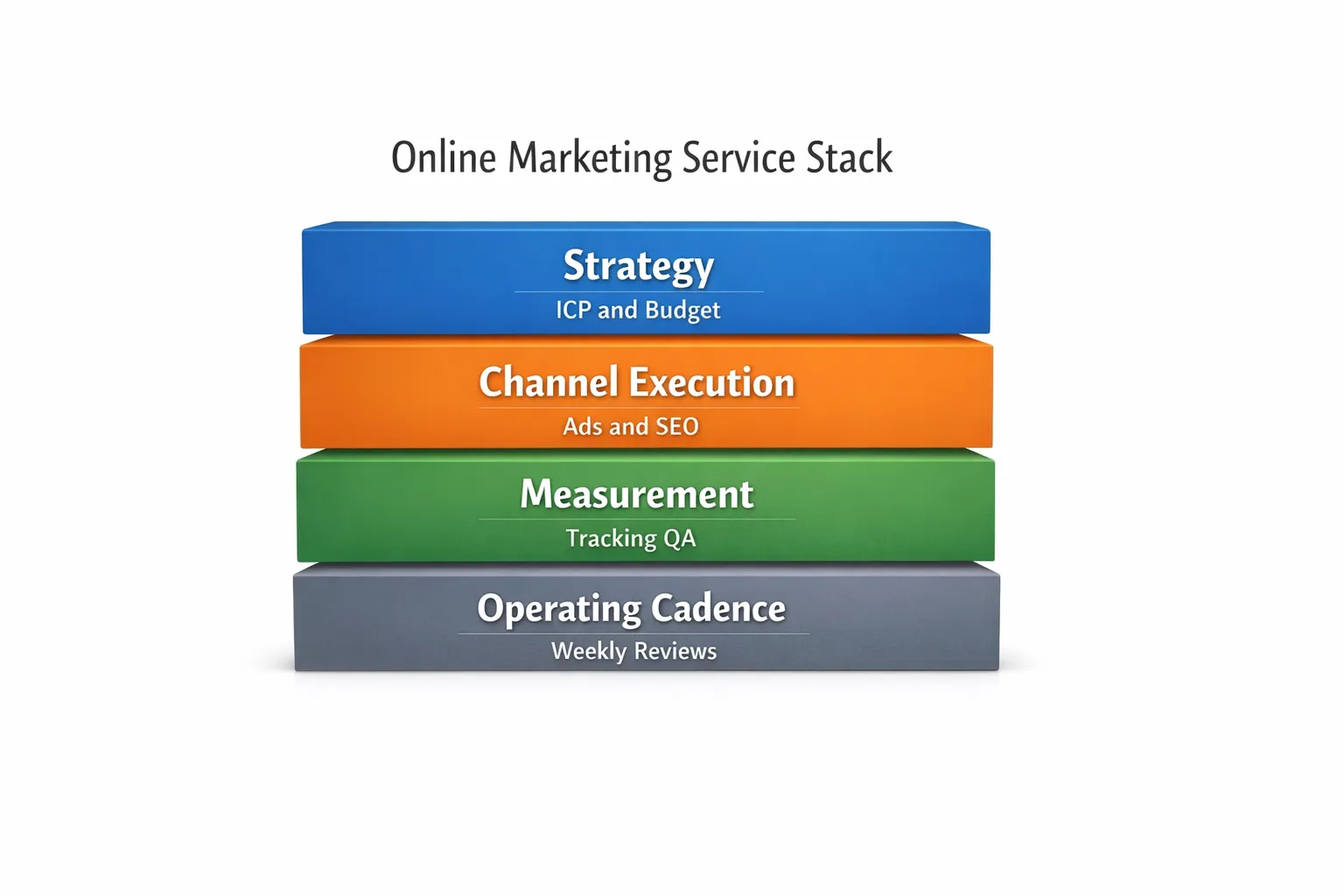
“Online marketing service” is an umbrella term. In practice, strong providers define scope across four layers: strategy, execution, measurement, and operating cadence. If a proposal only lists channels (SEO, PPC, paid social) without specifying deliverables, inputs, and timelines, you are buying ambiguity.
The four layers of scope
1) Strategy and planning
At minimum, you should see:
- Positioning and ICP assumptions (what you are selling, to whom, and why you win)
- Channel plan (what channels you will run, and why)
- Budget allocation logic (what spend goes where and what has to be true for it to work)
- A measurable “definition of done” for the first 30 to 90 days
2) Channel execution (the work people expect)
This is where providers differ most. Execution scope typically includes a subset of:
- Paid search (Google Ads, Microsoft Advertising)
- Paid social (Meta, TikTok, LinkedIn)
- SEO (technical, on-page, content)
- Content production (blogs, landing pages, ad creative)
- Email and lifecycle (newsletters, drip campaigns)
- CRO (landing page tests, funnel improvements)
3) Measurement and instrumentation (the work that makes results real)
This is often under-scoped, then becomes the source of conflict. Common measurement deliverables:
- Tracking plan (events, conversions, attribution assumptions)
- Tagging and analytics setup (GA4, GTM, pixels)
- QA and verification (test conversions, deduplication, domain verification)
- Reporting (dashboards, commentary, decisions)
4) Operating system (how delivery happens)
A professional engagement clearly defines:
- Meeting cadence (kickoff, weekly, monthly)
- Approvals and turnaround expectations
- Escalation path for blockers
- Who owns what (client vs provider)
The best way to pressure-test scope is to ask a simple question: “What has to be true for us to launch something measurable, and who does each step?”
A practical scope matrix you can use
Use this table to compare proposals and catch “missing layers” early.
| Scope area | Typical deliverables | Client inputs required | Common exclusions to clarify upfront |
|---|---|---|---|
| Strategy | ICP hypothesis, channel plan, initial roadmap | Access to prior results, product info, constraints | Sales enablement, full GTM repositioning |
| Paid media | Campaign builds, audience setup, ads, ongoing optimization | Ad account access, billing, creative approvals | Creative production, landing pages, CRM fixes |
| SEO | Technical audit, keyword map, on-page plan, content briefs | CMS access, dev resources, brand guidelines | Full site rebuild, copywriting at scale |
| Content | Editorial calendar, drafts, publishing workflow | SME reviews, brand tone, legal approvals | Design, subject matter research beyond brief |
| Flows, segmentation, copy, performance tracking | ESP access, lists, consent policy | Deliverability remediation, list acquisition | |
| Measurement | Tracking plan, GA4/GTM configuration, QA | Admin access, domains, consent requirements | Full data warehouse, offline conversion pipelines |
| Reporting | Weekly metrics, monthly insights, next actions | KPI definitions, attribution agreement | Executive dashboards with custom BI builds |
If your provider cannot fill this in without hand-waving, pricing and SLAs will be unreliable.
Pricing: what you are paying for (and what you are not)
There is no universal price list for an online marketing service because cost is driven more by operational complexity than by channel names. Two companies can both “run paid social,” but one requires multilingual creative, strict compliance review, offline conversion uploads, and multiple business units.
That said, most pricing falls into a few recognizable models.
Common pricing models (and when each fits)
| Pricing model | What it is | Best for | Watch-outs |
|---|---|---|---|
| Monthly retainer | Fixed monthly fee for a defined scope | Ongoing management across channels | Scope creep unless deliverables and volumes are explicit |
| Project / setup fee | One-time fee (audit, build, migration, tracking setup) | Clean starts, rebuilds, technical work | Can hide “implementation debt” if not paired with ongoing ops |
| % of ad spend | Fee scales with media budget | Large spends with stable operations | Incentive misalignment if spend grows without added complexity |
| Performance-based | Pay tied to leads, revenue, or ROAS | Mature tracking and clear attribution | Disputes if measurement is weak or sales process is inconsistent |
| Hybrid | Retainer + performance bonus or retainer + setup | Most modern engagements | Needs clear definitions for bonus triggers and exclusions |
A proposal should always separate:
- Service fees (what the provider earns)
- Media spend (what you pay platforms like Google or Meta)
- Third-party tools (reporting, call tracking, creative tools)
If those are blended into one number, you will struggle to evaluate value.
The real pricing drivers buyers miss
When two providers quote very different fees for “the same” online marketing service, the spread typically comes from these factors:
Channel count and asset sprawl
Each platform has its own access model, permissions, and verification steps. Multi-platform work multiplies onboarding and governance time unless it is standardized.
Creative volume and approval complexity
One ad concept per month is not the same as weekly testing across multiple formats, angles, and landing pages.
Measurement maturity
If you need clean conversion tracking, server-side events, deduplication, and offline conversion imports, the labor is real. Without it, “performance pricing” is mostly a narrative.
Speed requirements
A 72-hour launch expectation usually costs more than a two-week launch, not because the work changes, but because the provider must reserve capacity and enforce faster client-side approvals.
Compliance, privacy, and security constraints
Regulated industries (health, finance) and privacy-conscious implementations require additional process, documentation, and approval gates.
A pricing sanity check (buyer-side)
Before you accept a price, ask for these three clarifications in writing:
- Volumes: how many campaigns, ads, landing pages, or content pieces per month are included?
- Inputs: what do you need from your team, and by when, to avoid delays?
- Change control: what counts as out-of-scope, and how is it priced?
This keeps pricing honest because it ties cost to throughput.
SLAs: what to demand if you want predictable delivery
Many marketing SLAs are either meaningless (“we will do our best”) or disconnected from what causes delays (access, approvals, missing IDs, tracking not verified). A good SLA focuses on responsiveness, turnaround, launch readiness, and governance, not just report dates.
SLA vs KPI (do not mix them up)
- KPIs measure outcomes (CAC, ROAS, pipeline, rankings).
- SLAs measure service performance (response time, turnaround, time to launch).
A provider can meet an SLA and still miss KPIs if the offer is weak or the market shifts. Conversely, if SLAs are not met, KPIs become almost impossible to trust.
High-signal SLAs for an online marketing service
Use this as a starting point when negotiating.
| SLA category | What to define | Example target (adjust to your reality) | Why it matters |
|---|---|---|---|
| Communication | Response time during business hours | 1 business day | Prevents silent stalls and unclear ownership |
| Execution | Turnaround on standard tasks (edits, new ads, keyword adds) | 2 to 5 business days | Predictable throughput beats “hero mode” |
| Reporting | Reporting cadence and commentary depth | Weekly snapshot + monthly insights | Keeps decisions tied to data, not opinions |
| Creative approvals | Review windows for client approvals | Client approves within 2 business days | Most delays are approval delays, not marketing work |
| Launch readiness | Time-to-first-launch after prerequisites are met | 5 to 10 business days | Connects onboarding to real delivery |
| Security and access | Named-user access, least privilege, auditability | Enforced from day one | Reduces risk and future account chaos |
If you only take one thing from this article: SLAs should explicitly include what happens before “marketing” starts.
The onboarding SLA that drives everything: time-to-verified-access
In real engagements, the first bottleneck is not strategy or optimization. It is getting correct access to the right accounts, with the right permissions, without password sharing, then verifying tracking actually works.
That is why high-performing agencies increasingly define a single foundational SLA:
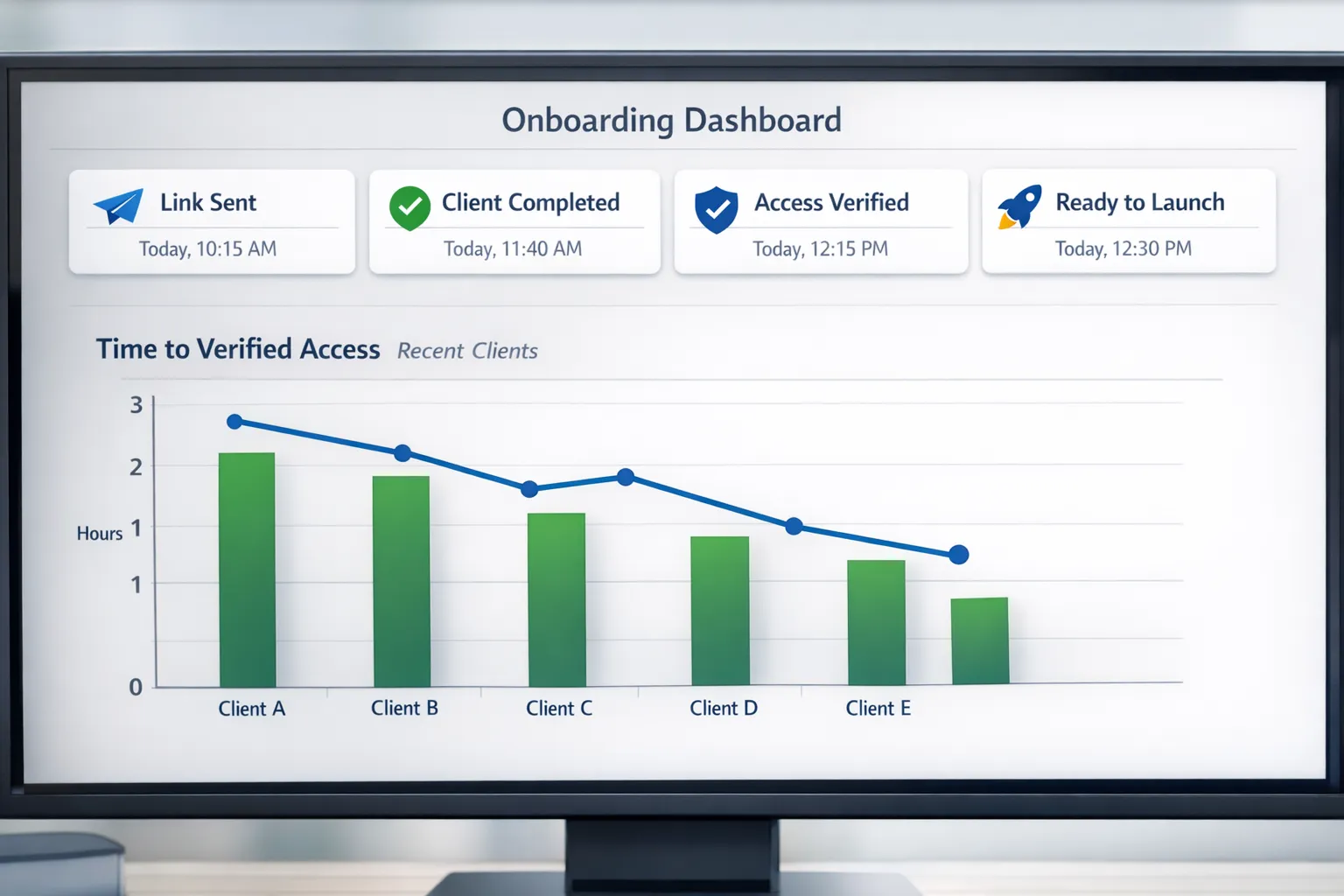
Time-to-verified-access: the elapsed time from sending onboarding instructions to confirming correct access and a working measurement baseline.
A practical time-to-verified-access SLA
You can adapt this language for statements of work.
| Step | Owner | SLA target | Acceptance criteria |
|---|---|---|---|
| Onboarding link sent | Provider | Same business day as contract signature | Client receives branded instructions and checklist |
| Access requests completed | Client | 24 to 48 hours | Partner/admin access granted for required platforms |
| Verification sprint | Provider + Client | Scheduled within 1 to 2 business days | Access confirmed, conversions tested, blockers logged |
| “Ready to launch” status | Provider | Same day as verification | Tracking plan confirmed, billing validated, approvals path set |
Two important notes:
- This SLA must include client responsibilities (approvals, IDs, 2FA, domain access). Otherwise it becomes unenforceable.
- Your provider should have a standardized access checklist per service package so you are not inventing requirements during kickoff.
For platform-specific access guidance, official docs like Meta Business Help and Google Ads access and security resources can clarify roles and permission models, but you still need a workflow to operationalize them.
How to operationalize scope, pricing, and SLAs (so they actually work)
Documents alone do not create predictable delivery. Operationalization means three things: a repeatable workflow, automation where it matters, and visibility.
1) Standardize scope into templates
The fastest teams turn scope into reusable building blocks:
- Service packages mapped to a permission checklist (what access is required per platform)
- A default measurement baseline (events, conversions, naming conventions)
- A fixed kickoff agenda that includes live access verification
This makes pricing easier too, because you can estimate based on known throughput.
2) Reduce access friction with a dedicated onboarding layer
Access setup is where many agencies burn hours: collecting credentials, chasing approvals, and translating platform steps for every client. A purpose-built onboarding layer reduces that overhead.
Connexify is designed specifically for this part of the system: a single, branded onboarding link that helps agencies and service providers set up fast, secure account access across platforms, with customizable permissions, white-label options, and API/webhook integrations. The goal is to remove manual steps and compress onboarding from days to seconds.
If you want a deeper operational playbook focused on agency access, Connexify has a related guide: Online Marketing Company SOPs: Client Access in Minutes.
3) Make SLA compliance measurable
An SLA that cannot be measured becomes a negotiation every time something slips.
At minimum, track:
- Time-to-verified-access (median and 90th percentile)
- % of onboarding links completed within 48 hours
- Avg time in “waiting for client approval” status
- Time-to-first-launch (from verified access)
This is also where integrations matter. If your onboarding tool can trigger status updates via webhooks into your CRM or project management system, you reduce manual chasing and create an audit trail.
Proposal language that prevents scope creep and SLA disputes
You do not need a 40-page legal document to avoid conflict. You need crisp definitions.
Scope boundaries (plain English)
Include statements like:
- “Creative production is limited to X concepts per month. Additional concepts are quoted separately.”
- “Landing page development is excluded unless explicitly listed. Recommendations are included.”
- “Analytics configuration includes GA4/GTM setup and QA for agreed conversion events. Data warehouse or custom BI is out-of-scope.”
SLA credits (use carefully)
If you want SLAs to matter, define a limited, fair remedy. For example, a small service credit if the provider misses a critical SLA due to provider-controlled delays (not waiting on client approvals).
If you go this route, specify:
- Which SLAs are credit-eligible
- What evidence counts (timestamps, status changes)
- Exclusions (platform outages, client delays, missing access)
Consider having counsel review this language, especially for performance-based engagements.
A decision-ready checklist
When evaluating an online marketing service, you are not just buying channel expertise. You are buying an operating system.
A strong proposal should clearly answer:
- What exactly is included each month (deliverables and volumes)
- What you must provide (access, IDs, approvals) and by when
- How pricing separates fees, media spend, and tools
- Which SLAs govern responsiveness, turnaround, and launch readiness
- How onboarding and access are handled securely, without password sharing
If you want to make onboarding and access predictable, Connexify offers a 14-day free trial and a product experience built around a one-link, branded onboarding flow for multi-platform access setup. You can explore it at Connexify or book a demo to see how it fits your agency’s workflow.