How to Offer White Label Digital Marketing Services
01/03/2026

You can scale your agency faster, extend your capabilities, and keep margins healthy by offering white label digital marketing services. The key is not just finding a fulfillment partner, it is productizing your offer, tightening governance, and delivering a smooth, consistent client experience under your brand. This guide gives you a practical blueprint to plan, package, price, onboard, and operate white label services without compromising quality or trust.
What white label digital marketing really means
White label delivery is when a specialist provider fulfills campaign work under your brand, while you handle sales, strategy, client communication, and billing. Common white label scopes include paid media setup and optimization, creative production, SEO deliverables, analytics and tagging, marketing automation, and reporting.
Done well, this model lets you scale capacity quickly, offer multi‑channel coverage without hiring, and focus on client relationships and strategy. Done poorly, it creates brand risk, handoff delays, and margin bleed. The difference comes down to standardization and onboarding.
Decide what to keep in‑house vs what to white label
Start by mapping services to the outcomes your brand is known for. Keep signature strategy and executive communication in‑house. Consider white labeling repeatable production work where process and QA can be standardized.
| Function | Keep in‑house if | White label if | Notes |
|---|---|---|---|
| Channel strategy and planning | Your value prop relies on strategy and senior advisory | You sell execution packages where strategy is templated | Involve partner in inputs, retain client‑facing ownership |
| Paid media optimization | You differentiate on advanced bidding and testing | You have clear guardrails and experiment calendars | Share playbooks, require weekly optimization notes |
| Creative production | Creative is core to your brand identity | You have brand kits and approval workflows | Pre‑approve templates, add brand‑safety checks |
| SEO deliverables | You have a proprietary methodology | Deliverables are standardized by tier | Align on definitions of done and QA |
| Analytics and tagging | You manage data governance | You can specify least‑privilege access and event specs | Verify events before launch, keep audit trails |
Package and position your white label offer
Productized services make white label work manageable. Define tiers that a partner can fulfill predictably and that your account team can sell with confidence.
- Name each tier, specify outcomes, deliverables, and limits. For example, channel coverage, spend bands, creative units per month, number of experiments.
- Publish SLAs that match your partner’s capacity, not just your aspirations. Set response times, change windows, and reporting cadence.
- Include onboarding as a deliverable. A clean, branded access and measurement setup is part of the value, not an afterthought.
Position the offer around speed to value and reliability. Clients care less about who pushes the buttons, they care about how quickly you launch, how safe the setup is, and whether performance is visible.
Price for margin and risk
Choose a pricing model that hides complexity from the client and covers your wholesale cost plus operating overhead.
- Cost‑plus retainer, a predictable monthly fee that includes your partner’s fees, your program management time, and a risk buffer for rework.
- Setup fee, to cover onboarding, measurement, brand intake, and the initial build. Tie this fee to a clear checklist.
- Scope controls, caps on ad hoc requests, creative revisions, or additional channels. Document overage rates.
Create a margin guardrail. If the blended gross margin for a tier drops below your minimum, adjust price or scope before selling more at a loss.
Select and vet white label partners
Run a structured evaluation focused on capability, governance, and speed. Pilot on a low‑risk account before going all in.
| Criterion | Why it matters | Signals to look for |
|---|---|---|
| Channel expertise | Fewer rookie mistakes, faster time to value | Case studies with similar budgets and verticals, clear experimentation framework |
| Onboarding speed | Revenue and trust depend on fast launches | Documented permission templates, live verification checklist, timeboxed SLAs |
| Security and governance | Protects your brand and clients | Least‑privilege approach, no password sharing, 2FA and audit logs |
| Reporting fit | Aligns with your narrative and KPIs | White‑label reports, annotation discipline, outcome‑first dashboards |
| Communication | Reduces rework and confusion | Ticketing norms, response times, escalation paths |
| Integrations | Eliminates manual swivel‑chair work | Ability to consume tasks via API or webhooks, compatible formats |
| Compliance | Lowers regulatory risk | Data processing addendum, vendor risk documentation, breach notifications |
For ongoing compliance and vendor risk management, consider an AI‑driven helper to monitor obligations and evidence collection. An example is an AI‑powered compliance management platform that can automate regulatory tracking, risk assessment, and vendor oversight so your white label program stays audit‑ready.
Build a repeatable onboarding system
White label only works at scale if onboarding is standardized, fast, and safe. Aim to compress the time from signed SOW to first campaign action and make ownership and approvals crystal clear.
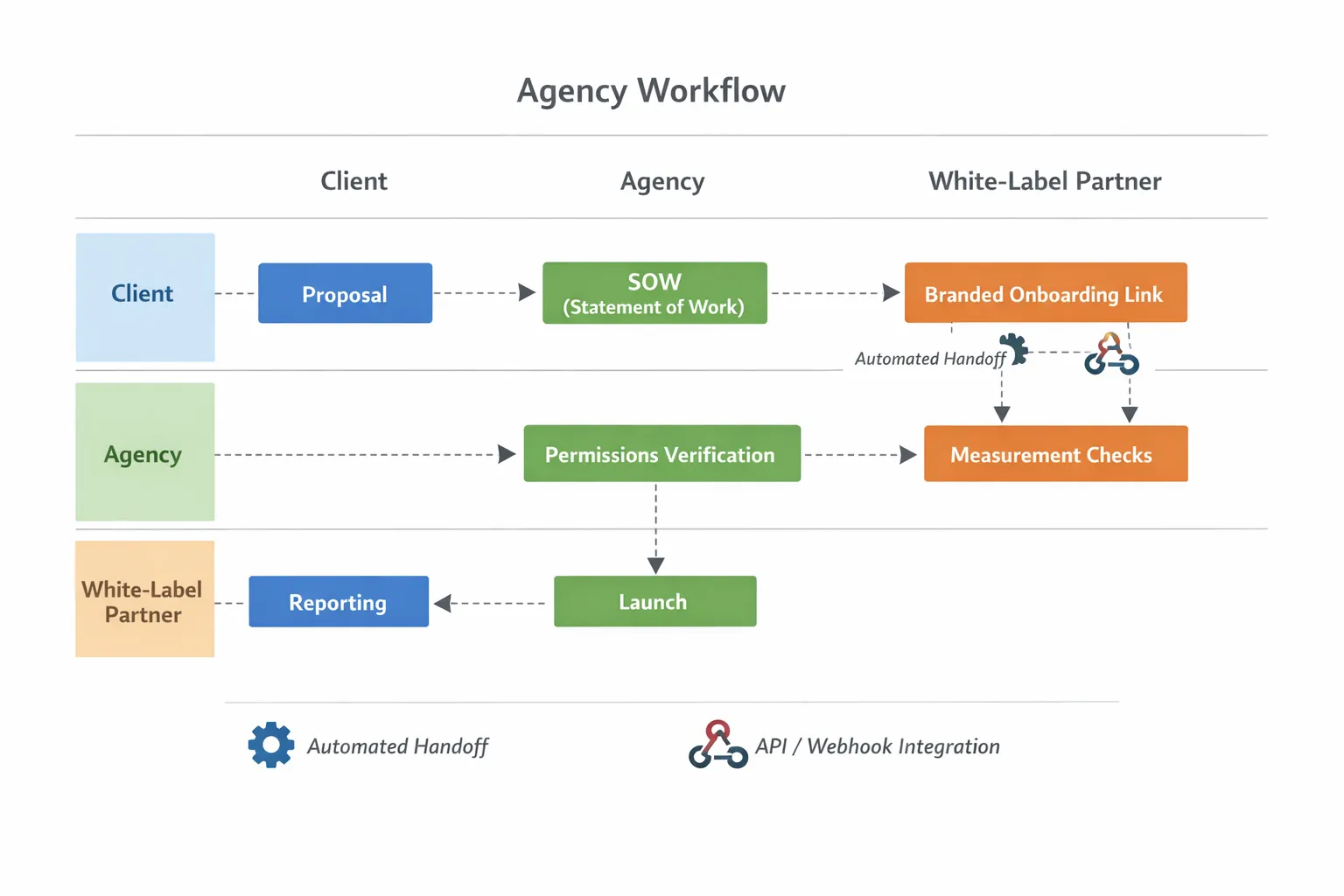
A simple, reliable onboarding flow
-
Pre‑sale alignment, confirm channels, assets you will need, measurement requirements, and legal terms.
-
Pre‑boarding checklist, collect basics like company details, billing contact, brand kits, and preferred comms channel.
-
Branded single onboarding link, capture identity, platform IDs, and consent, then route the client to connect assets securely. This avoids email ping‑pong and reduces errors.
-
Live verification sprint, a short call to verify permissions, events, catalogs, billing, and brand approvals.
-
Automated handoff to partner, push scoped access and intake to your fulfillment team or partner via API or webhooks.
-
Kickoff confirmation, share the go‑live plan, reporting cadence, and escalation paths.
| Step | Primary owner | Outcome |
|---|---|---|
| Pre‑sale alignment | Agency | Scope, channels, and risk flags documented |
| Pre‑boarding | Agency | Client basics and brand assets collected |
| Single‑link onboarding | Agency, Client | Secure, least‑privilege permissions in place |
| Verification sprint | Agency, Partner | Measurement and billing confirmed, launch checklist green |
| Automated handoff | Agency | Tasks and assets delivered to partner system |
| Kickoff confirmation | Agency | Client has dates, SLAs, and first milestones |
Governance principles for safer white label onboarding
- Use partner access and scoped roles, do not claim or move client‑owned assets.
- Enforce 2FA, require named accounts, and keep an auditable record of who has access to what.
- Avoid passwords in email, use OAuth or platform invites.
- Follow least‑privilege access and time‑boxed elevations for fixes.
Operating cadence, QA, and approvals
White label relationships succeed when work is visible and traceable.
- Weekly operating rhythm, an agreed day for updates, tasks due, and experiment notes. Keep it predictable.
- Change windows, define when campaigns and budgets can change to avoid surprises. Document exceptions.
- QA gates, include a pre‑flight checklist for targeting, budgets, pixels or events, creative specs, and brand‑safety rules before anything goes live.
- Approvals, separate content approval from launch approval. Use templated proofs and capture timestamps for auditability.
Reporting and transparency under your brand
Clients expect outcomes, not screenshots. Standardize a narrative that aligns with your tiers and make it white label friendly.
- Outcome‑first dashboards, lead volume, CAC, ROAS, or revenue contribution depending on channel and package.
- Annotations, tie results to experiments and campaigns so performance is explainable.
- Escalation notes, when performance degrades, show what changed and the planned countermeasures.
Compliance and data protection
Even if your partner is the processor doing the work, your brand is on the hook with the client. Bake compliance into your operating model.
- Contractual clarity, include data processing terms, breach notification timelines, and sub‑processor transparency.
- Regional obligations, document how you handle consent, data subject access requests, and retention policies.
- Vendor risk, maintain an inventory of platforms and partners, with scopes and contacts, and review it quarterly.
Metrics that keep your white label program honest
Define a small set of metrics that predict retention and margin, then review them weekly.
- Time to first value, signed SOW to first verified campaign action.
- Access completion rate, percentage of onboarding flows that get to 100 percent without manual rescue.
- Rework rate, number of tasks reopened by QA or client after approval.
- Gross margin by tier, revenue minus wholesale and delivery costs.
- Onboarding satisfaction, a short NPS or CSAT specific to the first 30 days.
A 30‑day rollout plan
Week 1, finalize service tiers, SLAs, and margin targets. Shortlist partners, collect their playbooks, and sign NDAs.
Week 2, build your onboarding OS. Prepare a branded single‑link flow, permission templates by platform, a 60‑minute verification script, and a go‑live checklist.
Week 3, pilot with one friendly client. Timebox the process, capture friction points, and fix language or steps that caused confusion.
Week 4, productize. Publish internal SOPs, formalize reporting templates, set weekly operating cadence, and train account managers on escalation paths.

Tools that make white label work feel in‑house
You do not need a dozen systems to offer white label services, but you do need a reliable onboarding layer that protects the client experience and your brand.
Connexify gives agencies a branded, white label way to collect client access and assets through one secure link. It supports multiple platforms, lets you configure customizable permissions, and automates handoffs to partners with API and webhook integrations. The user‑friendly dashboard keeps your team on the same page, secure data handling and no installation required mean you can roll it out quickly, and you can validate the fit with a 14‑day free trial.
If you want your white label program to feel like an in‑house team to clients, start by fixing onboarding. Compress the path from contract to first campaign action, make permissions and measurement bulletproof, and build predictable operating rhythms. Your clients will feel the difference, and your partners will deliver more consistently under your brand.
Ready to offer white label digital marketing services with a smooth, branded experience from day one, try Connexify and book your demo to see how a single onboarding link can reduce setup time from days to seconds.