Digital Marketing Agency Service: What’s Included and What’s Not
02/12/2026

Most buyers ask for “full-service marketing” and most agencies sell “full-service marketing.” The problem is that a digital marketing agency service can mean ten different things depending on the team, the channels, your budget, and your internal capacity.
This guide breaks down what’s typically included, what’s commonly not included, and how to translate a proposal into a clean scope so you can compare options and avoid surprises after you sign.
What a digital marketing agency service usually includes
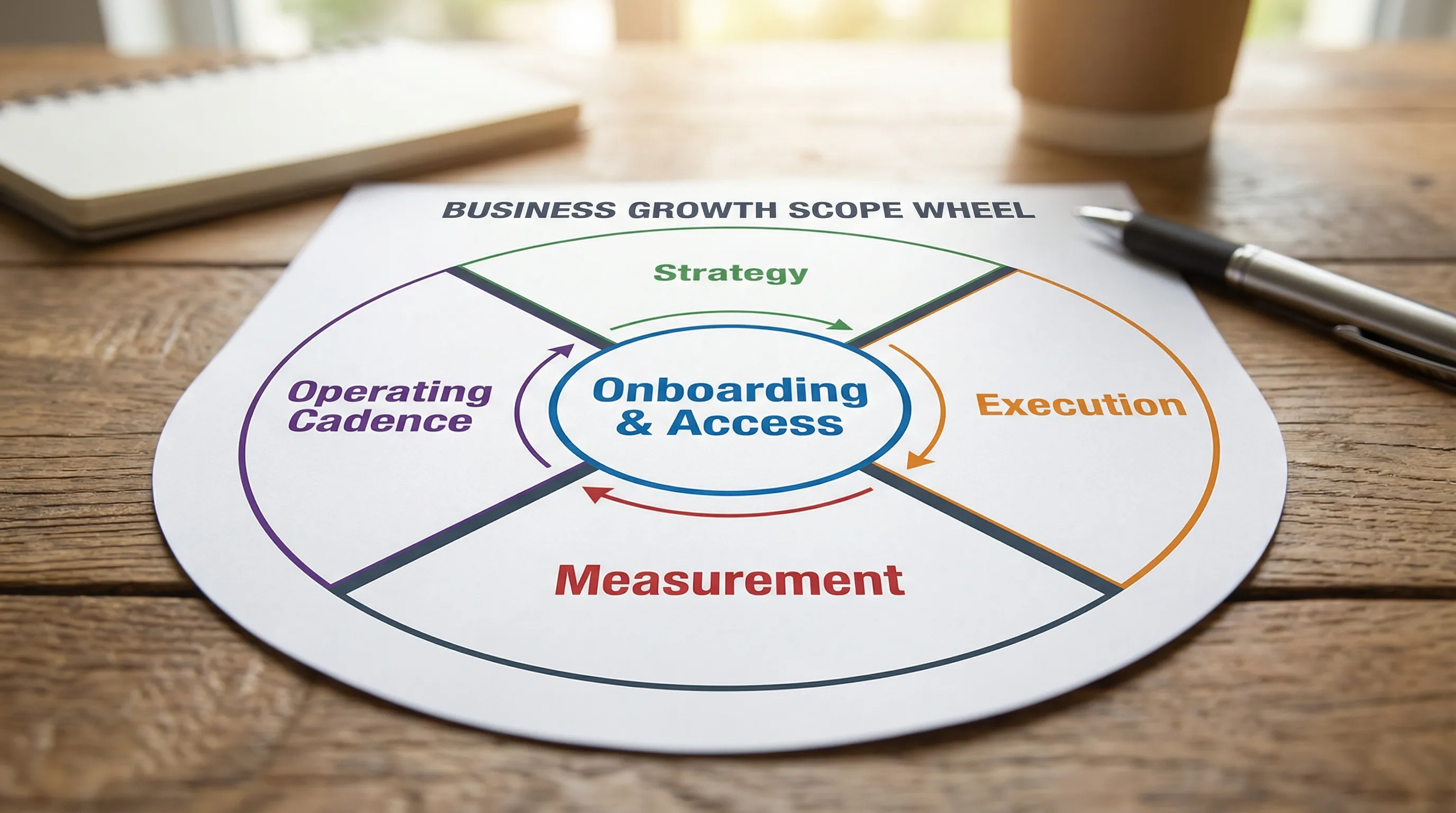
A modern agency engagement tends to include four layers: strategy, execution, measurement, and operating cadence. The exact mix varies, but these are the deliverables you should expect to see clearly defined.
1) Strategy and planning (the “what we’re trying to win” layer)
Even in execution-heavy retainers, good agencies carve out time to align on direction. Typical inclusions:
- A short discovery phase that aligns business goals, target customer, differentiators, and constraints (budget, seasonality, inventory, compliance)
- Channel strategy (which channels, why those channels, expected time-to-signal)
- A simple measurement plan (primary KPI, conversion definitions, and what counts as success)
- A 30 to 90 day rollout plan (what happens first, what gets tested, what gets postponed)
If strategy is included, it should produce artifacts, not just meetings. Look for deliverables like a one-page “win definition,” a channel plan, a testing roadmap, and a tracking checklist.
2) Channel execution (the “do the work” layer)
Execution is usually sold by channel and skillset. Depending on the engagement, a digital marketing agency service might include:
Paid media management
- Search ads account build and ongoing optimization (campaign structure, keywords, ads, extensions)
- Paid social setup and management (targeting, creative rotation, budget pacing)
- A/B testing plan, audience testing, and basic landing page recommendations
SEO and content
- Technical and on-page SEO recommendations
- Content briefs, content optimization, and publishing support (varies widely)
- Link building and digital PR, often an add-on because quality and cost vary
Lifecycle and retention (email, SMS, CRM campaigns)
- Campaign planning and calendar
- Segments, flows, and performance reporting
- Deliverability and list hygiene support (sometimes included, sometimes not)
Conversion rate optimization (CRO)
- Landing page audits
- Experiment ideas and prioritization
- Implementation is often not included unless the agency also provides dev resources
A strong proposal separates “setup/build” work from “ongoing management,” and states volume assumptions (for example, number of campaigns, number of creatives, number of pages optimized).
3) Creative and asset production (the “what the market sees” layer)
Creative is where scope creep happens fastest because “make it better” can be infinite.
Often included:
- Ad copywriting and variations
- Basic static creative (resizes, light design, templated production)
- Creative direction and feedback loops
Often excluded or limited:
- High-production video shoots
- 3D, animation, advanced motion design
- Brand identity work (naming, positioning system, full brand refresh)
If creative is included, you want explicit boundaries such as number of concepts, number of iterations, and what counts as a revision.
4) Measurement, analytics, and reporting (the “prove it” layer)
In 2026, serious performance work requires clean tracking. A typical service may include:
- Analytics setup guidance (often GA4), events and conversions mapping
- Tagging and pixels setup (often via a tag manager)
- UTM conventions and campaign naming standards
- Recurring reporting (weekly snapshot plus monthly narrative, or monthly only)
For reference, GA4 and event measurement basics are documented directly by Google in the GA4 documentation.
Advanced measurement may be a separate line item:
- Server-side tracking and advanced implementations
- Offline conversion imports and CRM-first attribution
- Data warehouse modeling and BI work
5) Operating cadence and project management (the “how work moves” layer)
Most buyers underestimate how much the operating model affects outcomes. Common inclusions:
- Kickoff call plus stakeholder alignment
- A task and approval workflow (often through your PM tool or the agency’s)
- Weekly or biweekly working sessions
- Monthly performance review (what happened, why, what changes next)
- Documentation (runbooks, account map, change log)
If the agency says they are “full service” but doesn’t define cadence, owners, and response times, expect friction.
6) Secure onboarding and access setup (often implied, but should be explicit)
This is the part that silently delays launches. Any agency managing ads, analytics, social accounts, or CMS work will need access and permissions.
A professional digital marketing agency service should include:
- Clear instructions for granting access (without sharing passwords)
- Least-privilege permissioning (only what the agency needs for the scope)
- A verification step to confirm access works before kickoff is over
Platforms themselves emphasize role-based access and secure sharing. For example, Meta documents business roles and permissions in Meta Business Help Center.
What’s usually not included (or only included if you pay for it)
Many disputes come from assumptions. Here are the exclusions that show up most often in real SOWs.
Media spend and third-party costs
Agencies commonly manage spend, but you typically pay these separately:
- Ad spend (Google Ads, Meta, TikTok, LinkedIn)
- Influencer fees
- Stock footage, music licensing, and paid creative tools
- Data tools, call tracking, heatmaps, and reporting platforms
A clean proposal distinguishes “management fee” from “media budget,” and clarifies who pays each vendor.
Website development and major design work
Many agencies will recommend landing page changes, but do not assume they will build them.
Often excluded unless specified:
- Net-new page builds
- Theme rebuilds or full redesigns
- Complex integrations (payments, member portals, custom apps)
If you need dev work, make sure the statement of work names the tech stack, the number of pages, and the acceptance criteria.
Legal and compliance ownership
Agencies can follow platform rules, but they are not your legal department.
Usually excluded:
- Privacy law interpretation (GDPR/CPRA and consent strategy)
- Terms updates, cookie policies, data processing agreements, legal review
For advertising compliance, agencies often reference platform policies, but you still need internal approval. Examples include Google Ads policies and industry guidelines.
Guaranteed results
A credible agency can commit to process, cadence, and transparency. They cannot ethically guarantee outcomes like:
- “We will get you to #1 on Google”
- “We guarantee ROAS of X by date Y”
You can, however, require measurable operational commitments, such as reporting cadence, response times, and time-to-verified-access.
Unlimited creative, unlimited revisions
“Unlimited” is usually a marketing phrase that hides constraints. If creative is central to the engagement, insist on:
- Defined outputs (how many concepts and variants)
- Defined revision limits and what counts as a revision
- A shared approval workflow and deadlines
Sales ownership
Unless you’re hiring a revenue operations firm, sales enablement is often limited.
Commonly excluded:
- Full CRM rebuilds
- Sales process design and training
- SDR management and call coaching
Some agencies can support lead quality improvements and offline conversion tracking, but sales execution generally stays with your team.
A practical scope matrix you can use to compare proposals
If you’re comparing agencies, normalize every proposal into a consistent matrix. You want to see what is included, what is optional, and what is your responsibility.
| Service area | Typically included | Often add-on | Often client-owned responsibility |
|---|---|---|---|
| Strategy | Goals, positioning inputs, channel plan | Deep market research, brand strategy | Final business decisions, offer approval |
| Paid media | Build + optimization, pacing, testing | Advanced creative production, new landing pages | Ad spend, product pricing, promo calendar |
| SEO | Audits, on-page recommendations | Technical implementation, link building | CMS access, engineering support |
| Measurement | Conversion mapping, tagging guidance, reporting | Server-side tracking, data warehouse | Privacy/legal approvals, source-of-truth revenue data |
| Creative | Ad copy, basic design variations | Video shoots, animation, full brand kit | Brand guidelines, claims substantiation |
| Ops cadence | Meetings, reporting, workflow | 24/7 support, dedicated PM | Timely approvals, stakeholder availability |
| Onboarding & access | Secure access instructions and verification | Automated onboarding, permission templates | Providing correct IDs, granting roles |
This matrix also reveals whether an agency is actually “full service” or simply bundling a few tasks.
What the agency will need from you (and what happens if you can’t provide it)
Great execution still fails if the inputs are missing. A good SOW will clearly list client responsibilities, especially for access and measurement.
| Client input | Why it matters | What breaks without it |
|---|---|---|
| Platform access (ads, analytics, social) | The team cannot build or optimize | Launch delays, partial visibility, wasted meetings |
| Conversion definitions (what counts as a lead or sale) | Reporting and optimization need a target | Vanity metrics, misaligned optimization |
| Creative and brand assets | Faster production and fewer revisions | Slow cycles, inconsistent brand execution |
| Approval owner and SLA | Work needs a decision-maker | Stalled launches, constant “waiting on client” |
| Billing readiness (ad accounts, payment method) | Campaigns cannot run without it | Last-minute emergencies |
| CRM or revenue data (if applicable) | Improves lead quality optimization | Inability to connect marketing to outcomes |
If you know you are bandwidth-constrained, address it up front. Many “agency failures” are actually “input failures” that were never negotiated.
Scope language that prevents surprises
When you read or write a statement of work, look for these specifics.
Deliverables with volume assumptions
Good: “Create up to X campaigns and Y ad groups in month one, then optimize weekly.”
Risky: “Manage Google Ads.”
Definition of done
Each deliverable should have acceptance criteria. Example: “Measurement-ready means test conversion recorded in the ad platform and analytics, and verified in a report.”
Change control
Marketing changes fast, but chaos is optional. Your SOW should describe how new requests are handled:
- What counts as in-scope vs out-of-scope
- How change requests are estimated and approved
- What gets deprioritized when something new is added
Operational SLAs that matter
Instead of vague promises, look for commitments like:
- Response time for tickets
- Turnaround time for new creative
- Reporting cadence
- Time-to-verified-access after contract signature
Those SLAs protect both sides: you get predictability, and the agency gets the inputs they need.
Red flags that signal “missing scope”
A few proposal patterns reliably lead to disappointment:
- “Full-service” with no deliverables, no cadence, and no volume assumptions
- Reporting that focuses on clicks and impressions, with no conversion definitions
- No plan for access, permissions, or onboarding security (especially if anyone suggests password sharing)
- Vague creative language (“as needed”) without revision limits
- No clarity on ownership (who owns ad accounts, pixels, creative files, and audiences)
If you want a quick sanity check, ask the agency to walk you through the first 7 days post-signature. If they cannot describe the onboarding and verification steps clearly, you are buying uncertainty.

Where Connexify fits: productizing onboarding so delivery starts faster
Many agencies can do the strategy and execution. The bottleneck is often onboarding, especially getting secure, correct access across multiple platforms without weeks of email threads.
Connexify is built to streamline that part of a digital marketing agency service:
- Send one branded onboarding link to collect and verify access
- Support multiple platforms in one flow
- Use customizable permissions and a consistent, least-privilege approach
- Offer white-label options for agencies
- Connect your process via API and webhook integrations
- Track progress in a user-friendly dashboard
- Keep onboarding secure, with no installation required
If your biggest “what’s included” gap is the messy reality between signed contract and first launch, a dedicated onboarding layer can be the difference between time-to-value measured in days versus weeks.
You can explore how Connexify works at Connexify or see the broader playbook in How Digital Marketing Agencies Streamline Client Onboarding. If you want to pressure-test onboarding in your own process, you can start with the 14-day free trial or book a demo from the site.