Social Media Advertising Agencies: How They Onboard
02/07/2026

Client onboarding is where most social media advertising agencies either build instant trust or quietly lose momentum. The first week of a new engagement is usually packed with permission requests, pixel checks, billing setup, creative intake, and approvals. If those steps live in scattered email threads and “quick calls,” you end up with the two outcomes clients hate most: delays and uncertainty.
A strong onboarding process turns a signed contract into a measurable launch plan, verified platform access, and a clear path to first results, without compromising security.
What “good onboarding” means for social media advertising agencies
For paid social, onboarding is not “send a questionnaire and schedule a kickoff.” It is a short, structured production phase with specific outputs.
A solid onboarding is complete when you can confidently say:
- Access is verified (not just “invited”) for the exact ad accounts, pixels, pages, catalogs, and analytics properties you need.
- Measurement is ready (events fire correctly, attribution is agreed, and reporting sources are known).
- Creative inputs are complete (brand kit, offers, angles, constraints, and approvals workflow).
- The first launch is de-risked (budget, billing, targeting constraints, and compliance checks are done).
- Owners and SLAs are explicit (who does what, by when, and what “done” means).
This is why the best agencies treat onboarding as a product: repeatable, time-boxed, and measurable.
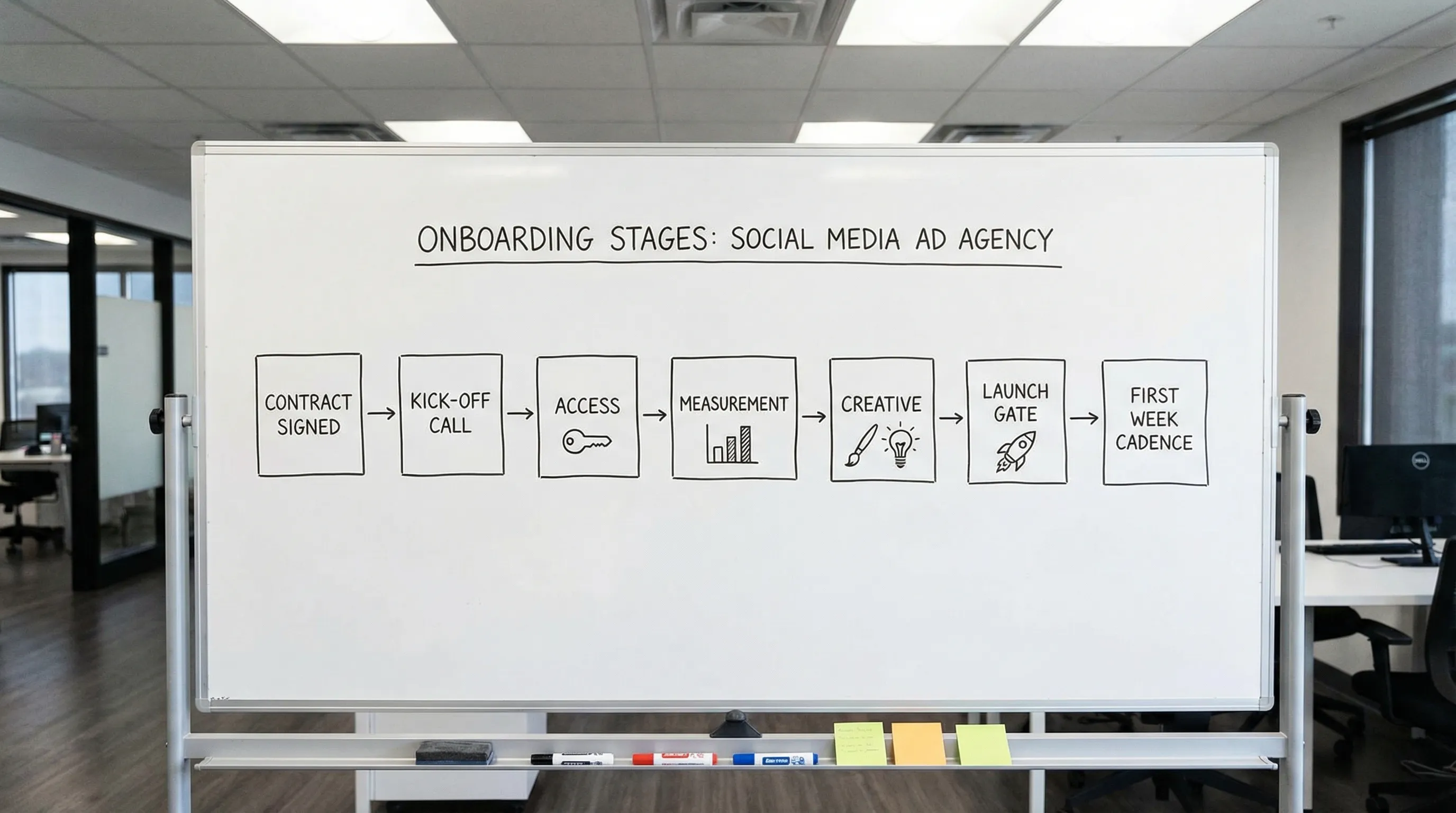
The 7-stage onboarding flow most high-performing agencies use
Different agencies name these steps differently, but the underlying sequence stays consistent because it matches how ad platforms and creative workflows actually work.
1) Close-to-kickoff handoff (same day)
Goal: prevent “signed but stuck.”
What happens:
- Sales hands over the scope, win definition, key risks, and any promises made.
- Delivery assigns an internal owner (account lead) and sets the launch target date.
- You confirm the primary objective (lead gen, ecommerce, pipeline, recruiting, retention).
If the client’s goal is hiring, treat it as its own onboarding path. Recruiting campaigns often require coordination with HR, an ATS or CRM, and sometimes external recruiting partners. For example, civil engineering and infrastructure clients frequently run specialized hiring funnels, and aligning with a specialist recruiter can clarify roles, talent personas, and conversion steps (application, screening, interview). If your client uses one, document that relationship early, such as a partner like Alexander Executive Search’s specialist recruitment services so your ads and landing flow match real hiring operations.
Definition of done: onboarding link or intake is sent, kickoff scheduled, internal owner assigned.
2) Intake that captures decisions, not just data (Day 0 to Day 1)
Goal: get the minimum viable inputs to build and measure campaigns.
Beyond basic company details, strong intakes capture:
- Decision-makers and approvers (marketing, finance, legal/compliance)
- Offer constraints (pricing, guarantees, geographic limits, excluded audiences)
- “No-go” topics and brand safety guidelines
- Historic context (what has already been tested, what failed, what must not repeat)
Definition of done: intake completed, approvers and escalation path identified.
3) Access setup with least-privilege permissions (Day 1)
Goal: secure, role-based access without password sharing.
This is where most delays happen because platform access is multi-layered. Agencies that move fast standardize two rules:
- Client-owned assets, agency granted partner access (where platforms support it)
- Least privilege by role (buyers do buying, analysts do reporting, developers do events)
Here is a practical “what to request” map you can use across common paid social stacks.
| Category | Examples | Why it’s needed | Common mistake |
|---|---|---|---|
| Ad platform container | Meta Business Portfolio, TikTok Business Center, LinkedIn Business Manager | Enables the correct identity and governance context | Inviting the wrong email or wrong business entity |
| Ad account access | Ad Account ID and role (admin/advertiser/analyst) | Build, launch, and troubleshoot campaigns | Getting Page access but not ad account permissions |
| Tracking assets | Pixel, Conversions API access, events manager permissions | Verify events, configure priorities, diagnose attribution | Launching before confirming events actually fire |
| Destination assets | Website CMS or landing page builder access (scoped), domain/DNS access if needed | Install tags, verify domains, fix conversion flow issues | Asking for full admin when read-only or scoped access would work |
| Reporting sources | GA4, CRM, call tracking, ecommerce platform | Closed-loop measurement and lead quality | Relying on platform-only reporting for business outcomes |
| Billing touchpoints | Invoicing contacts, payment method owner, tax details if relevant | Avoid launch failures and delayed spend | Discovering payment issues on launch day |
Definition of done: agency can log in, see the right assets, and perform required actions in each platform.
4) Measurement verification sprint (Day 1 to Day 2)
Goal: prove you can measure before you scale.
A measurement sprint is a short, explicit checklist, usually done live on a call or screen-share, then documented.
A lightweight verification pass typically includes:
- Confirm the conversion event(s) and their definitions (lead, qualified lead, purchase, booked call)
- Validate event firing with test conversions
- Confirm attribution windows and any platform constraints
- Ensure UTMs (or equivalent) are standardized
- Confirm where “truth” lives for revenue or pipeline (CRM, ecommerce, bookings)
Definition of done: you can run a test action and see it appear where it’s supposed to appear, including the reporting source the client cares about.
5) Creative, offers, and approvals (Day 2 to Day 4)
Goal: remove creative ambiguity and approval bottlenecks.
The fastest agencies do two things during onboarding:
- They collect a complete brand and offer kit (logos, fonts, claims rules, product margins, promos, compliance constraints).
- They define a simple approvals workflow with owners and time limits.
You do not need a complicated system to start, but you do need clarity:
- Who approves copy?
- Who approves design?
- Who approves landing pages?
- What is the turnaround SLA?
Definition of done: first creative batch is approved (or approval criteria are fully defined and scheduled).
6) Launch plan and build (Day 3 to Day 7)
Goal: translate strategy into a build that matches measurement and constraints.
This stage includes:
- Campaign structure (objectives, budgets, ad sets, audience plan)
- Tracking mapping (which campaign maps to which KPI and event)
- QA gate (links, events, placements, policy checks, naming conventions)
Definition of done: campaigns are built, QA passed, and launch time is confirmed with the client.
7) First-week operating cadence (Week 1)
Goal: stabilize performance and reduce client anxiety.
Week 1 should be operationally different from “normal delivery.” It is more frequent, more diagnostic, and more communication-heavy.
Typical best practice:
- Daily checks for spend pacing, disapprovals, learning limitations, and event volume
- A clear “first signal” expectation (what you will learn in 3 to 7 days)
- One structured client update that ties actions to hypotheses, not just metrics
Definition of done: the account is stable, measurement is trusted, and the next iteration backlog is clear.
A kickoff agenda that prevents rework
Most kickoff calls fail because they focus on introductions and channel talk, not decisions.
A high-signal kickoff agenda for paid social usually covers:
- Win definition: what outcome counts, and how it will be measured
- Offer and audience constraints: what you can and cannot claim, who you must exclude
- Conversion flow walkthrough: ad click to conversion to follow-up
- Access confirmation: what’s already verified, what is still pending
- Approvals and turnaround: names, deadlines, escalation path
- First launch plan: timeline, creative batch size, budget, and “first signal” expectations
Document decisions immediately after the call, and send a one-page recap. It becomes the reference when opinions shift later.
Operational SLAs and metrics that separate pros from chaos
If you want onboarding to improve over time, you need a small set of metrics that are easy to capture and hard to argue with.
| Metric | What it measures | Why it matters | Good starting target |
|---|---|---|---|
| Time to verified access | From contract signed to confirmed access across required platforms | Predicts launch speed and reduces firefighting | 24 to 72 hours |
| Onboarding completion rate | % of clients who complete intake and access steps without chasing | Exposes friction and unclear instructions | 80%+ |
| Time to measurement-ready | Contract signed to validated conversion tracking | Prevents “optimizing blind” | 2 to 5 business days |
| Rework rate | % of builds redone due to missing info or wrong permissions | Protects margins | Trending down monthly |
| Time to first value | Contract signed to first meaningful deliverable (creative live, leads, report) | Ties onboarding to retention | 7 to 14 days |
Treat these as process KPIs, not vanity numbers. When they slip, the fix is usually better standardization, not “work harder.”
Where onboarding breaks most often (and how agencies prevent it)
A few failure patterns show up repeatedly in social media advertising onboarding:
“We have access” that is not actually usable
Invites get accepted, but the wrong role is granted, the wrong business is selected, or 2FA blocks the operator at the worst time. The prevention is simple: verify access live and record what was verified.
Launching before measurement is validated
Paid social platforms can spend money immediately, even if conversions are misconfigured. Mature agencies enforce a launch gate: no spend scale until the conversion event is proven end-to-end.
Creative bottlenecks disguised as “strategy”
If offers, claims rules, and approvals are unclear, your team will slow down to protect the client’s brand. Fix it by capturing constraints during intake and making approvals time-boxed.
Billing surprises
Payment methods, invoicing contacts, and ad account spending limits can stall a launch that is otherwise ready. Pull billing into onboarding instead of treating it as “finance later.”
How onboarding software changes the workflow (and what to look for)
Many agencies start with forms, spreadsheets, and email. That works until you manage multiple platforms, multiple roles, and multiple clients at once.
A dedicated onboarding layer helps when you need:
- A single branded link that routes clients through the right steps
- Multi-platform onboarding (not just one ad network)
- Permission templates and customizable access requests by service tier
- A client experience that reduces back-and-forth and confusion
- Integrations into your stack (webhooks, API) so handoffs are automatic
- A dashboard so onboarding progress is visible (internally and, optionally, to clients)
Connexify is built for this exact problem: streamlining client onboarding for agencies and service providers with one-link onboarding, a branded experience, support for multiple platforms, customizable permissions, white-label options, API and webhook integrations, and secure data handling (no installation required). If you want to see how a single onboarding link can compress setup from days to seconds, you can explore Connexify at connexify.io.
Turning onboarding into a competitive advantage
For social media advertising agencies, onboarding is not administrative overhead. It is the first deliverable the client experiences, and it determines how quickly you can create signal, learn, and improve performance.
If you standardize the stages, define “done,” verify access and measurement early, and track a handful of operational SLAs, onboarding becomes a compounding advantage: faster launches, fewer emergencies, better margins, and more confident clients.