Agency Social Media Marketing: A Lean Ops Playbook
02/06/2026

Most agency social media marketing advice assumes you have an endless bench of strategists, editors, designers, and account managers.
In reality, most agencies win (and keep) clients because they run a tighter system than competitors: clear positioning, fast proof, consistent pipeline, and an onboarding experience that makes the client feel in control.
This lean ops playbook is written for agency owners and operators who want growth without chaos. Not “post more on LinkedIn.” Not “try 12 channels.” A simple operating model you can run weekly.
What “lean ops” means for agency social media marketing
Lean ops is not being cheap. It is being deliberate.
In an agency context, lean operations means:
- You choose a small number of moves that compound (one ICP, one promise, two acquisition lanes).
- You measure leading indicators (response time, booked calls, access readiness), not just vanity metrics.
- You design the delivery system to support marketing (because clients talk, churn is loud, and referrals are earned).
If your marketing feels inconsistent, the root cause is often operational: unclear scope, slow onboarding, messy approvals, or reporting that does not connect to business outcomes. Fixing those creates better marketing outputs with the same headcount.
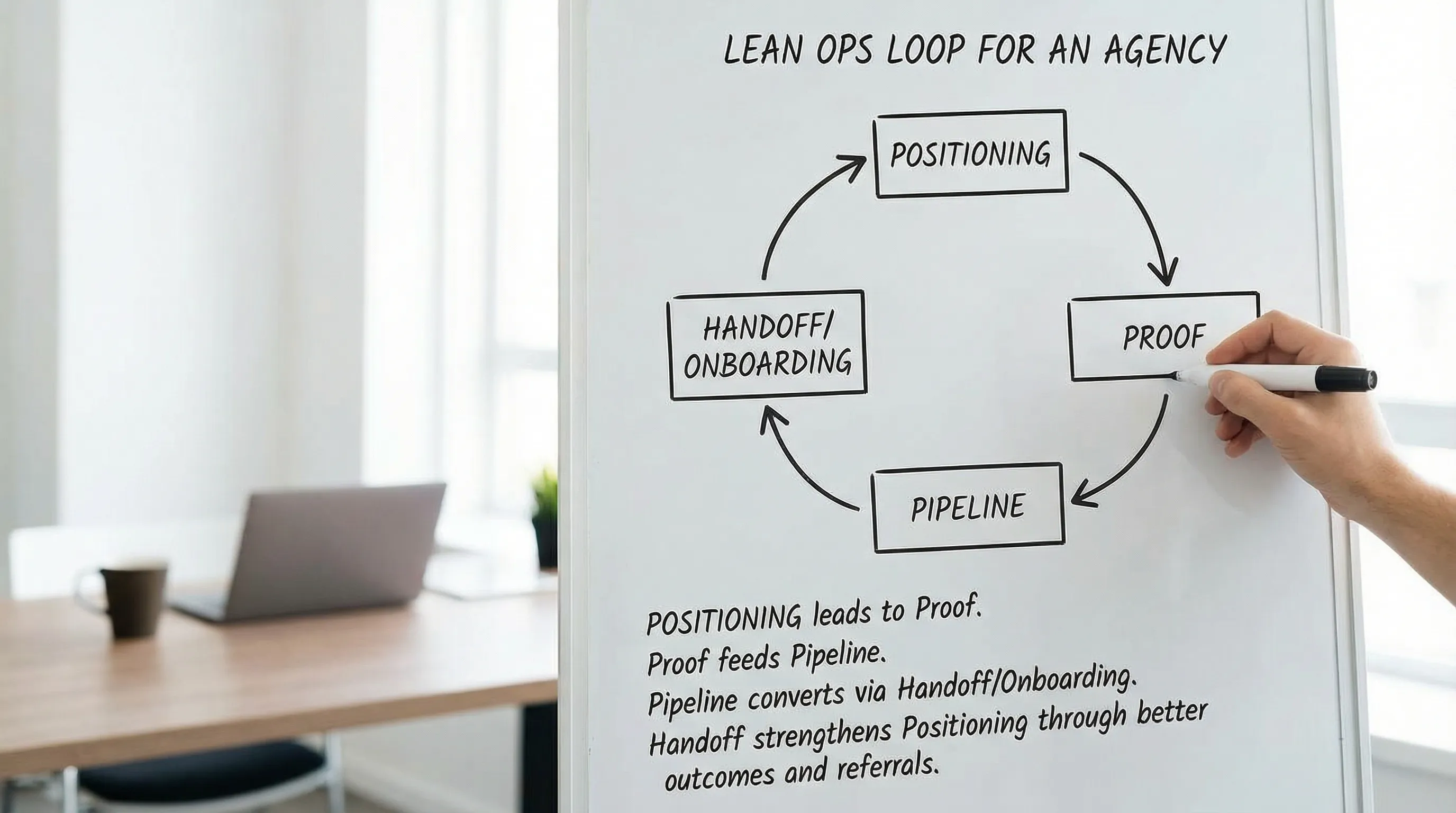
The Lean Ops Loop: Positioning, Proof, Pipeline, Handoff
You do not need more tactics. You need four systems that reinforce each other.
1) Positioning: pick a narrow buyer and one measurable promise
Most agencies describe capabilities. Buyers are hiring outcomes.
A lean positioning statement has three parts:
- Buyer: a specific type of team with a specific constraint
- Outcome: what improves, in business terms
- Mechanism: how you deliver it reliably
Examples (use as patterns, not templates):
- “We help B2B SaaS marketing teams turn paid social into qualified pipeline by fixing the measurement and creative iteration loop.”
- “We help multi-location brands increase booked appointments with short-form creative plus local conversion tracking.”
Two practical rules keep this lean:
- One primary ICP for 90 days. You can serve others, but your marketing must be optimized for one.
- One primary conversion. Usually it is “book a call,” “request an audit,” or “start a short pilot.”
If you want a quick stress test, ask: “Could a prospect forward our homepage to a CFO and still get a yes?” If not, your promise is probably too activity-based.
2) Proof: build a “proof library” instead of random case studies
Agency social media marketing performs when you can reduce perceived risk quickly.
A proof library is a set of reusable assets you can deploy across sales calls, proposals, and social content. It is not just a PDF case study.
Include proof in three levels:
- Proof of competence: before/after creative, ad account audits (sanitized), process screenshots, example reporting views
- Proof of outcome: pipeline, revenue, CPA, conversion rate, retention, or a clear proxy KPI (with context)
- Proof of operating rigor: timelines, QA checklists, onboarding steps, SLAs, security posture
Keep it lean by standardizing the format. For example:
- Situation (who, what constraint)
- What we changed (3 bullets)
- What improved (1–3 metrics)
- What it took (time, inputs, access)
- What we would do in the first 14 days for a similar client
That last line matters because it makes your proof actionable, not inspirational.
3) Pipeline: run two acquisition lanes you can sustain
Lean agencies choose two lanes and execute them consistently:
- Lane A (inbound): content and distribution that attracts the right buyer
- Lane B (targeted outbound/partners): a short list, personalized outreach, relationship-driven referrals
You can absolutely run paid acquisition for your agency, but do it after your offer and proof are sharp. Paid spend does not fix positioning.
Here is a simple way to choose lanes based on constraints:
| Constraint | Better lane | Why it fits lean ops |
|---|---|---|
| You have strong delivery proof but low visibility | Inbound content | Proof converts once it is seen |
| You have niche expertise and a clear target list | Targeted outbound | You can be specific without volume |
| You need faster feedback on offer and messaging | Outbound + short pilot | Shortens the learning cycle |
| You have a founder-led network | Partner referrals | Highest trust, lowest CAC |
For most small and mid-sized agencies, the lean default is:
- Inbound built around a weekly “operator” post (what you learned, what broke, what you fixed)
- Outbound built around a short list of accounts and a specific “diagnostic” offer
A lean distribution cadence that actually works
If you only do one thing on social, do this:
- Publish one anchor post per week (a 600–1200 word LinkedIn post, a short Loom-style breakdown, or a 5-slide carousel).
- Repurpose it into 3–5 smaller pieces over the next week.
- Send it to 10 relevant people (clients, prospects, partners) with a one-line “thought this might help” note.
That is enough volume to learn, and it is sustainable.
4) Handoff: turn onboarding into a marketing asset
The fastest way to improve agency social media marketing is to reduce the gap between “closed-won” and “first visible value.”
Clients do not just buy results, they buy momentum.
A lean handoff system answers, in plain language:
- What happens in the first 48 hours?
- What do you need from the client (access, assets, approvals, constraints)?
- What does “ready to launch” mean?
Operationally, the bottleneck is almost always access and permissions across platforms. When access is slow, everything else slips: tracking, creative QA, publishing cadence, and reporting.
This is where tools and process combine. Connexify is designed for exactly this layer: a single, branded onboarding link that helps agencies set up fast, secure, multi-platform access with customizable permissions, white-label options, and API/webhook integrations, without requiring installs.
If you want your marketing to feel premium, your onboarding has to feel premium.
The “agency growth scoreboard” (what to measure weekly)
Most agencies track followers, impressions, and “leads.” Lean ops tracks the few metrics that predict revenue and delivery health.
Use a single weekly scoreboard with definitions that your team can’t interpret differently.
| Metric | What it tells you | How to define it (so it stays honest) |
|---|---|---|
| Qualified conversations started | Top-of-funnel quality | DM threads or email replies with your ICP that include a business problem |
| Calls booked | Demand capture | Calendar bookings from ICP accounts, not “any meeting” |
| Show rate | Message-market fit | % of booked calls that happen |
| Proposal-to-close rate | Offer clarity | Closed-won divided by proposals sent |
| Time-to-verified-access | Delivery readiness | Time from “signed” to confirmed correct platform access |
| Time-to-first-value | Momentum | Time to first shipped asset, live campaign, or measurable lift |
| Referral asks sent | Future pipeline | Number of explicit referral asks to happy clients/partners |
Two notes:
- Time-to-verified-access is an underused lever. It is also a trust signal.
- Scoreboards only work if you review them weekly, with decisions attached.
A weekly operating rhythm (90 minutes that compounds)
A lean rhythm keeps marketing, sales, and delivery aligned.
Weekly Growth Review (60 to 90 minutes)
Agenda:
- Scoreboard review (10 minutes): what moved, what stalled
- Pipeline review (15 minutes): which accounts, which next steps, which owner
- Content review (15 minutes): what shipped, what resonated, what to repeat
- Delivery friction review (15 minutes): where onboarding or approvals slowed down work
- Decisions (last 10 to 20 minutes): 1–3 changes to implement this week
If you do nothing else, do this. It creates the feedback loop that most agencies lack.
Daily 10-minute “ops check” (optional but powerful)
Keep it lean. The goal is to prevent multi-day stalls.
- New client or prospect blockers?
- Waiting on access or approvals?
- Anything that jeopardizes this week’s “first value” delivery?
Lean playbooks for the two most common agency bottlenecks
Bottleneck A: “We create content, but it doesn’t convert into calls”
This is usually not a distribution problem. It is a buyer intent problem.
Fix it by tightening your content around:
- “What we do in the first 14 days”
- “What we refuse to do (and why)”
- “The 3 reasons social programs fail in your niche”
- “A teardown of a real funnel, creative, or reporting setup”
Also, add a call-to-action that matches your ICP’s risk tolerance:
- A short audit
- A measurement readiness check
- A pilot with a clear definition of done
Bottleneck B: “We close deals, then onboarding drags and clients get anxious”
This is where lean ops becomes a competitive advantage.
Common root causes:
- Access requests are manual, scattered, and unclear.
- You discover missing assets only after kickoff.
- Nobody owns verification, so issues surface late.
A lean fix is to productize onboarding:
- One intake flow
- Role-based permission templates
- A clear “ready to launch” checklist
- Live verification (15 to 30 minutes) instead of async guessing
Connexify supports this approach with one-link onboarding, a branded client experience, and a dashboard so your team can see what is complete and what is stuck. If your agency runs on multiple platforms, that cross-platform access layer is what removes the “waiting on permissions” tax.
Risk and governance (yes, it affects marketing)
As social media becomes more performance-driven and more regulated (privacy, platform enforcement, brand safety), governance is not just legal hygiene. It is part of your value proposition.
Two practical governance moves that also help sales:
- Least-privilege access: ask for only what you need for the scope, and document it.
- Asset ownership clarity: clients should own their Pages, ad accounts, pixels, domains, and creative source files.
If your agency works with music, creators, or brands with valuable creative, IP risk becomes operational. In those cases, it can be worth pointing clients to specialized support for monitoring, enforcement, and licensing. For example, Third Chair’s AI-driven IP monitoring and licensing focuses on helping music rights holders protect and monetize their intellectual property, which can complement an agency’s growth efforts.
A lean implementation plan (14 days, not 6 months)
You can implement this playbook quickly if you focus on sequencing.
Week 1: sharpen the commercial system
- Pick one ICP and write a one-sentence promise.
- Create one “proof asset” (a teardown, a before/after, a mini case study).
- Decide your two acquisition lanes.
- Set up the weekly scoreboard.
Week 2: tighten the delivery-to-marketing loop
- Standardize your onboarding requirements (access, assets, approvals).
- Add a time-to-verified-access target and assign an owner.
- Build one repeatable kickoff agenda that ends with “next 48 hours.”
- If you need a faster onboarding layer, pilot a one-link flow so access does not stall your first deliverable.
This is the difference between marketing as content and marketing as an operating system.
Frequently Asked Questions
What is agency social media marketing, exactly? Agency social media marketing is how an agency uses social channels (plus supporting systems like proof, pipeline, and onboarding) to attract, convert, and retain clients. It is not the same as delivering social media marketing services for clients.
Which social platform is best for agency marketing in 2026? The best platform is the one where your specific buyers already pay attention and where you can publish consistently. For many B2B agencies, LinkedIn remains the most reliable starting point because it supports operator-style content and direct conversations.
How many acquisition channels should an agency run? Two is a strong lean default. One inbound lane (content and distribution) plus one outbound or partner lane is usually sustainable without hiring a dedicated growth team.
What should agencies track besides followers and impressions? Track metrics tied to revenue and delivery readiness: qualified conversations, calls booked, show rate, proposal-to-close rate, time-to-verified-access, and time-to-first-value.
How do we reduce onboarding time for social media clients? Standardize what you request (assets, IDs, permissions), use least-privilege roles, verify access live, and centralize the flow. A branded one-link onboarding experience can eliminate back-and-forth and reduce permission errors.
Make onboarding your unfair advantage
If your agency social media marketing is strong but growth still feels “spiky,” your bottleneck may be the handoff: access, permissions, and verification across platforms.
Connexify helps agencies streamline onboarding with a single branded link, secure multi-platform access setup, customizable permissions, and API/webhook integrations, with no installation required.
If you want to turn onboarding into a client experience that supports retention and referrals, explore Connexify at Connexify and start a 14-day free trial, or book a demo to see how it fits your workflow.