Choosing a Marketing Platform for Agencies: 7 Must-Haves
01/04/2026

Most agencies don’t fail because they lack creative talent or media buying skills. They stall because the client journey is fragmented: proposals live in one place, access requests happen in email, assets are scattered across drives, and reporting is in a separate tool. A “marketing platform for agencies” is really your operating layer for turning a signed contract into measurable results, fast, securely, and at scale.
If you’re choosing a marketing platform (or rebuilding your stack in 2026), the goal is not to buy more tools. It’s to eliminate the handoff gaps that slow launches, increase risk, and burn margin.
Below are 7 must-haves to look for, plus what to ask vendors so you can separate “nice UI” from operational leverage.
What “marketing platform for agencies” should mean (in practice)
Agency leaders often use “platform” to describe very different things:
- A true all-in-one suite (CRM, email, landing pages, reporting)
- A delivery stack (ads, analytics, tag manager, BI)
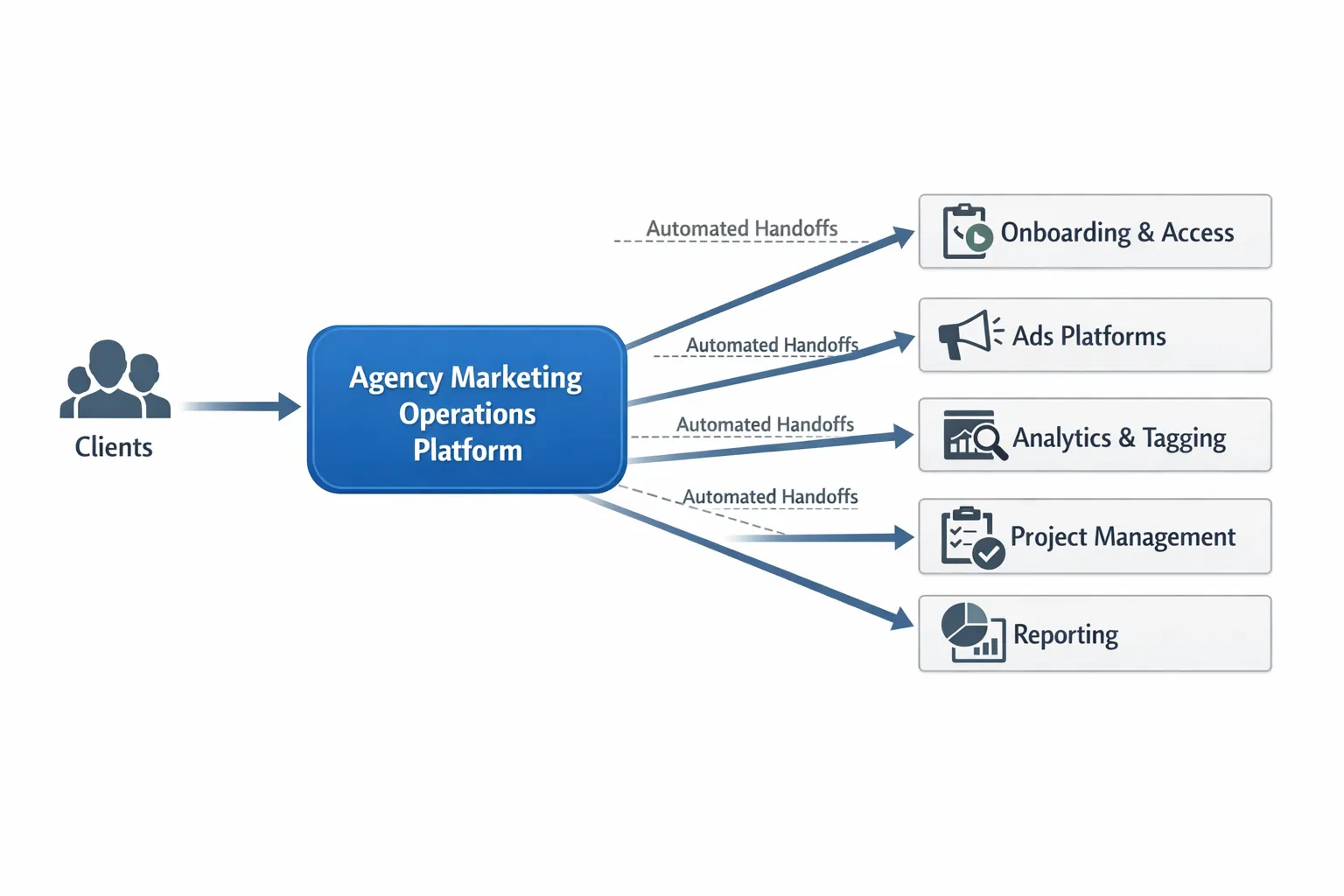
- An ops layer that standardizes onboarding, access, approvals, and handoffs
For most agencies, the right answer is a platform strategy: a core system of record plus integrations that keep work moving without fragile manual steps.
The 7 must-haves below are written for the practical reality: you will always run multiple platforms, so your “platform” must connect them, govern them, and make onboarding predictable.
1) A dedicated onboarding and access layer (not just forms)
In agency operations, onboarding is where time-to-value is won or lost. If your platform treats onboarding as a Typeform plus a kickoff call, you’ll keep paying the tax of:
- Waiting days for logins, IDs, and permissions
- Copy-pasting access instructions per platform
- Chasing stakeholders who are not sure what to do next
- Risky behaviors like password sharing
What to look for: an onboarding layer that can request and verify access across platforms with a guided flow, ideally through a single branded link.
Connexify is purpose-built for this use case: it streamlines client onboarding for agencies by enabling fast, secure account access setup through one branded link, supporting multiple platforms, customizable permissions, white-label options, plus API and webhook integrations. (No installation required, and there’s a 14-day free trial.) You can learn more at Connexify.
Vendor questions to ask
- Can we generate a single onboarding link per client, per service line, or per package?
- Can we control permissions by role (strategist vs designer vs analyst) and by platform?
- How do you prevent insecure workflows (password collection, shared accounts)?
2) Multi-platform support that matches your real client mix
A marketing platform for agencies must reflect an inconvenient truth: your clients’ stacks are inconsistent.
Even two companies in the same industry can run completely different combinations of:
- Ad platforms (Meta, Google, TikTok, LinkedIn, Pinterest)
- Analytics and tagging (GA4, GTM, server-side tagging)
- Ecommerce and CMS (Shopify, WordPress, Webflow)
- CRM and lifecycle tools (HubSpot, Salesforce, Klaviyo)
What to look for: broad coverage where it matters, plus flexible extension points.
- If the tool only “integrates” via a Zapier connector for one event, you may outgrow it quickly.
- If it supports APIs and webhooks, you can connect it to your process even when a native integration doesn’t exist yet.
Vendor questions to ask
- Which platforms are truly supported end-to-end (not just “we can link out to them”)?
- Do you offer webhooks for key lifecycle events (intake completed, access granted, approval given)?
- How do you handle clients with multiple brands, regions, or business units?
3) Security and governance by default (least privilege, auditability, offboarding)
A “marketing platform” is not a nice-to-have interface. It becomes a control point for sensitive business access: ad accounts, analytics, billing profiles, pixels, catalogs, customer data, and sometimes even domain or site administration.
At minimum, your platform should enforce modern governance expectations:
- Role-based access control so team members only see what they need
- Least-privilege access as a default posture (a core concept in security frameworks such as NIST’s Zero Trust guidance)
- Audit trails so you can answer “who got access to what, and when?”
- Clean offboarding so access is removed predictably when a client pauses or churns
Vendor questions to ask
- Do you support least-privilege templates per role and per service package?
- What audit logs exist, and can we export them?
- How do you handle client-owned assets versus agency-owned assets?
4) A branded, client-friendly experience that reduces back-and-forth
Agencies underestimate how much friction is caused by a client feeling unsure in the first 10 minutes:
- “Is this link legit?”
- “Where do I upload assets?”
- “What if I don’t have admin access?”
- “What happens after I submit?”
A marketing platform for agencies should improve conversion from “signed” to “launched” by making the journey obvious.
What to look for:
- Branded onboarding links and pages
- White-label options (if you need them)
- Plain-language steps, progress indicators, and confirmation screens
- Mobile-friendly UX (because many access approvals happen on phones)
This is not just aesthetics. It reduces errors and eliminates support tickets.
Example: If you serve local businesses with small teams, the decision maker might also be the operator. A clean branded flow matters even more when onboarding a time-constrained owner, like a manufactured home dealer in San Antonio who needs a straightforward path to grant access, share listings assets, and move on with their day.
5) Automation for handoffs (PM, CRM, Slack, documentation)
If you want scale, your platform must do more than store information. It has to move work forward.
The biggest hidden cost in agency operations is handoffs:
- Sales to delivery
- Strategy to creative
- Creative to media buying
- Media buying to analytics
- Agency to client for approvals
What to look for: automation primitives that match agency reality.
- API access for custom workflows
- Webhooks to trigger downstream actions
- Data models that map to accounts, assets, permissions, and contacts
This is where an onboarding layer becomes a force multiplier. For example, once intake is completed and access is granted, you can automatically:
- Create a project in your PM tool
- Create a client channel
- Assign tasks based on service package
- Populate your internal runbook with the correct IDs and links
Vendor questions to ask
- What triggers are available (intake submitted, access verified, approval captured)?
- Can we map fields into our CRM and PM tool without manual copy-paste?
- Do you support structured permission requests, not just free-text notes?
6) Measurement readiness baked into the workflow
Many agencies choose platforms based on reporting dashboards. But the reporting layer is only as good as the measurement foundation.
Your platform should help you standardize what must be true before launch:
- Correct account IDs and asset mapping
- Tracking configured (as applicable to your channel mix)
- Ownership clarified (client-owned vs agency-owned)
- Naming conventions and campaign metadata agreed
What to look for: a system that treats “measurement readiness” as a checklist and a gate, not a best-effort reminder.
This does not mean the platform needs to be an analytics suite. It means it should support a repeatable workflow that captures the right inputs and reduces preventable launch delays.
Vendor questions to ask
- Can we template intake requirements by channel and by service package?
- Can we require certain fields before kickoff (IDs, URLs, stakeholder contacts)?
- How do we document what was verified, and when?
7) Visibility, SLAs, and operational metrics (so you can manage the machine)
A marketing platform for agencies must give you visibility into what’s happening across clients, especially during onboarding and launch.
Without operational metrics, you end up managing by anecdotes:
- “Clients are slow lately.”
- “Meta access is always a pain.”
- “We keep missing kickoff deadlines.”
What to look for: clear status tracking and the ability to measure bottlenecks.
Examples of metrics that actually improve agency performance:
- Time from contract signed to intake completed
- Time from intake completed to access granted
- Percentage of onboardings completed without back-and-forth
- Top blockers (missing IDs, insufficient permissions, wrong admin)
Connexify, for example, is designed around compressing onboarding from days to seconds, and includes a user-friendly dashboard so teams can see where each client stands.
Vendor questions to ask
- Can we see onboarding status across all clients in one view?
- Can we segment by service line, package, or account owner?
- Can we export events for analysis in our BI tool?
A practical scorecard to compare platforms quickly
Use the table below as a lightweight procurement tool. You can score each item 0 to 2 (missing, partial, strong), then discuss gaps as a leadership team.
| Must-have | What “good” looks like | What to ask in a demo | Red flags |
|---|---|---|---|
| Onboarding and access layer | One guided flow, minimal email chasing | “Show me onboarding for a new client from link to access granted.” | Password-based workflows, heavy manual steps |
| Multi-platform support | Supports your channel mix, plus extension options | “Which platforms are native vs custom via API/webhooks?” | Only a few integrations, no roadmap clarity |
| Security and governance | RBAC, audit trail, offboarding | “How do you enforce least privilege and prove access history?” | No audit logs, unclear data handling |
| Branded client experience | Branded links, clear steps, confirmations | “Can we fully brand the client-facing flow?” | Generic vendor-branded pages only |
| Automation for handoffs | Webhooks, API, structured data | “Which events can trigger actions in our systems?” | CSV exports and manual copy-paste |
| Measurement readiness | Templates and gates for critical inputs | “How do you standardize tracking prerequisites by package?” | Measurement handled ad hoc |
| Visibility and metrics | Status tracking, bottleneck reporting | “What onboarding and ops metrics are built in?” | No operational KPIs |
How to run a low-risk trial (and avoid a costly platform switch later)
A good vendor will help you pilot with real clients. Keep the test narrow and operational.
Define one workflow to standardize first
Pick a flow that happens constantly and causes delays. For most agencies, that’s client onboarding and access provisioning.
Define success in simple terms:
- Fewer messages required to get access
- Faster time to kickoff readiness
- Clearer internal handoffs
Pilot with 5 to 10 clients across different scenarios
Choose a mix:
- A small business owner who needs hand-holding
- A mid-market client with multiple stakeholders
- A client with strict governance (permissions and approvals matter)
Document what you would automate next
Even if you only implement onboarding in phase one, choose a platform that can grow into:
- Approvals
- Creative and asset intake
- PM and reporting handoffs
- Offboarding and access reviews
Where Connexify fits if onboarding speed is your priority
If your agency is evaluating a marketing platform for agencies because launches take too long, it’s worth addressing the biggest bottleneck first: onboarding and access.
Connexify is designed to standardize and accelerate that step with:
- One-link client onboarding
- Branded onboarding experience and white-label options
- Support for multiple platforms
- Customizable permissions
- API and webhook integrations
- Secure data handling
- No installation required, plus a 14-day free trial
If you want to see whether a one-link onboarding layer can remove days of back-and-forth from your delivery cycle, explore Connexify at connexify.io and book a demo when you’re ready.