Build a Social Media Marketing Agency Clients Trust
12/09/2025

Trust is the growth engine of any social media marketing agency. It turns discovery calls into retainers, keeps clients through algorithm shifts, and fuels referrals long after a campaign ends. In 2025, clients have more choice than ever and they judge you fast, often in the first days of the relationship. The quickest way to earn trust is to remove friction, make security obvious, and deliver time to value quickly.
Research continues to show that credibility and responsiveness shape buying decisions. The Edelman Trust Barometer highlights trust as a primary driver of choice and loyalty across categories, including B2B relationships. Social buyers also expect timely, transparent communication, as the Sprout Social Index reports growing expectations for responsiveness and accountability on social channels. And experience still beats promises, with Zendesk’s CX Trends showing that consistent, helpful interactions build durable loyalty.
Trust is a system, not a feeling
Use this T.R.U.S.T. framework to anchor how you win and keep clients:
- Transparent strategy and scope, set clear goals, budgets, timelines, and what is in or out.
- Responsive communication, create predictable updates and fast acknowledgments.
- Useful outcomes, define a small set of KPIs that map to revenue or pipeline.
- Secure access and data practices, show exactly how client data is protected.
- Time to value, compress the path from kickoff to first meaningful results.
Design an onboarding that inspires confidence
Onboarding is your first deliverable. The more seamless it is, the more confident a client feels about everything that follows. Replace scattered emails and risky password sharing with a single, branded, secure flow and a clear timeline.
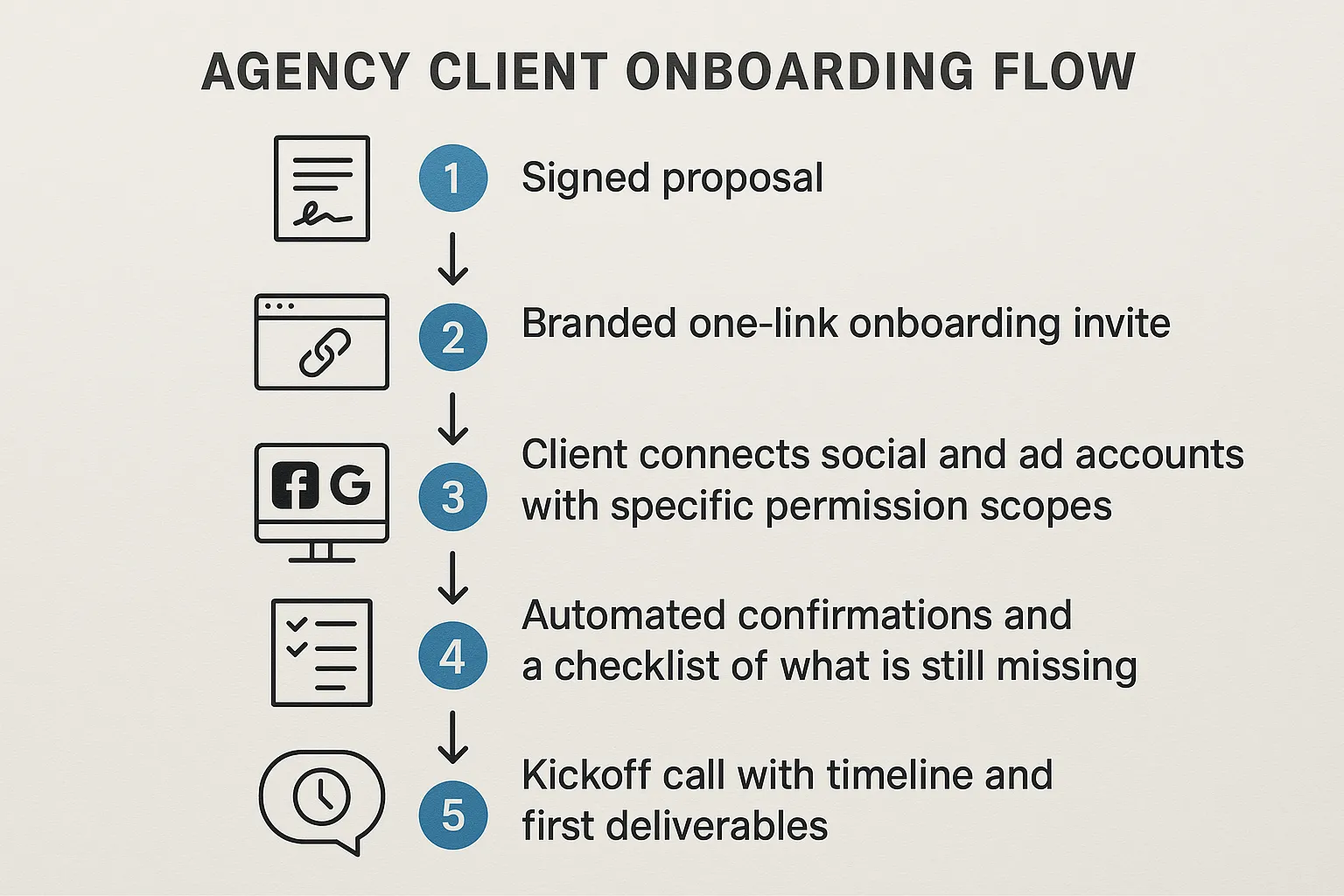
Here is what a trust-first onboarding looks like:
-
Send a branded one-link invitation that requests only the access you need, not full admin by default.
-
Provide a 10 minute checklist with due dates, what connects where, and how you will verify access.
-
Confirm completion in real time, then recap what you received and what is still outstanding.
-
Share your 30, 60, and 90 day plan with milestones and the exact metrics you will use.
Core assets to request by platform
| Platform | What you typically need | Typical permission scope | How to verify |
|---|---|---|---|
| Meta (Facebook and Instagram) | Page access, Ad Account, Pixel, Catalog if applicable | Advertiser or Analyst as needed, only request Admin when required for setups | Confirm you can view ad account, events in Events Manager, and catalog items |
| Company Page admin or content access, Campaign Manager account, Insight Tag | Account Manager or Campaign Manager roles aligned to work | Load Campaign Manager and confirm you see accounts, verify Insight Tag fires | |
| TikTok | Ads account, Pixel | Operator or Analyst for campaigns and reporting | Confirm pixel events and account billing status |
| Google (Ads, Analytics, Tag Manager) | Google Ads account, GA4 property access, GTM container | Standard or Edit depending on tasks, avoid owner-level unless required | View streaming data in GA4 and test tags in GTM preview |
| YouTube | Channel permissions via Brand Account or Studio | Editor limited to needs, or Viewer for reporting | Confirm access to analytics and video library |
| Business account access, Pinterest Tag | Analyst or Ad Manager role | Check tag validation and account visibility | |
| X (Twitter) | Ads Manager account, website tag if used | Campaign Manager or Analyst | Confirm account visibility and event collection |
| Other channels | Appropriate ad accounts, pixels, catalogs, data sources | Least privilege for the tasks | Send a small test event or pull a report successfully |
Never ask for passwords over email. Use role-based invites, require multi-factor authentication, and keep an audit trail of who requested which permissions and why.
Make security and compliance obvious
Security is a trust story your client should see and understand. You do not need to drown them in jargon, simply show that you are applying modern best practices and requesting the least access required.
- Ask for the narrowest permission scope that supports the task.
- Use MFA everywhere and document where it is enabled.
- Keep an access log, who has access to which accounts, who approved it, and when it expires.
- Separate production from experimentation, limit who can publish live assets.
- Align with Zero Trust principles from NIST so stakeholders understand your approach to minimizing risk. See NIST SP 800-207 on Zero Trust Architecture.
Link for reference: NIST SP 800-207 Zero Trust Architecture
Prove ROI early with a 30-60-90 plan
Clients hire your social media marketing agency to create commercial impact. A simple 90 day plan shows how you will move from access to insights to outcomes.
| Phase | What you deliver | Example KPIs | Why it builds trust |
|---|---|---|---|
| 0 to 30 days | Asset access complete, baseline measurement, tracking audit, first creative and audience tests, brand safety checks | Access completion rate, time to first campaign live, data freshness, CTR, CPM | Shows momentum, verifies data integrity, demonstrates you can ship |
| 31 to 60 days | Structured testing plan, creative and hook variations, landing page improvements, budget reallocation to early winners | Cost per result trend, quality lead rate, add-to-cart rate, video view-through, CPV | Proves you learn and adapt, not just spend |
| 61 to 90 days | Scaling winners, frequency management, cross-channel sequencing, quarterly business review | ROAS or CAC movement, pipeline attribution, revenue influenced | Connects the work to business outcomes and plans next quarter |
Keep your KPI set small and stable. For paid social, two or three quality indicators plus cost per result and one business metric are enough to tell a clear story.
Reporting and communication that reduce anxiety
Trust erodes when clients are surprised. Set a communication rhythm that makes progress visible and predictable:
- Weekly update, short notes on what shipped, what you learned, and what is next.
- Monthly review, deeper analysis of performance vs. plan, budget recommendations, creative insights.
- Quarterly business review, tie channel performance to pipeline or revenue, realign goals, plan next experiments.
Start every report with a one page executive summary. Put wins, risks, and decisions at the top. Use screenshots sparingly and annotate them so non-specialists can follow your logic.
Show authority without bragging
Buyers do not need hype, they need proof. Package your expertise into assets that reduce perceived risk.
- Case studies with clear baselines and outcomes (not just percent lifts, include absolute numbers when you can share them).
- Short frameworks that make your approach tangible, for example, your creative testing ladder or audience maturation model.
- Industry-specific playbooks for 2 or 3 verticals you serve best.
- A glossary of metrics and what each one means to business leaders.
Cite relevant industry research to ground your approach. Useful sources include the Edelman Trust Barometer, the Sprout Social Index, and Zendesk CX Trends.
Operational excellence clients can see
Behind the scenes, consistency creates trust. A few simple habits go a long way:
- Standardize naming, for example, Channel_Objective_Audience_Creative_Version_Date, helps any stakeholder recognize campaigns quickly.
- Version control your creative assets and document approvals so there is no confusion about what is live.
- Use pre-launch checklists, pixels firing, UTM parameters present, brand safety settings, frequency caps.
- Maintain a decision log for major changes, date, what changed, why, and expected impact.
When a client asks why performance changed, you can trace your steps and show the reasoning.
How Connexify helps agencies earn trust on day one
Connexify is client onboarding software purpose-built for agencies and service providers. It streamlines account access through a single, branded link, which removes manual steps and reduces onboarding time from days to seconds.
Here is how agencies use Connexify to make trust tangible:
- One-link client onboarding, replace scattered invites and risky credential requests with a single, secure flow that clients complete in minutes.
- Branded onboarding experience and white-label options, reassure clients they are still in your environment.
- Supports multiple platforms with customizable permission scopes, request only what you need for each channel and keep an audit trail in your dashboard.
- API and webhook integrations, trigger your internal workflows when a client connects an account, for example create tasks or update your CRM.
- User-friendly dashboard, see who connected what, what is missing, and follow up with precision.
- Secure data handling and no installation required, reduce friction for busy client teams.
- 14 day free trial, try it on your next client and measure the difference in time to value.
Learn more or request a demo at connexify.io.

Frequently Asked Questions
What should a social media marketing agency onboarding checklist include? Access invites for each platform with least privilege roles, a tracking and pixel audit, brand safety preferences, creative assets and brand guidelines, target audiences and exclusions, KPIs and budgets, and a timeline with due dates and owners.
How fast should clients expect results from paid social? You can usually ship a first campaign in the first week once access is complete. Expect signal collection and early learning in weeks one and two, meaningful optimization between 30 and 60 days, and clearer ROI visibility by 90 days depending on sales cycles.
How many platforms should we launch on at once? Start with one or two that best match the ICP and budget, then expand as you learn. Depth beats breadth early, it is easier to isolate variables and prove traction.
How do we handle credentials and permissions safely? Never share passwords over email. Use official role based invites, require multi factor authentication, keep an access log, and remove access that is no longer needed. Ask vendors about role based controls and audit trails.
What are the best early trust metrics to track? Access completion rate, time to first campaign live, data completeness, weekly learning velocity, one or two quality indicators like qualified lead rate or add to cart rate, and the trend in cost per result.
How can we reduce churn in the first 90 days? Set expectations up front, show progress weekly, tie work to business metrics monthly, and use a 30 60 90 plan so clients know what is coming next. Make security visible, and remove friction anywhere you can.
Ready to build more trust in less time?
Create a frictionless first impression with onboarding that clients actually enjoy. Try Connexify free for 14 days or book a demo to see how a single, branded link can turn days of back and forth into seconds.
Start here, https://www.connexify.io.