Web Marketing: A Practical Guide for Small Teams
01/28/2026

Most small teams don’t fail at web marketing because they lack ideas. They fail because they try to do everything at once, across too many channels, with unclear goals and weak measurement.
This guide is a practical, small-team-friendly system for web marketing: how to pick channels, build a conversion-ready site, track what matters, and run a weekly cadence that compounds.
What “web marketing” means for a small team
Web marketing is any activity that attracts attention online and converts it into revenue or pipeline, typically through your website (or landing pages) plus distribution channels like search, social, email, and paid ads.
For small teams, the goal is not “be everywhere.” The goal is:
- One clear audience (who you help)
- One clear offer (what you do and the outcome)
- One primary conversion (what you want visitors to do)
- One simple operating rhythm (how you execute each week)
If you can keep those four stable for 90 days, your marketing starts to behave like a system instead of a series of random tasks.
Step 1: Set a measurable goal (and one primary KPI)
Before you choose tactics, decide what success looks like in business terms. Common web marketing goals for small teams:
- Generate qualified leads for a sales team
- Drive trial signups for a SaaS product
- Book demos for a service business
- Increase ecommerce revenue
Then choose a primary KPI that matches that goal.
| Goal | Primary KPI | Supporting KPIs | Typical time-to-signal |
|---|---|---|---|
| Lead gen | Qualified leads per week | Landing page conversion rate, cost per lead, sales acceptance rate | 2 to 6 weeks |
| SaaS growth | Activated trials per week | Trial-to-paid rate, activation rate, time-to-value | 2 to 8 weeks |
| Ecommerce | Revenue per week | Conversion rate, AOV, CAC, repeat purchase rate | 1 to 4 weeks |
| Local service | Calls/bookings per week | Google Business Profile actions, form completion rate | 2 to 8 weeks |
A small team can track dozens of metrics, but it can only prioritize a few. Pick one KPI to drive decisions, and a short list of supporting KPIs to diagnose.
Step 2: Pick 1 to 2 acquisition channels you can win
Channel selection is where most small teams waste time. A useful rule: start with one “intent” channel and one “capture” channel.
- Intent channels capture existing demand (search, directories, referrals).
- Capture channels create demand and re-engage it (email, retargeting).
Here’s a practical way to choose.
| Channel | Best when | Small-team effort | Speed | Notes |
|---|---|---|---|---|
| SEO (content + pages) | People already search for your solution | Medium | Slow to medium | Compounds over time, needs consistency |
| Paid search | High intent keywords exist | Medium | Fast | Great for validation, can get expensive |
| Paid social | You have clear ICP + strong creative | Medium to high | Medium | Works best with a focused offer |
| Partnerships | Adjacent businesses serve your ICP | Medium | Medium | Often highest quality leads |
| Directories / listings | Your niche has trusted “where to find” sites | Low to medium | Medium | Underused, especially in niche markets |
| Email marketing | You can capture emails consistently | Low to medium | Medium | Best ROI channel long term |
If you’re unsure, start with SEO + email (compounding) or paid search + email (faster validation).
Step 3: Make your website conversion-ready (before scaling traffic)
More traffic won’t fix unclear messaging. Before you ramp channels, ensure your site answers these questions quickly:
- Who is this for?
- What outcome do they get?
- Why should they trust you?
- What should they do next?
A simple high-converting page structure
Most small teams benefit from a straightforward structure:
- Hero: one-sentence promise + primary CTA
- Problem and stakes: what happens if they don’t solve it
- Solution: your approach or product, explained plainly
- Proof: testimonials, case studies, numbers, logos (if you have them)
- How it works: 3 to 5 steps, minimal jargon
- FAQ: objections and edge cases
- Final CTA: repeat the next step
Also, don’t ignore performance and usability basics. Google’s Search Central documentation is the most reliable place to understand what helps search visibility and user experience.
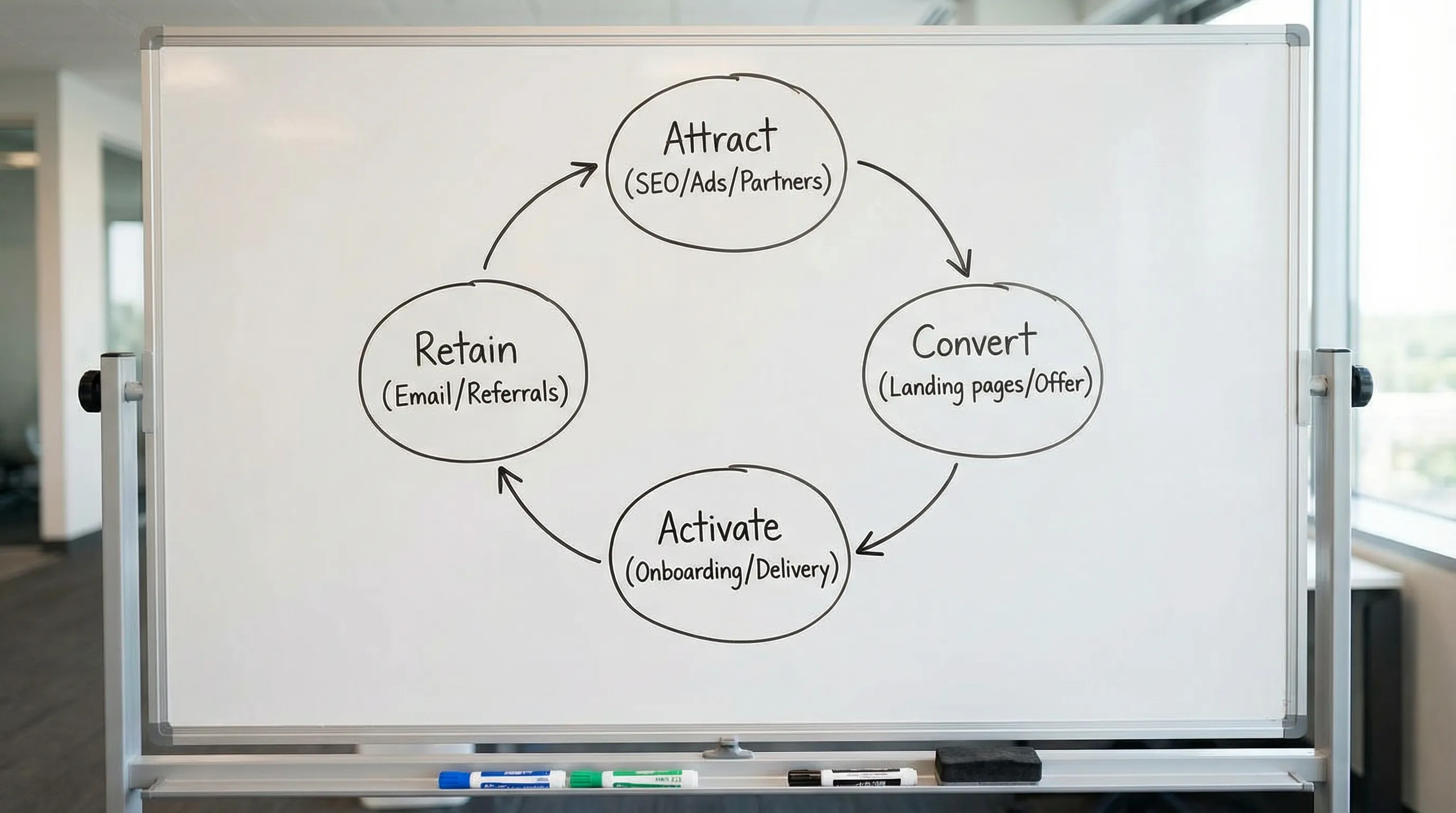
The most common conversion bottlenecks (small teams can fix fast)
- Too many CTAs: pick one primary action per page.
- Vague value proposition: replace “we help you grow” with a specific outcome and audience.
- No proof: even one quantified mini-case study beats none.
- Slow follow-up: conversion is not just the form, it’s the speed to the first real interaction.
Step 4: Set up “minimum viable measurement” in one afternoon
You do not need an enterprise analytics stack. You need clean basics:
- Google Analytics 4 for site behavior
- Google Search Console for organic search visibility
- UTM conventions for campaigns
- A simple dashboard (even a spreadsheet) reviewed weekly
What to track each week (without getting lost)
| Funnel stage | Track weekly | Why it matters |
|---|---|---|
| Acquire | Sessions by channel, top landing pages | Shows where attention is coming from |
| Convert | Conversion rate by landing page, form starts vs completes | Finds friction and broken pages |
| Qualify | % qualified leads, demo show rate | Protects you from vanity metrics |
| Revenue | Pipeline created, closed-won influenced | Keeps marketing tied to outcomes |
If your team can only do one thing this week: define what counts as a qualified lead and make sure it is captured in your CRM consistently.
Step 5: Build a content system that a small team can actually maintain
Small-team content wins by being:
- Narrow (one ICP, one category)
- Practical (templates, checklists, examples)
- Distribution-first (written to be repurposed)
A sustainable cadence for many small teams is:
- One “money page” improvement per week (homepage, landing page, pricing page, demo page)
- One content asset every 1 to 2 weeks (guide, checklist, comparison)
- Two distribution pushes per asset (newsletter, LinkedIn post, partner share)
When choosing topics, prioritize:
- Questions prospects ask on calls
- Objections that slow deals down
- “Alternative to” and “vs” comparisons (when you can be fair and accurate)
- Implementation content that reduces churn after purchase
Step 6: Use niche listings and communities to get qualified traffic
Not all web marketing is Google Ads and blog posts. In many markets, the fastest path to qualified visits is showing up where buyers already browse.
Examples include:
- Industry directories
- Marketplace partner pages
- Local and professional association listings
- Curated “best tools” lists
Even in gaming communities, niche directories can be a major discovery channel. For example, if you were marketing a Minecraft server or related service, being listed on a trusted Minecraft server directory helps players filter by game mode, version, and accessibility, which is exactly how intent-driven traffic works in that niche.
The small-team playbook here is simple:
- Find 10 places your ICP already trusts.
- Create one strong listing profile (clear promise, proof, CTA).
- Track visits and conversions from each listing using UTMs.
- Double down on the 2 to 3 that produce qualified actions.
Step 7: Turn onboarding and follow-up into a marketing advantage
Small teams often focus on acquisition, but speed to value is what drives retention, referrals, and case studies.
Two practical moves:
1) Respond faster than competitors
If someone fills out a form or requests a demo, your speed matters. A simple SLA like “respond within 15 minutes during business hours” can outperform many sophisticated campaigns.
2) Remove friction after the “yes”
If you’re an agency or service provider, your marketing results are constrained by how quickly you can start work. Delays are usually caused by:
- Waiting on account access across multiple platforms
- Chasing asset IDs, permissions, and logins
- Back-and-forth emails that confuse stakeholders
This is where operational tooling becomes part of web marketing, because it protects your reputation and improves time-to-value.
If you want a deeper operational view, Connexify’s blog also covers how agencies treat onboarding as an execution layer, not an afterthought. A good place to start is: How digital marketing agencies streamline client onboarding.
A 90-day web marketing plan for small teams (simple, not easy)
You don’t need a complex roadmap, you need a sequence.
Days 1 to 14: Foundation
- Clarify ICP, offer, and primary KPI
- Fix top 3 pages (homepage, a core landing page, contact/demo)
- Set up GA4, Search Console, and UTMs
- Decide your 1 to 2 channels
Days 15 to 45: Publish and distribute
- Ship 2 to 3 high-intent pages or articles
- Add proof blocks (mini case studies, quantified outcomes, testimonials)
- Start a simple email capture and a monthly newsletter
Days 46 to 90: Optimize and systemize
- Improve conversion on your top landing pages
- Expand what works (more of the same topic cluster, more of the same ad group)
- Document your weekly cadence and handoffs
Frequently Asked Questions
What is web marketing, in simple terms? Web marketing is how you attract people online and convert them into leads, signups, or customers, usually through your website plus channels like search, social, email, and ads.
What’s the best web marketing channel for a small team? The best channel is the one your audience already uses and that you can execute consistently. Many small teams start with SEO (compounding) plus email (retention and nurturing).
How much should a small business spend on web marketing? It depends on goals and margins, but a practical approach is to start small, prove a repeatable cost per lead or cost per acquisition, then scale gradually.
How long does web marketing take to work? Paid channels can produce signals in days, while SEO typically takes weeks to months. The key is setting up measurement so you can see early indicators like conversion rate and lead quality.
What should I measure first in web marketing? Start with one primary KPI tied to revenue (qualified leads, demos booked, activated trials), then track conversion rate and lead quality to avoid optimizing for vanity traffic.
Make onboarding part of your growth engine
If you’re a small agency or service provider, web marketing does not stop at “lead acquired.” The handoff after the sale is where momentum is won or lost.
Connexify helps streamline client onboarding with one branded link that enables fast, secure access setup across platforms, with customizable permissions, white-label options, and API/webhook integrations. That means less back-and-forth, fewer delays, and faster time-to-value for clients.
Explore Connexify at connexify.io, book a demo, or start your 14-day free trial to see how much time a standardized onboarding flow can save.