Social Media Marketing Company Near Me: Checklist
01/23/2026

Hiring a social media marketing company near me sounds simple until you realize most “local” providers still operate like a remote vendor: vague deliverables, unclear reporting, and a slow, messy onboarding that burns your first month.
This checklist is designed for decision-makers who want to choose a local (or locally available) team and get to results faster, with fewer surprises.
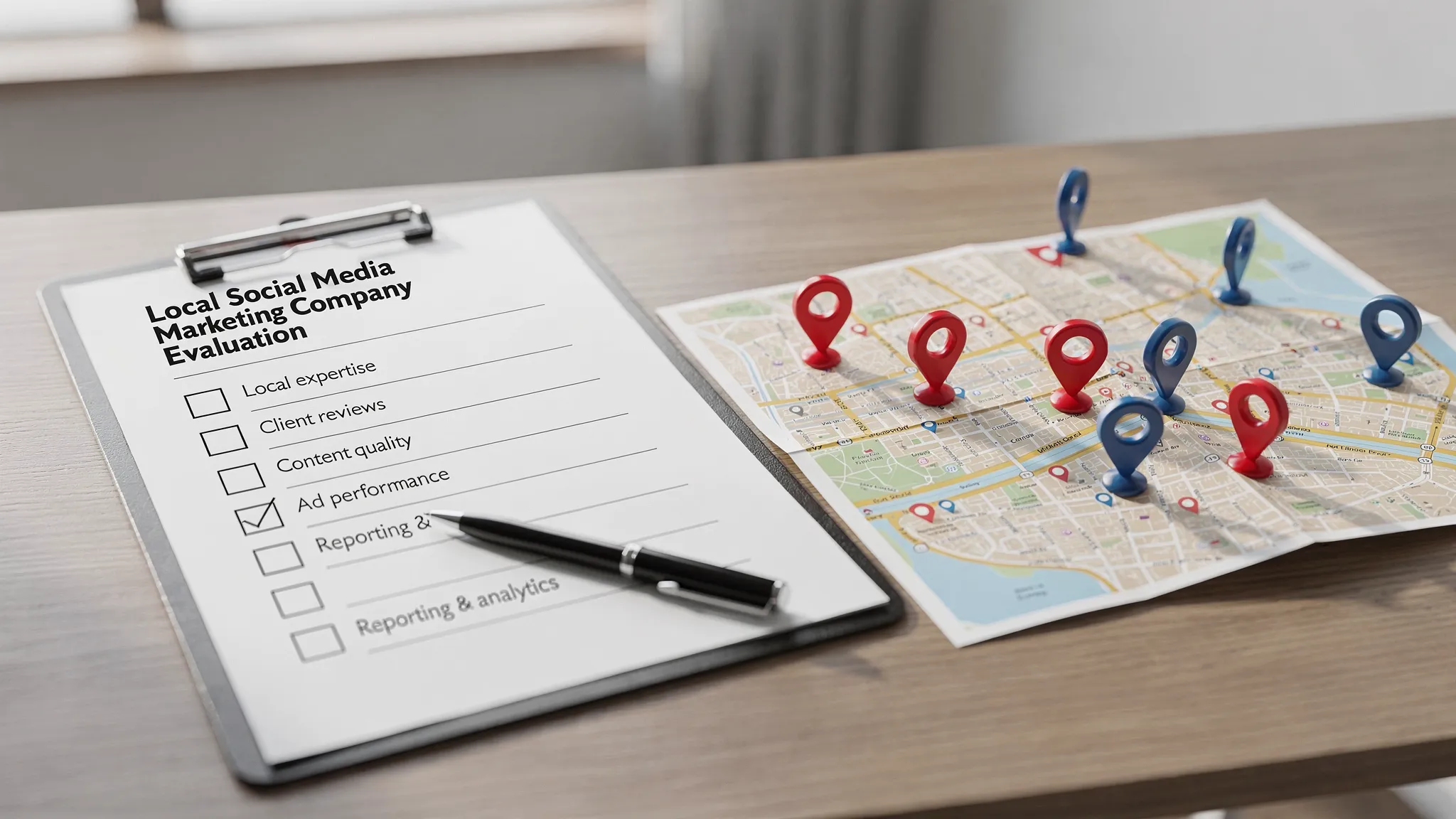
How to use this checklist (without turning it into a 3-week project)
Use it in three moments:
- Before you book calls: filter out weak options in 15 to 20 minutes.
- During the discovery call: validate strategy, fit, and how they work.
- Before you sign: confirm onboarding, measurement, and commercial terms.
If a company cannot answer these clearly, it usually shows up later as missed deadlines, “we need access to X” delays, and reporting that does not map to revenue.
The “near me” reality check (what local should actually mean)
A local social media marketing company is valuable when it improves speed, context, and collaboration, not because their address is close.
Local should translate into at least one of these advantages:
- You can meet in person for kickoff, content capture, or stakeholder alignment.
- They understand your local market dynamics (seasonality, competitors, community channels).
- They can respond quickly when approvals, brand issues, or events happen.
- They have proven results with businesses like yours in your region.
If the pitch is mostly about “we’re nearby,” treat that as a weak differentiator.
Checklist Part 1: Fit and credibility (fast pre-screen)
Before you take a call, verify whether the company is likely to perform.
Proof you want to see
- Case studies with context: industry, offer, budget range (if paid social), time window, and what changed.
- Specific outcomes: not just “engagement,” but leads, booked calls, sales, or pipeline (depending on your funnel).
- Real constraints: what they could not control (inventory, pricing, brand approvals, long sales cycle).
Reviews and reputation signals (what matters)
Look for patterns, not star ratings.
- Do reviews mention responsiveness, clarity, and follow-through?
- Do they mention measurable impact, not just “nice people”?
- Do negative reviews show a consistent operational issue (missed deadlines, billing disputes, account access chaos)?
Local relevance
Ask for one example where they improved results in a comparable local environment (same city size, similar customer behavior, similar competition). If they cannot, they are not truly “near you” in the way that matters.
Checklist Part 2: Strategy clarity (can they explain how growth will happen?)
A strong company can explain its plan in plain language, then connect it to metrics.
Questions to ask
What is your working hypothesis for growth in our business? A good answer includes audience, offer angle, channel mix (organic vs paid), and the first constraint to remove.
How do you translate social into revenue for a business like ours? Expect a funnel explanation: awareness to intent to conversion, plus what gets tracked.
What are the first 30 days designed to prove? You want a concrete “proof of progress” plan, not a content calendar as the only output.
What to avoid
- Over-promising virality.
- “We’ll post consistently and engagement will follow.”
- No mention of measurement readiness (pixels, events, UTMs, CRM handoff).
Checklist Part 3: Content and creative (the difference between activity and performance)
Social performance often hinges on creative throughput and feedback loops.
Confirm their production system
- Content inputs: what they need from you (brand guidelines, product shots, access to subject matter experts).
- Creative cadence: how many new creative concepts per month (and how iterations happen).
- Approvals workflow: who approves, where, and what happens when approvals are late.
A practical “creative quality” test
Ask for 3 examples of work that match your situation:
- One example with a similar offer.
- One example with a similar target audience.
- One example where performance improved after iteration (what changed and why).
If you need physical brand visuals
For local businesses that shoot on-site (clinics, gyms, real estate offices), small environment upgrades can improve video consistency. If you need easy set-ready wall art for backdrops or office visuals, you can browse ready-to-hang art prints and posters to quickly elevate your space without a long sourcing process.
Checklist Part 4: Paid social capability (if ads are part of your plan)
Even if you start organic-first, many companies will recommend paid amplification once you have winning creative.
What “good” paid social answers include
- Account structure: how campaigns will map to your funnel.
- Testing plan: how they test creative, audiences, and offers.
- Budget logic: how they decide spend levels (and what must be true before scaling).
- Landing experience: how they ensure clicks turn into leads or purchases.
Minimum standards (non-negotiables)
- You retain ownership of ad accounts and key assets whenever possible.
- Clear access model (partner access, role-based permissions).
- No password sharing as a process.
Checklist Part 5: Measurement and reporting (what you will see every month)
Reporting should help you make decisions, not just summarize activity.
Ask to see a sample report
You are looking for:
- A small set of primary KPIs tied to the goal (leads, booked calls, purchases, pipeline).
- The “why” behind performance changes (creative, targeting, offer, landing page, seasonality).
- Next actions, owners, and timelines.
Confirm tracking readiness
In 2026, measurement still breaks most often due to basics: incorrect pixels/events, missing UTMs, broken handoff to CRM, or unclear definitions of “qualified.” If they do not have a tracking readiness step before launch, you are likely to lose the first few weeks.
Checklist Part 6: Onboarding and access (where most engagements lose time)
This is the most overlooked part of hiring a social media marketing company near me.
Even great strategists stall when access to Meta, TikTok, Google Analytics, creative assets, and approvals is handled through scattered emails and “can you add me?” messages.
What to ask about onboarding
What do you need from us in the first 72 hours? You want a clear bill of materials: accounts, IDs, permissions, brand assets, approvals, and points of contact.
How do you request and verify access across platforms? Look for a standardized flow, not a one-off manual scramble.
How do you handle permissions and security? Expect least-privilege access, auditable steps, and a clean offboarding plan.
A simple onboarding scorecard you can use
| Area | What to verify | What “good” looks like |
|---|---|---|
| Access | They can list required assets per platform | Clear IDs, roles, and verification steps |
| Speed | They have an onboarding SLA | They can explain how they avoid multi-day delays |
| Security | No password sharing | Role-based permissions, 2FA expectations |
| Transparency | You can see onboarding status | A single source of truth for what is pending |
| Handoffs | Sales to delivery is structured | Owners, timelines, and clear next steps |
If you want onboarding to feel like one coherent experience (instead of a dozen separate logins and emails), tools like Connexify are built for exactly this. Connexify streamlines client onboarding with one branded link that helps agencies and service providers set up fast, secure account access across platforms, with customizable permissions, white-label options, and integrations via API and webhooks.
Checklist Part 7: Commercial terms and working model (prevent surprises)
Most disappointment comes from mismatched expectations, not bad intent.
Confirm the scope in plain English
- What is included for organic social (posting, community management, content creation)?
- What is included for paid social (creative, media buying, landing page support, tracking)?
- What is excluded (photo shoots, influencer management, copywriting volume, revision rounds)?
Ask about SLAs
Look for commitments around:
- Response times.
- Revision turnaround.
- Reporting cadence.
- Time-to-launch assumptions (and what delays it).
Pilot options
If you are uncertain, ask for a short pilot with a clear pass/fail definition. A reputable company will be able to define what success looks like in a limited time window.
Red flags that should end the evaluation
Treat these as hard stops:
- They want you to share passwords (instead of using roles/partner access).
- They cannot explain what they need to get started.
- Reporting is only vanity metrics (likes, reach) with no business connection.
- They cannot describe a testing process for creative and messaging.
- They over-promise outcomes without asking detailed questions about your offer, margins, capacity, or conversion flow.
Quick decision table: compare 2 to 4 companies objectively
Use this to prevent “best sales call wins.” Score each item 0 to 2 (0 = missing, 1 = partial, 2 = strong).
| Category | What you score | 0–2 score |
|---|---|---|
| Fit | Relevant proof in your industry or local market | |
| Strategy | Clear plan and first-30-days priorities | |
| Creative | Strong examples plus iteration process | |
| Paid (if needed) | Testing plan, structure, and access model | |
| Measurement | Tracking readiness plus decision-grade reporting | |
| Onboarding | Clear bill of materials, fast access, secure permissions | |
| Commercial | Scope clarity, SLAs, and change control |
A company with a slightly higher fee but a much stronger onboarding and measurement process often wins on total cost, because you avoid weeks of delay and rework.
Frequently Asked Questions
What should a social media marketing company near me provide in the first month? A clear onboarding plan, access verification across platforms, tracking readiness, initial creative and messaging tests, and a reporting cadence tied to business goals.
Do I actually need a local company, or is remote fine? Remote can work well if they have strong operations and fast onboarding. Local matters most when you need on-site content capture, in-person stakeholder alignment, or deep local market context.
How do I know if a company is good at paid social versus organic? Ask for separate proof and processes. Paid requires a testing framework, measurement discipline, and secure access handling. Organic requires editorial planning, creative systems, and community management.
What’s the biggest cause of delays after signing? Access and approvals. Missing asset IDs, unclear permissions, slow handoffs, and scattered onboarding steps can stall launch for days or weeks.
Should I give an agency full admin access to everything? Usually no. Use least-privilege, role-based access that matches the scope, and make sure access can be audited and revoked cleanly.
Make onboarding your advantage (not your bottleneck)
If you are hiring a social media marketing company and want results faster, focus on the part most businesses ignore: a secure, standardized onboarding flow.
Connexify helps agencies and service providers onboard clients through one branded link, with fast multi-platform access setup, customizable permissions, white-label options, and integrations via API and webhooks. You can explore Connexify at connexify.io and start with the 14-day free trial or book a demo to see the flow end to end.