Social Media Agency Services: What to Expect
01/07/2026

Hiring a social media agency can feel like buying a “black box”: you pay a monthly retainer, content appears, and you hope it turns into revenue. The best agencies are the opposite. They run a clear operating system with defined deliverables, fast setup, tight governance, and reporting you can actually use.
This guide breaks down social media agency services in practical terms: what’s usually included, how work typically flows, what you’ll be asked to provide, what results are realistic, and what to look for before you sign.
What social media agency services usually include
Most agencies mix and match from the same core service categories. The differences are in depth, quality, and how well those services connect to your business goals.
Strategy and planning
A solid agency starts with a plan that connects social activity to outcomes (pipeline, ecommerce revenue, qualified traffic, retention, or brand demand).
Typical deliverables:
- Brand and channel audit (what’s working, what’s wasting time)
- Audience and positioning guidance
- Content pillars and messaging framework
- Channel plan (which networks, what to post, and why)
- Measurement plan (what to track and how it ties to business KPIs)
Organic social (content, publishing, and community)
Organic services are about consistent publishing and engagement that matches your brand voice.
Typical deliverables:
- Content calendar (weekly or monthly)
- Post creation (copy + creative, depending on scope)
- Scheduling and publishing
- Comment and message management (sometimes during business hours)
- Community engagement (responding, liking, proactive outreach)
Paid social (ads management)
If you’re investing in growth, many agencies add paid social to speed learning and reach.
Typical deliverables:
- Campaign structure and targeting strategy
- Creative testing plan (angles, hooks, offers)
- Budget pacing and optimization
- Pixel/conversion tracking coordination
- Weekly performance checks (sometimes daily during launches)
Creative production (design, video, and UGC coordination)
Increasingly, performance depends on creative volume and iteration speed.
Typical deliverables:
- Static design templates and variations
- Short-form video editing for Reels/TikTok/Shorts
- UGC sourcing guidance or creator coordination (varies by agency)
- Creative performance insights (what patterns are winning)
Analytics and reporting
Reporting should answer: “What happened, why, and what are we doing next?” not just screenshot metrics.
Typical deliverables:
- Monthly performance report
- Insights summary tied to goals (leads, purchases, demos booked)
- Recommendations and next-month plan
- Attribution notes (what can and cannot be proven)
Governance, compliance, and brand safety
This is often overlooked until something goes wrong.
Typical deliverables:
- Role-based access and permissioning guidance
- Approval workflows (especially in regulated industries)
- Escalation path for sensitive comments or PR issues
- Account ownership clarity (client-owned assets, agency access)
Add-ons you may see
These can be valuable, but they’re not always necessary at the start.
Common add-ons:
- Influencer/creator campaigns
- Social listening and reputation monitoring
- Social commerce support (catalogs, product tagging)
- Employee advocacy programs
- Customer support workflows (routing DMs to helpdesk)
A quick “what’s included” checklist
Use this table to sanity-check proposals. A good proposal doesn’t need every item, but it should clearly state what you are and are not getting.
| Service area | What you should expect to receive | What to clarify before signing |
|---|---|---|
| Strategy | Audit insights, channel plan, content pillars, measurement plan | How often strategy is revisited (monthly, quarterly) |
| Organic content | Calendar, copy, creative (or clear scope), publishing | Monthly post volume, revision rounds, who supplies assets |
| Community | Response guidelines, engagement cadence, escalation rules | Response time, coverage hours, crisis handling |
| Paid social | Build, optimize, test plan, budget pacing, reporting | Ad spend is separate, creative volume, landing page responsibility |
| Reporting | KPI-driven insights + next actions | What metrics matter (not vanity), attribution limitations |
| Governance | Secure access approach, approvals, documentation | No password sharing, least-privilege roles, offboarding process |
How an engagement typically runs (from kick-off to steady-state)
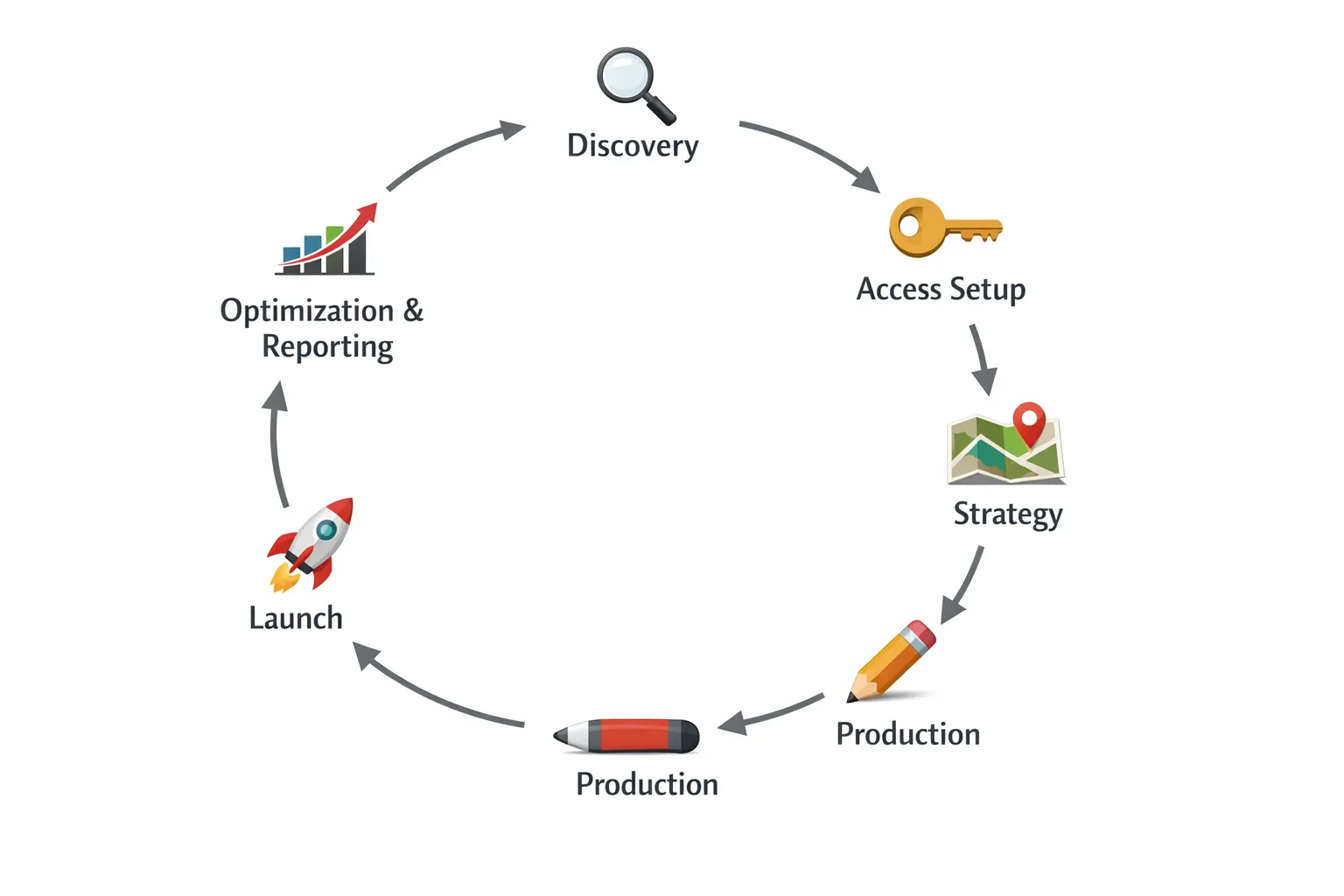
Even if two agencies offer similar deliverables, the best ones run a tighter process. Here’s the “normal” lifecycle you should expect.
Discovery and audit
This is where the agency learns your business model, offer, past performance, and constraints.
You’ll typically discuss:
- Your growth targets (and how you currently measure success)
- Your ideal customer profile
- Your strongest offers and objections
- Past creative and campaign learnings
- Brand voice, approvals, and risk tolerance
Onboarding and access setup
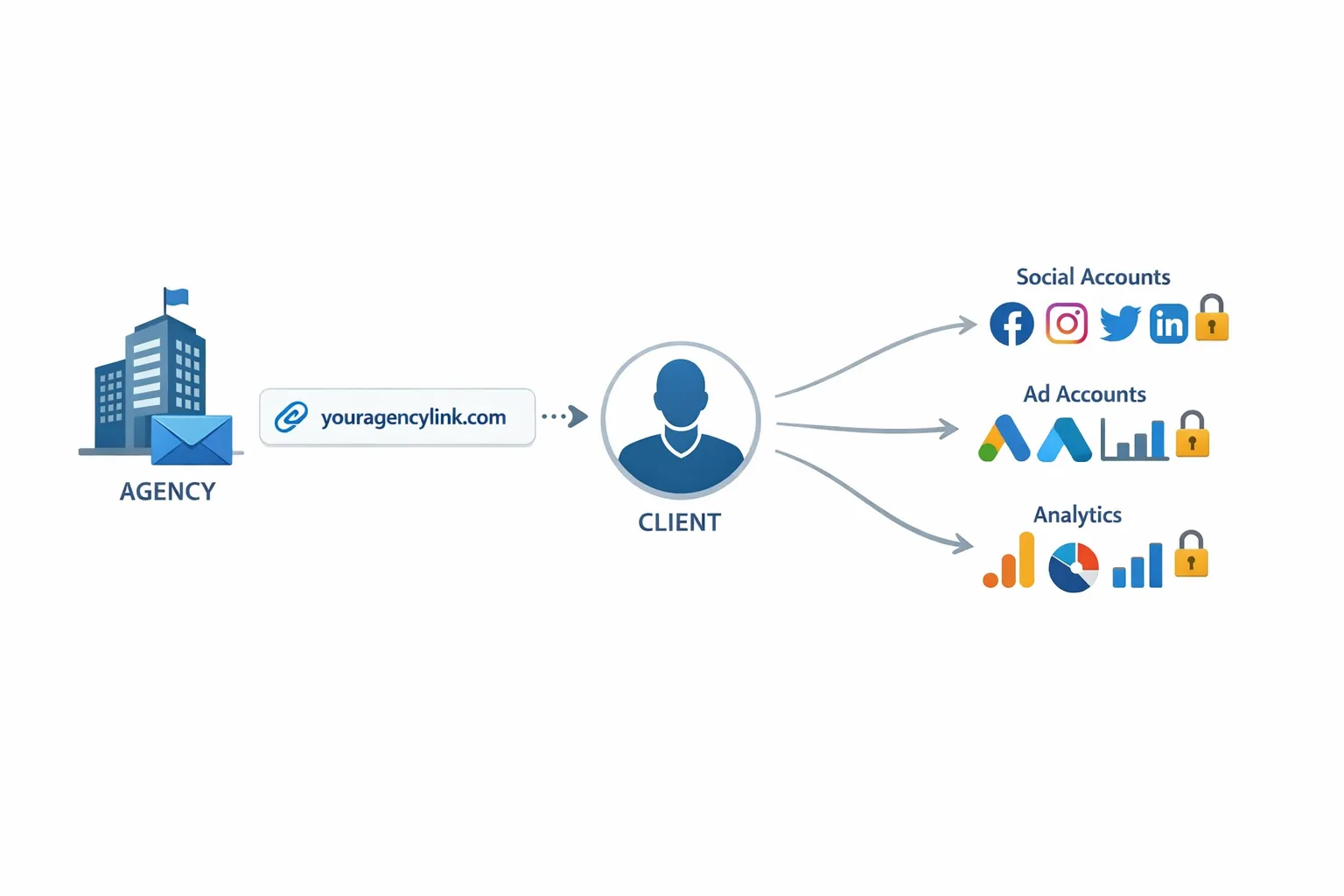
This is where timelines often slip. To deliver results, the agency needs access to the right assets with the right permissions.
A professional agency will:
- Request access via platform-native partner methods when possible
- Avoid password sharing
- Ask for only the permissions required (least privilege)
- Document what was granted and by whom
If onboarding is chaotic, it’s a red flag. It usually predicts messy reporting, missed deadlines, and security issues later.
Production and launch
Once access and strategy are in place, execution begins:
- Content creation and approvals
- Publishing and community management
- Paid campaign build and creative testing (if included)
- Tracking verification (if applicable)
Optimization and reporting cadence
After the first few weeks, you should settle into a repeatable rhythm:
- Weekly check-ins (often 15 to 30 minutes)
- Monthly reporting + next-month plan
- Quarterly strategy refresh (especially for paid and creative)
What a good agency will ask you for (and what you should prepare)
Expect the agency to request information and assets that speed up decision-making and reduce back-and-forth. If they don’t ask for these, you may end up paying for “figuring it out” time.
Business inputs
You’ll typically be asked for:
- Primary goal (pipeline, ecommerce revenue, awareness, retention)
- Target audience and priority geographies
- Top products or services, offers, and margins (at least ranges)
- Differentiators, proof points, and customer objections
- Competitive set (who you win against and who you lose to)
Brand and creative inputs
To avoid generic output, agencies usually need:
- Brand guidelines (voice, tone, visual rules)
- Approved claims and disclaimers (especially in regulated industries)
- Existing creative library (photos, product shots, videos, testimonials)
- Examples of content you like (and content you hate)
Operational inputs
These keep work moving:
- A single point of contact and backup approver
- Approval SLA (for example, approvals within 48 hours)
- Escalation path for sensitive comments or PR concerns
- Customer support routing rules for DMs (if community management is included)
Access inputs (the “keys to the kingdom”)
Access requests vary by platform and service scope, but you should expect requests for:
- Social profiles (Page, channel, handle)
- Ad accounts (if running paid)
- Tracking and analytics tools (if measuring conversions)
- Website or landing page access (often read-only or via collaboration tools)
Here’s a helpful way to think about the handoff:
| Category | Client typically provides | Agency typically provides |
|---|---|---|
| Goals | Targets, constraints, definition of a qualified lead/sale | KPI plan, forecasting assumptions, reporting framework |
| Brand | Guidelines, do-not-say list, approved claims | Voice and creative system, templates, content pillars |
| Creative assets | Photos, product info, testimonials, case studies | Variations, hooks, edits, testing roadmap |
| Access | Partner access approvals, admin contacts, billing owner | Permission guidance, setup checklist, documentation |
| Feedback | Timely approvals and business context | Iteration, optimization, and clear next steps |
Results you should expect (and what you should not)
Social can drive serious outcomes, but timelines matter. In most engagements, you’ll see progress in layers.
What you can reasonably expect in the first 30 days
- Clean foundations (profiles, tracking coordination if applicable, publishing cadence)
- Clear creative direction (what themes and formats you’re leaning into)
- Early performance signals (top posts, early ad CTR/CPA ranges if running paid)
What usually takes 60 to 90 days
- More reliable performance baselines
- Clearer audience and creative winners
- Improved conversion rates (often tied to landing page improvements)
What you should be skeptical of
- Guaranteed virality
- Guaranteed revenue outcomes without controlling the conversion path
- “We do everything” without defining scope, owners, and timelines
One practical note: social performance often bottlenecks on the destination. If your landing pages are slow, unclear, or not conversion-focused, even great campaigns stall. If you need help tightening that foundation, partnering with a specialist team for custom web design can improve conversion rates and make your social spend work harder.
Pricing and contract structures you’ll commonly see
Agencies price social in a few standard ways. None are automatically good or bad. The key is matching the model to your goals and risk tolerance.
Monthly retainer
Best for ongoing content + community + iterative optimization.
Commonly includes:
- A set amount of content production
- Publishing and management
- Reporting and ongoing strategy
Watch-outs:
- Vague scope that enables endless “out of scope” upsells
- No defined deliverables (post volume, response times, revision limits)
Project-based (one-time)
Best for audits, strategy builds, or creative sprints.
Commonly includes:
- Audit + strategy deck
- Content system setup
- Template packs
Paid social management fee
Often charged as:
- A flat monthly fee, or
- A percentage of ad spend (with minimums)
Clarify whether creative production is included, because creative volume often determines performance.
Performance-based components
These can work, but require tight definitions (what counts as a lead, attribution window, CRM access). Be cautious if measurement is weak or the agency cannot influence the full funnel.
How to evaluate an agency before you sign
A strong website and portfolio are not enough. You’re buying execution quality and operational reliability.
Ask how they run delivery
You want specificity:
- Who does the work (senior strategist vs rotating junior team)
- How content is created, reviewed, and approved
- What the monthly cadence looks like
- How they handle experiments and learning
Ask how they measure success
A good agency can explain:
- Which metrics matter for your stage (awareness vs demand capture)
- How they handle attribution limits
- What leading indicators they watch (creative fatigue, frequency, CTR, saves, watch time)
Ask about access, security, and offboarding
This is a reliability test. Look for answers that include:
- Partner access models (instead of sharing passwords)
- Least-privilege permissions
- Documentation and audit trails
- A clear offboarding plan (removing access, transferring assets)
Ask what “fast onboarding” means in their world
Speed matters because it reduces wasted weeks. A professional team should be able to describe a standard timeline to:
- Receive access
- Confirm tracking readiness (if applicable)
- Publish first content
- Launch first paid tests (if included)
Why onboarding is part of the service (even if nobody calls it that)
Many businesses evaluate agencies on creative and strategy, but overlook onboarding. In reality, onboarding is where agencies either:
- Build trust through clarity and security, or
- Create friction that drags down time to value
Modern agencies increasingly use onboarding software to make access setup predictable across platforms, especially when multiple tools and permissions are involved.
If you’re an agency or service provider looking to productize a faster, safer handoff, Connexify is designed for exactly this. It provides one-link client onboarding with a branded experience, customizable permissions, support for multiple platforms, white-label options, and API/webhook integrations, so access setup can move from “days of back-and-forth” to a standardized flow.
You can learn more or start a 14-day free trial at Connexify.
The bottom line
When you hire a social media agency, you’re not just buying posts. You’re buying a system: strategy, production, publishing, optimization, and governance, all tied to business goals.
If you’re comparing providers, use this article as your baseline: confirm deliverables, cadence, measurement, and especially how access is handled. If you’re running an agency and want onboarding to be a competitive advantage instead of a bottleneck, a single branded onboarding flow can be the difference between launching in days and launching in weeks.