Online Marketing Agencies: How to Vet Them Fast
01/13/2026

Hiring an online marketing agency should feel like buying speed, clarity, and execution. In reality, it often turns into weeks of vague proposals, inconsistent answers, and uncertainty about who will actually do the work. The fastest way to vet agencies is to evaluate how they think, how they measure, and how they operationalize delivery (especially onboarding, access, and reporting).
Below is a practical, time-boxed framework you can run in a day or two to separate “sounds good” from “will perform.”
What “vetting fast” actually means
Speed does not mean skipping due diligence. It means compressing due diligence into the few signals that predict outcomes.
A strong online marketing agency usually shows competence in three places early:
- Diagnosis: they ask better questions than you do.
- Evidence: they can prove results in situations similar to yours.
- Operations: they have a repeatable onboarding and measurement process (no chaos, no credential scavenger hunt).
If you evaluate those three areas in a structured way, you can confidently shortlist in under an hour, run two high-signal calls, and decide without “analysis paralysis.”
Step 1 (15 minutes): Write a one-page “win definition”
Most agency relationships fail because the buyer and agency never agree on what success looks like.
Before you take calls, write a one-page definition of “win” that includes:
- Your primary growth goal (examples: qualified pipeline, ecommerce revenue, booked calls)
- Your constraint (budget ceiling, internal bandwidth, launch date)
- Your non-negotiables (compliance needs, brand guidelines, geographic targets)
- What you already have (CRM, analytics stack, ad accounts, creative resources)
This becomes your filter. Agencies that cannot translate your win definition into a plan will waste your time later.
Step 2 (20 minutes): Build a shortlist using “fit filters,” not Google rankings
Search results and awards are weak signals. Instead, use fit filters that reduce risk:
Service-to-problem fit
You are not hiring “marketing.” You are hiring a solution to a specific bottleneck.
Examples:
- If you need fast demand capture, prioritize agencies with deep paid search / paid social systems.
- If you need compounding growth, prioritize SEO + content capability.
- If you need higher conversion efficiency, prioritize landing page + CRO strength.
An agency can be excellent and still be the wrong tool for your job.
Proof-in-context
Look for proof that matches your reality, not vanity metrics:
- Similar price point and sales cycle
- Similar traffic sources
- Similar conversion event (lead forms vs product purchases)
- Similar constraints (small team, regulated industry, limited creative)
Operator credibility
A fast check that often works: find one long-form artifact.
- A detailed case study with methodology
- A teardown video or written audit
- A playbook-style article that shows their thinking
If everything is only short posts and polished slogans, assume the delivery engine is thin.
Step 3 (10 minutes): Run a “proposal reality check” before you take calls
Ask for two things before a sales call:
- A one-page plan: channels, milestones, what they need from you, and what they will deliver in the first 30 days.
- A sample report or dashboard: what you will see weekly or monthly.
If they refuse or send generic templates, you just saved yourself an hour.
Step 4 (30 minutes): Use a high-signal discovery call agenda
A good agency call is mostly them clarifying your situation and constraints, then describing tradeoffs.
Use this agenda to keep it fast and comparable:
1) “What would you do in the first 14 days?”
You are listening for operational clarity.
A strong answer includes:
- Asset and access requirements (ad accounts, analytics, CMS, CRM)
- Measurement plan (events, attribution limits, naming conventions)
- Launch sequencing (what must be true before spending ramps)
A weak answer jumps immediately to tactics (“we’ll run ads and test creatives”) without prerequisites.
2) “What would make you say no to working with us?”
This question forces honesty. Strong agencies have disqualifiers.
Examples of healthy disqualifiers:
- No ability to implement tracking
- No budget to achieve statistical learning (for paid media)
- Product margins too thin for paid acquisition
If they say yes to everything, they are selling, not diagnosing.
3) “Show me a similar engagement and walk me through the numbers”
Ask them to narrate:
- Baseline situation
- Intervention (what changed)
- Timeframe
- What did not work (and what they did next)
If they cannot explain failures, you are not seeing the full truth.
Step 5 (20 minutes): Evaluate their onboarding and access model (this is the hidden tell)
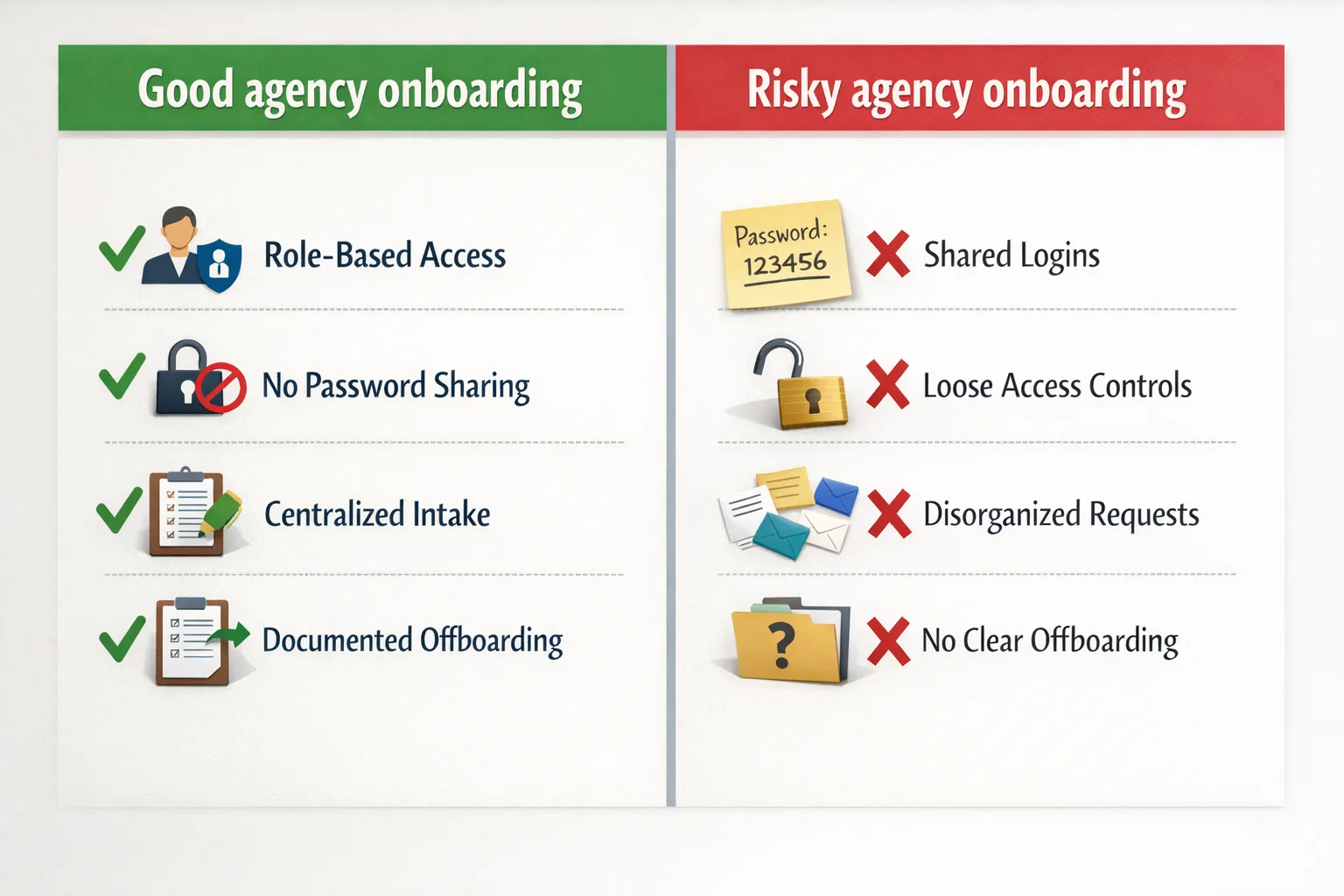
Online marketing performance is constrained by access, approvals, and measurement readiness. Agencies that onboard well tend to execute well.
Here’s what “good” sounds like when you ask how onboarding works:
- They do not ask for passwords.
- They request role-based access (least privilege) across platforms.
- They have a single place for onboarding intake, IDs, and permissions.
- They can explain how they handle offboarding and access removal.
If you operate in a regulated industry, also ask how they handle data protection obligations. When you need deeper guidance on privacy governance, policies, or compliance programs, involving specialists like privacy and compliance consultants can help you pressure-test an agency’s approach.
The 10-question “fast vetting” script (copy/paste)
Use these questions in order. They are designed to surface capability, honesty, and operational maturity quickly.
- What is the fastest path to measurable value for our business, and what assumptions does that depend on?
- Which channel would you deprioritize first, and why?
- What does your first 30 days deliverable list look like (not activities, deliverables)?
- Who is on the account day-to-day, and what % of their time is actually allocated?
- How do you set up tracking, events, and attribution, and what do you do when tracking is incomplete?
- What does your weekly communication cadence look like, and what gets discussed?
- Show a similar case study and explain what changed week by week.
- What are the top three reasons clients fail with you?
- How do you handle platform access, permissions, and offboarding (specifically, do you ever ask for passwords)?
- What does renewal look like, and what would make a client not renew?
You do not need an hour to get answers to these. If the agency cannot answer crisply, that is the answer.
A simple scorecard to compare agencies objectively
To avoid “the best salesperson wins,” use a scoring table. You can rate each category from 1 to 5.
| Category | What good looks like | What to watch out for |
|---|---|---|
| Strategy clarity | Clear diagnosis, explicit assumptions, prioritization | Buzzwords, “we do everything,” no tradeoffs |
| Proof in context | Comparable case studies with numbers and narrative | Vague results, no baseline, no timeframe |
| Measurement maturity | Clear plan for events, attribution, reporting cadence | “We’ll figure it out later,” unclear KPIs |
| Onboarding operations | Role-based access, documented intake, fast launch process | Password requests, scattered forms, ad hoc setup |
| Team and capacity | Named operator, defined responsibilities, realistic timelines | “A specialist will join later,” unclear resourcing |
| Communication | Predictable weekly touchpoints and escalation path | Only monthly calls, reactive communication |
| Governance and security | Least privilege, offboarding plan, auditability | No clear access model, messy ownership |
| Commercial alignment | Scope boundaries, change control, renewal criteria | Ambiguous scope, hidden fees, unclear ownership |
A practical rule: if an agency scores low on onboarding, measurement, or governance, treat it as a performance risk, not an admin detail.
Red flags that matter more than price
Price is not the main risk. Hidden operational debt is.
“We need full admin everywhere”
Sometimes admin is necessary, but defaulting to it is a governance smell. Mature agencies request the minimum permissions required for the job.
“Just add us to everything and we’ll sort it out”
That usually turns into weeks of back-and-forth and missed prerequisites.
No clear definition of “done”
If onboarding, tracking setup, creative approvals, and launch criteria are not defined, you will experience drift.
Reporting that is only screenshots
You want decision-grade reporting, tied to agreed KPIs, with commentary on what changed and what happens next.
How to de-risk your decision with a small pilot
If you are torn between two agencies, do not debate. Pilot.
A good pilot is not “run ads for a month.” It is a measurement and execution test with clear acceptance criteria.
Examples of strong pilot outcomes:
- Tracking plan finalized and implemented (events, conversions, naming)
- Access provisioned cleanly across required platforms
- First campaign or first SEO sprint shipped with documented changes
- Weekly update cadence established with clear next actions
If an agency cannot deliver those fundamentals quickly, scaling spend will not fix it.
What great onboarding looks like after you choose an agency
Once you select a partner, you want onboarding that compresses time-to-first-value, without compromising security.
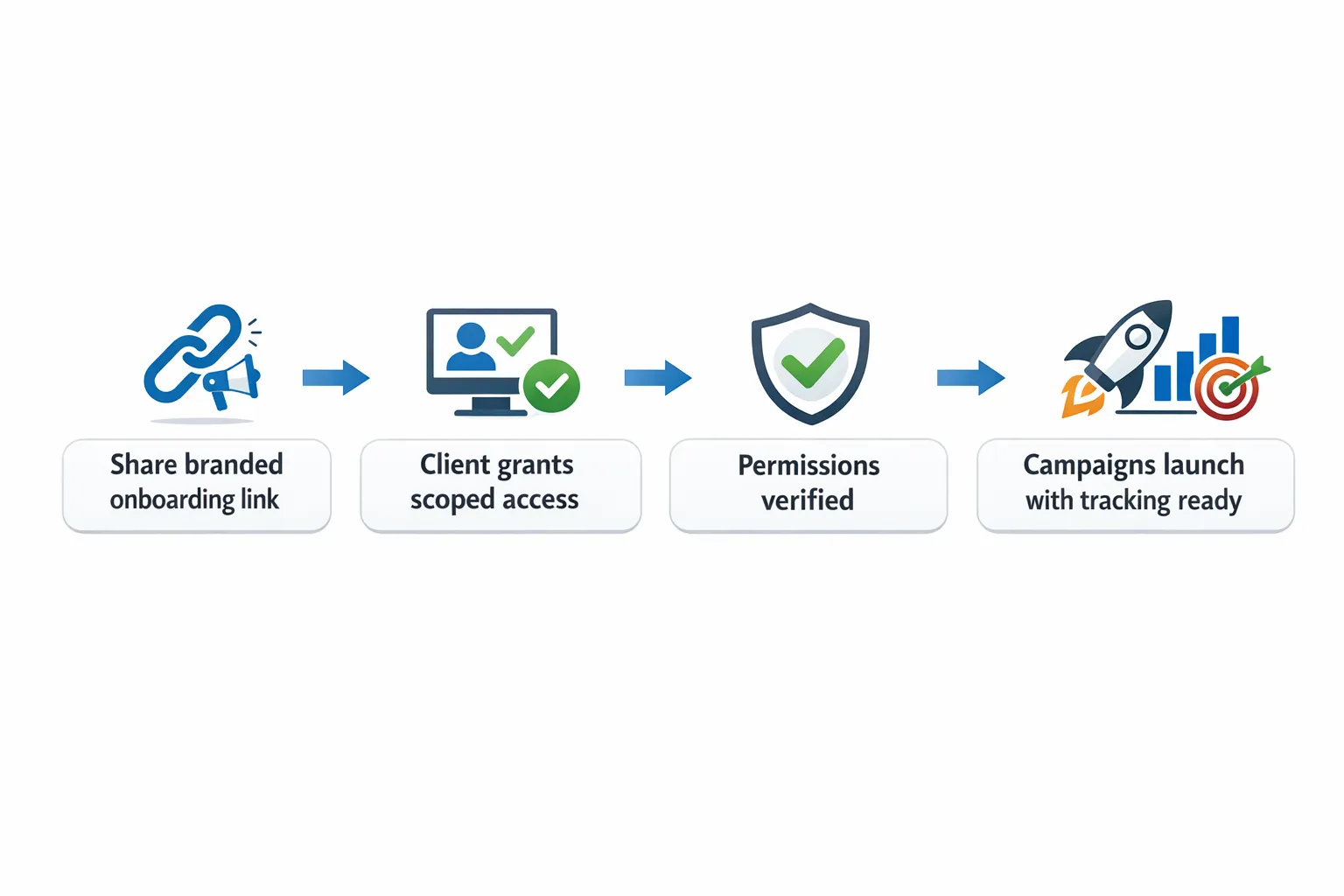
A clean onboarding experience typically includes:
- One place to collect asset IDs, approvals, and platform access
- A branded client-facing flow that reduces confusion
- Permission templates so the right roles are requested the first time
- Integrations (API/webhooks) to hand off data to your CRM or project management tools
This is exactly the operational gap that client onboarding software can solve. For example, Connexify helps agencies and service providers set up secure, multi-platform access through a single branded link, with customizable permissions, optional white-labeling, and API/webhook integrations. If you are an agency operator, it can reduce onboarding time from days to seconds. If you are the client hiring an agency, seeing a structured onboarding flow like this is often a sign you are dealing with a mature operator.
If you want to understand what streamlined onboarding looks like in practice, Connexify has a deeper guide on how digital marketing agencies streamline client onboarding.
The fastest path to a confident hire
To vet online marketing agencies fast, focus on signals that predict delivery: diagnosis quality, proof in context, and operational rigor. Use a time-boxed process, ask sharper questions, and score agencies against the same criteria.
When you do this, the “best fit” usually becomes obvious, and you will avoid the most expensive mistake in marketing: choosing a partner whose execution engine cannot match their pitch.