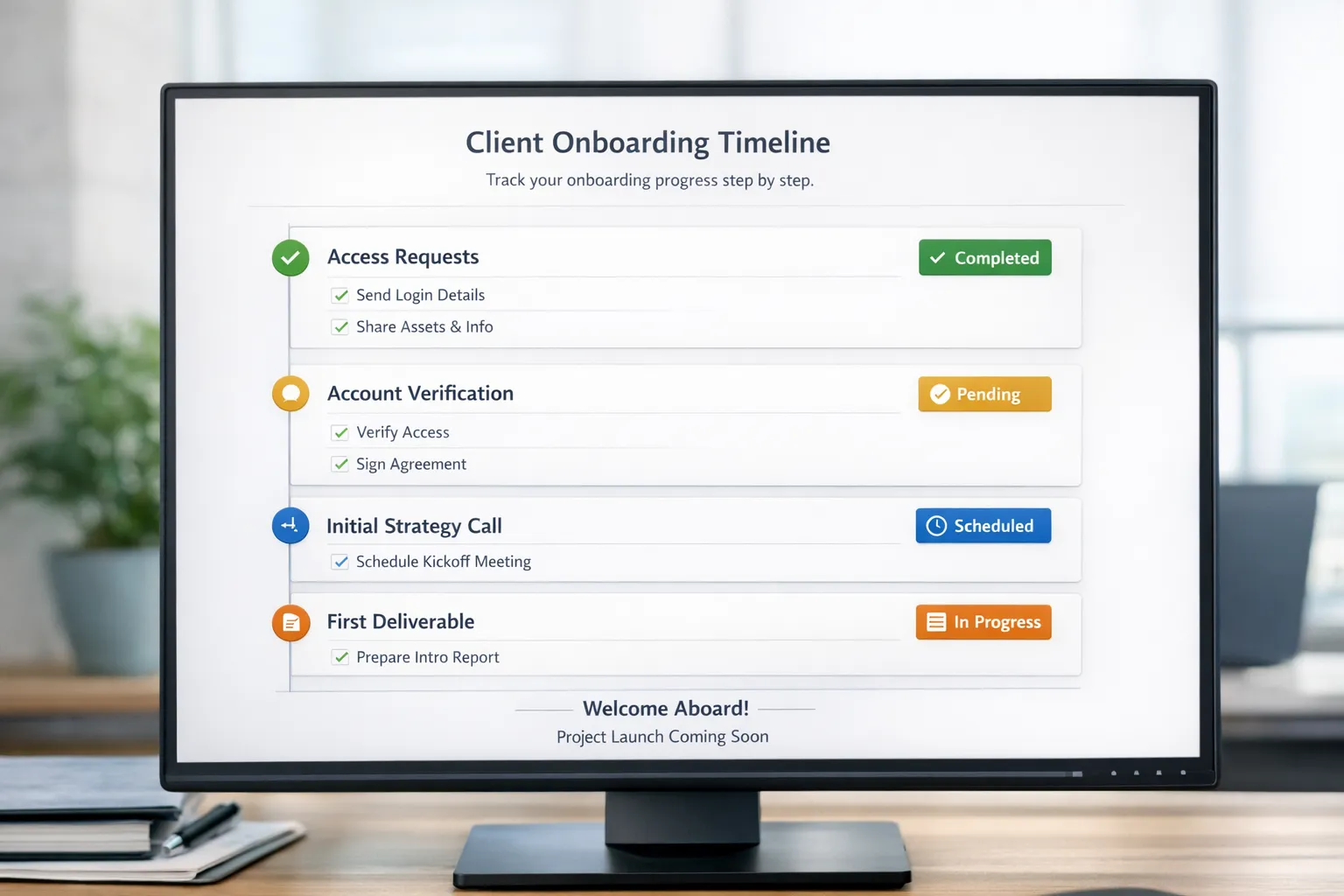
Digital Agency Marketing: A Fast Client Onboarding Plan
01/08/2026

Agency marketing is usually treated like a top-of-funnel problem: more leads, better positioning, stronger ads, sharper proposals. In practice, many agencies lose growth in the first 72 hours after the contract is signed, when client setup drags on, access requests get messy, and “we can’t start yet” becomes the first real experience.
If you want your digital agency marketing to compound in 2026, you need a fast onboarding plan that turns closed-won into visible momentum quickly, while staying secure and repeatable.
Why onboarding is a digital agency marketing lever (not just ops)
A fast onboarding motion shows up in marketing outcomes in three places:
1) Higher close rates (sales enablement). Buyers are wary of switching costs. When you can explain, in plain language, exactly how you’ll get access and ship the first milestone quickly, you remove a major hidden objection.
2) Better retention and expansion (lifecycle marketing). Onboarding is where expectations harden. If the first week feels organized, secure, and proactive, clients are more patient during testing phases and more open to upsells later. Bain’s widely cited retention research is still directionally useful here: small retention gains can materially lift profitability (Bain & Company).
3) More referrals and case studies (brand marketing). Clients do not refer you because your Notion template is pretty. They refer you when you deliver “time to value” fast and make them feel safe while doing it.
The takeaway: your onboarding plan is part of your go-to-market.
The fast client onboarding plan (built for marketing agencies)
This plan is designed for agencies running paid media, SEO, lifecycle/email, creative, analytics, or full-funnel growth. The structure is simple: compress time-to-first-value without cutting corners on access governance.
The 5 phases and the only SLA that really matters
Your #1 onboarding SLA should be time-to-verified-access, meaning the time between contract signature and your team confirming they can actually work inside the client’s accounts (ads, analytics, CRM, CMS, etc.).
Use the phases below as your standard motion.
| Phase | Goal | What “done” means | Ideal timebox |
|---|---|---|---|
| 1. Pre-sale alignment | Remove hidden blockers | Client knows what access you’ll need and who owns it | Before signing |
| 2. Day-0 handoff | Start momentum immediately | Welcome + access request sent, kickoff booked | 15–60 minutes after signing |
| 3. Verification sprint | Confirm access and measurement basics | Access verified, key tracking checked, blockers assigned | Same day or next business day |
| 4. First value delivery | Create a concrete early win | Audit, baseline, or first campaign draft delivered | Within 5 business days |
| 5. Governance and scale | Make it sustainable | Permissions documented, workflows automated, offboarding defined | Week 2 |
Phase 1: Pre-sale alignment (make onboarding part of your pitch)
Most agencies wait until after signature to ask for access. That is backward.
In your proposal or SOW, include an “Onboarding Requirements” block that covers:
- The platforms you’ll need access to (by service line)
- The client role required to grant access (admin, owner, finance contact)
- The expected timebox for access verification
- A security stance (no password sharing, least privilege)
This does two marketing jobs at once: it signals maturity and it reduces the probability of a slow start.
A simple positioning line you can use:
“Our onboarding is designed to get to verified access fast, without sharing passwords. You’ll receive a single onboarding link with step-by-step requests by platform.”
Phase 2: Day-0 handoff (turn ‘closed-won’ into movement)
Speed here is more psychological than technical. Clients interpret silence as disorganization.
Your Day-0 handoff should include three things:
A welcome message that sets the pace. Confirm next steps, who owns what, and when they’ll see the first deliverable.
A single place to complete onboarding. Avoid scattered emails, forms, and “can you invite us to X” threads across multiple tools.
A scheduled verification call. Even if you plan to do most onboarding asynchronously, a short verification sprint prevents multi-day stalls.
This is where a dedicated onboarding layer can replace manual coordination. For example, Connexify provides a single, branded onboarding link where clients can complete access setup across platforms with customizable permissions, plus API and webhook integrations to hand off data to your internal systems. (No installation required, and there’s a 14-day free trial.)
If you want the onboarding experience to feel like your agency, not a patchwork, look for:
- Branded and/or white-label onboarding flows
- Permission templates so you request only what you need
- A secure method for access collection (no passwords in email)
- A dashboard view so your team can see what’s missing
Phase 3: The 30-minute verification sprint (the anti-stall mechanism)
A verification sprint is a short live session (or a structured async checklist) that confirms access and removes “we thought you had it” issues.
What you verify depends on your service, but keep the principle consistent:
- Confirm your team can access the right assets
- Confirm the client can see what you’re doing (transparency reduces anxiety)
- Confirm measurement basics so early results are attributable
This is also the moment to enforce your security posture:
- No password sharing
- Named user access (not shared logins)
- Least-privilege permissions by role
- A clear owner on the client side for approvals and access changes
If you need platform-specific access playbooks, link them as follow-ups rather than turning your main onboarding email into a wall of instructions.

Phase 4: First value delivery (market your competence with an early win)
“First value” is not a full campaign launch. It’s the first tangible output that proves the agency is moving and thinking.
Good first-value deliverables are:
- A measurement and tracking baseline (what’s firing, what’s missing)
- A quick account audit with prioritized fixes
- A creative or landing page gap assessment
- A 2-week execution plan tied to business outcomes
Make the deliverable easy to consume. The goal is not volume, it’s clarity.
A strong structure for the first-value doc:
- What we saw (facts)
- What it means (impact)
- What we recommend (prioritized)
- What we need from you (approvals, assets, constraints)
- What happens next (timeline)
This is also prime time to capture marketing collateral:
- Ask for permission to use anonymized learnings later
- Identify one metric you can credibly improve in 30 days
Phase 5: Governance and scale (so onboarding stays fast as you grow)
Fast onboarding breaks when the agency grows because knowledge stays tribal.
Governance is the part of the plan that prevents speed from turning into risk.
Build a simple permissioning standard by package
Even if you support many platforms, your access logic should be predictable. Define permissions based on what you sell, not on who happens to be working the account.
Examples (high level):
- Strategy-only package: read access + reporting connections
- Execution package: publish/launch permissions in the relevant tools
- Full-funnel growth package: execution permissions plus measurement/admin collaboration
Keep it documented. Your future self will thank you.
Automate handoffs into your stack
If you are still retyping client data from an intake form into your PM tool, CRM, or Slack, you’re paying an invisible tax on every new logo.
This is where integrations matter. Tools that support APIs and webhooks can automatically push onboarding status and fields to your systems, reducing both time and error rate.
Define offboarding on day one
Offboarding is part of onboarding. It’s also a trust signal.
At minimum, define:
- How access is removed when the engagement ends
- Who owns the final export of assets (creative, reports, tracking documentation)
- Where permissions are documented so nothing is forgotten
The metrics that make this a “plan” (not a vibe)
If you want onboarding to improve your marketing outcomes, track it like a growth lever.
| Metric | What it tells you | Practical target |
|---|---|---|
| Time-to-verified-access | How fast you can start real work | Same day to 1 business day |
| Onboarding completion rate | Whether clients get stuck | 90%+ for core requirements |
| Blocker frequency | What breaks repeatedly | Trending down monthly |
| Time-to-first-value | Speed of visible progress | 3–5 business days |
| Onboarding NPS or CSAT | Whether the process feels smooth | Improving quarter over quarter |
Use these metrics in your marketing, too. “We verify access in 24 hours” is a stronger claim than “we’re full service.”
What to send clients: a conversion-friendly onboarding message (template)
Here is a compact version that works well after signature and sets your pace without sounding robotic:
Subject: Next step: access setup + kickoff
Body:
Hi [Name], excited to get started.
To move quickly, we’ll confirm access and measurement first. Please use this onboarding link to complete setup across the tools we’ll need: [your onboarding link].
Once you submit it, we’ll run a short verification sprint and confirm we’re good to build. If anything is missing, we’ll tell you exactly what and who needs to approve it.
Kickoff is scheduled for: [date/time].
Thanks, [Signature]
If your onboarding is powered by a branded flow (for example, a Connexify link), this email becomes much more reliable because you are not juggling multiple platform instructions and follow-ups.
Where Connexify fits (without rebuilding your whole process)
If your agency already has proposals, e-sign, and a project management tool, the missing layer is often the “access and setup” step that connects everything.
Connexify is built specifically for that: one-link client onboarding with a branded onboarding experience, support for multiple platforms, customizable permissions, and optional white-label. It’s designed to cut onboarding time dramatically by eliminating manual back-and-forth, while keeping access secure. You can also connect it to your workflows via API and webhook integrations.
If you want to see whether a single-link onboarding flow would reduce your time-to-verified-access, you can start with a trial or book a walkthrough:
- Explore Connexify: Client onboarding software
- Book a demo: Request a demo
A practical way to implement this in 7 days
Do not redesign everything. Implement in layers:
Days 1–2: Document your onboarding requirements by package (what access you need, and why).
Days 3–4: Create your Day-0 handoff message and schedule a standard verification sprint.
Days 5–7: Centralize onboarding into a single flow, brand it, and connect it to your internal handoffs so your team can see status without chasing.
The fastest-growing agencies treat onboarding like part of the product. When onboarding gets fast, your digital agency marketing gets easier because every new client turns into proof, momentum, and referrals.